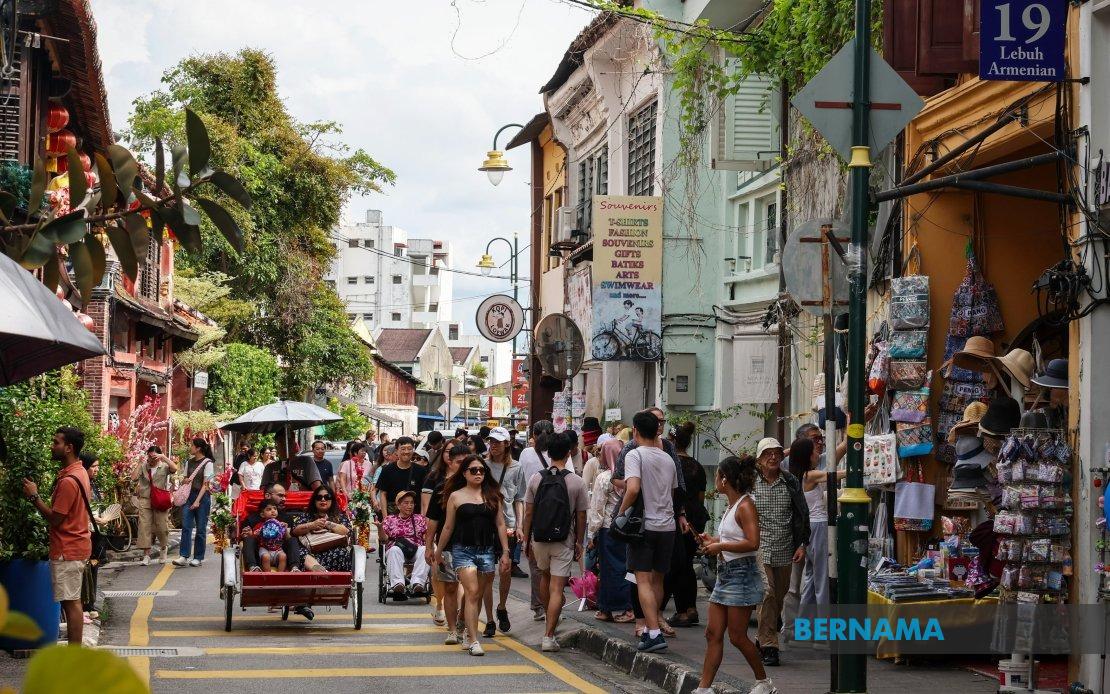
Penang's state government has committed to a thorough safety examination of its heritage buildings following a concerning incident in George Town's heritage district, where structural debris collapsed from a shophouse along Armenian Street, leaving two tourists injured and prompting urgent action from local authorities.
The accident occurred when a wooden beam and concrete debris dislodged from the historic structure, striking two Sri Lankan visitors identified as Mohamad Ammtar, 66, and Fatimah, 55. Both victims received immediate medical attention at the scene before being transported to Penang Hospital for more comprehensive treatment. While Mohamad Ammtar was subsequently discharged after his examination, Fatimah remained hospitalised for further assessment, including a computerised tomography scan to evaluate the severity of her injuries.
Initial structural investigations revealed that termite damage was the primary cause of the building's deterioration and subsequent collapse. This finding underscores a widespread vulnerability affecting many older structures throughout the island, particularly in heritage districts where buildings date back several centuries. Termites, which thrive in Penang's tropical climate, are known to compromise timber components without obvious external signs of damage, making them a particularly insidious threat to heritage preservation efforts.
Jason H'ng Mooi Lye, chairman of Penang's Local Government and Town and Country Planning Committee, announced that the state government will collaborate with the National Heritage Department to engage an independent engineer. This professional will conduct a comprehensive structural evaluation to identify heritage buildings that are currently unsafe or vulnerable to similar incidents. The study represents a significant step toward balancing the state's commitment to heritage conservation with its legal and moral obligation to protect public safety.
The methodology being considered by authorities involves issuing formal restoration notices to building owners once the assessment identifies properties requiring urgent intervention. The Penang Island City Council will be empowered to enforce these notices, compelling owners to undertake necessary remedial works. This regulatory approach aims to ensure that deteriorating heritage structures are restored before they pose genuine risks to pedestrians and visitors in George Town, a UNESCO World Heritage Site that attracts considerable domestic and international tourism revenue.
A critical dimension of Penang's restoration strategy involves reconsidering the materials used in heritage building conservation. While preserving original architectural features remains essential to maintaining historical integrity, H'ng indicated that authorities will evaluate alternatives to traditional materials like wood that have become compromised by age and environmental factors. Modern, more durable materials that can replicate the aesthetic qualities of original elements offer potential solutions to the durability challenge, though implementation must navigate conservation principles and heritage protection guidelines.
The distinction between restoration and conservation represents an important policy consideration for Penang's heritage sector. Conservation typically emphasises minimal intervention and preservation of original materials, reflecting international best practices codified by organisations like UNESCO. However, the Armenian Street incident demonstrates that strict adherence to these principles may occasionally create public safety hazards. Penang's approach seeks to establish a practical framework that acknowledges this tension, permitting judicious material substitution when original components have deteriorated beyond safe functionality.
Wong Hon Wai, chairman of the State Tourism and Creative Economy Committee, stressed that George Town World Heritage Incorporated and the municipal council will issue formal advisories to heritage building proprietors throughout the state. These communications will emphasise the structural safety obligations of property owners and outline available resources for conducting building assessments. The advisory campaign reflects recognition that many heritage building owners may lack awareness of structural vulnerabilities or the financial capacity to address serious deficiencies independently.
For Malaysian readers, this incident carries implications extending beyond Penang's borders. Heritage districts in Kuala Lumpur, Melaka, Ipoh, and Georgetown across Malaysia face comparable pressures from aging infrastructure, tropical climate exposure, and the challenge of balancing heritage preservation with contemporary safety standards. Penang's systematic response may establish a template that other state governments and heritage authorities can adapt to their own circumstances, creating consistency in heritage building management across the country.
The economic dimensions of this safety initiative merit consideration. Heritage tourism represents a significant contributor to Penang's economy, and incidents threatening visitor safety could deter international travellers and damage the state's reputation. Conversely, comprehensive safety assessments demonstrate governmental responsibility and may actually enhance confidence among tourists and investors. The upfront costs of the structural survey and subsequent restoration work represent an investment in sustainable heritage tourism and community protection.
The human cost of the Armenian Street collapse, though fortunately limited to two injuries, illustrates why building safety cannot be treated as secondary to preservation aesthetics. Heritage buildings serve contemporary communities and visitors; they are not merely museum pieces. Penang's commitment to conducting independent structural assessments represents appropriate governance, acknowledging that heritage value and public safety are not mutually exclusive but rather mutually dependent objectives that responsible authorities must pursue simultaneously.
Looking forward, the effectiveness of Penang's initiative will depend on sustained funding, consistent enforcement of restoration notices, and genuine collaboration between government agencies, heritage experts, and building owners. The state's heritage buildings represent irreplaceable cultural assets and significant employment generators through tourism. Protecting these structures through evidence-based safety measures ultimately serves both conservation goals and the practical needs of contemporary users and visitors who navigate these historic spaces daily.

