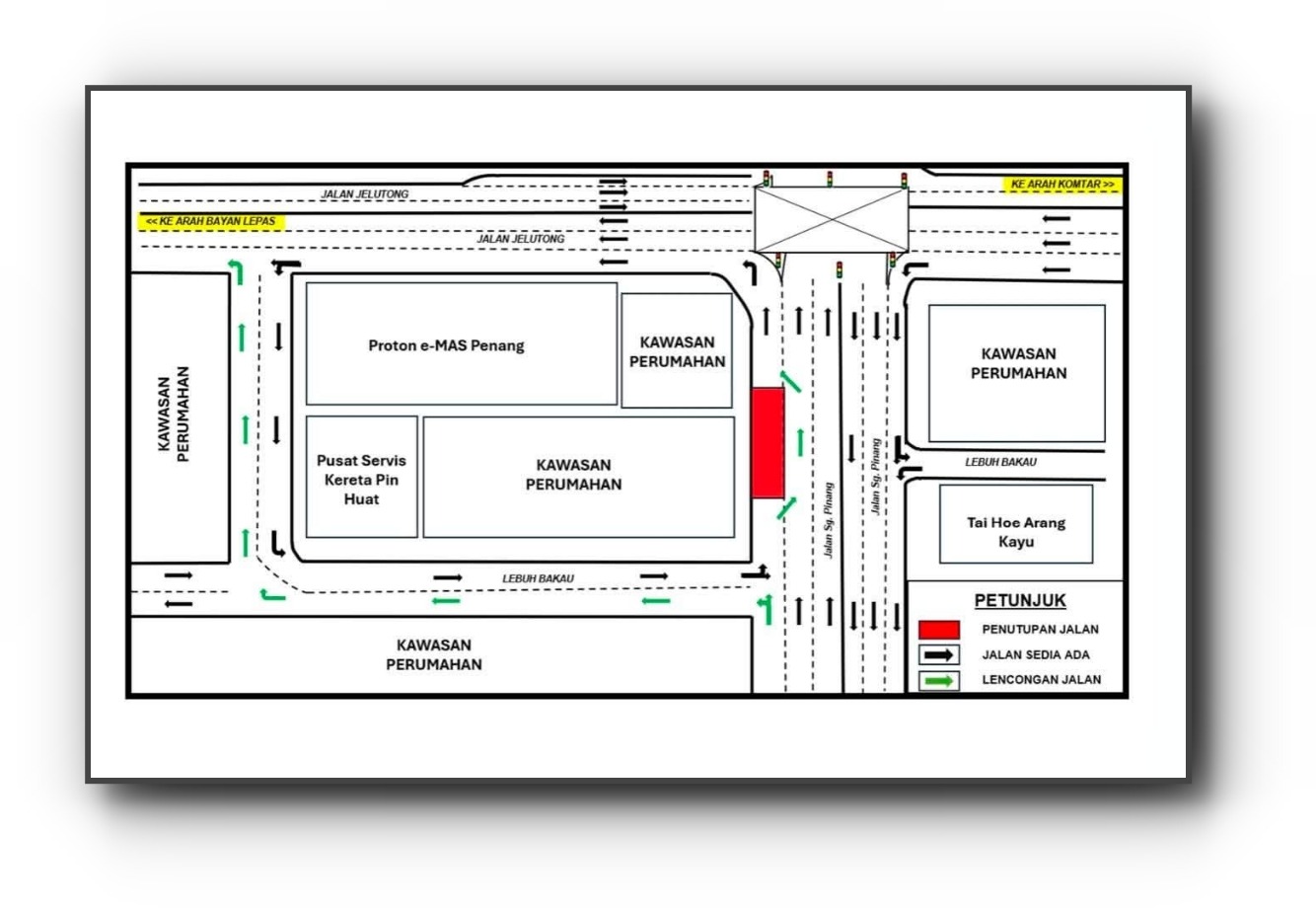
Traffic along Jalan Sungai Pinang in George Town will experience significant disruption over the coming weeks as the leftmost lane closes to accommodate critical infrastructure maintenance. Beginning at 9 am on August 28, the closure will remain in effect continuously until 11.59 pm on September 6, affecting commuters and businesses dependent on this major arterial route connecting the city centre to the Jelutong corridor.
The road works form part of Tenaga Nasional Bhd's broader utility relocation programme, aimed at modernising electrical and related infrastructure across Penang's urban areas. Such projects, though necessary for long-term service reliability, inevitably create short-term friction for road users accustomed to unrestricted access. The specific affected section extends from the Lebuh Bakau junction eastward to the traffic light intersection of Jalan Sungai Pinang and Jalan Jelutong, meaning that roughly two kilometres of thoroughfare will experience congestion or delays during peak travel periods.
Sungai Pinang state assemblywoman Lim Siew Khim, who also chairs the state's Social Development, Welfare and Non-Islamic Religious Affairs Committee, announced the closure through her official social media channels. Her statement emphasised that while the leftmost lane becomes inaccessible, the remaining lanes will continue to facilitate vehicular flow, preventing complete gridlock. This phased approach allows TNB to execute necessary work whilst maintaining some capacity for traffic movement—a pragmatic compromise between infrastructure demands and public convenience.
For drivers seeking to avoid congestion, authorities have identified Lebuh Bakau as the primary alternative corridor to reach Jalan Jelutong during the 10-day window. This detour adds considerable distance and time to journeys, particularly for morning and evening commuters travelling between George Town's commercial districts and residential areas in the north. Businesses along the affected stretch may also experience reduced foot traffic and delivery complications, warranting advance planning by shopkeepers and office managers.
The state assemblywoman's announcement stresses a comprehensive traffic management strategy to minimise disruption and safeguard all parties involved. Safety signboards will mark lane closures and upcoming obstacles, while traffic cones physically delineate work zones from open roadways. Flagmen will be stationed at strategic points to direct vehicles and manage bottlenecks, particularly during turning movements at the Lebuh Bakau junction where traffic transitions onto alternative routes.
Utility relocation projects of this magnitude reflect the ongoing challenges faced by rapidly urbanising Malaysian cities balancing infrastructure modernisation with existing traffic demands. Penang, as one of Malaysia's most congested urban centres, frequently contends with such closures as its century-old road network undergoes upgrading to support electrical, water, and telecommunications systems. While inconvenient in the short term, these works ultimately strengthen the resilience and capacity of essential services upon which the state's residents and economy depend.
The timing of the closure—commencing at the end of August—occurs during a period when many schools have resumed academic sessions and businesses operate at normal capacity. The 24-hour nature of the closure means that early morning deliveries, late-night transport operations, and shift workers will all face navigation challenges. Road users are particularly advised to exercise heightened caution, a standard precaution when construction activities introduce unpredictable traffic patterns and multiple control points along major routes.
For commuters unfamiliar with the George Town area, the diversion through Lebuh Bakau effectively adds a significant loop to journeys previously completed on the direct Sungai Pinang route. This congestion inevitably spreads across interconnected roads, potentially affecting secondary routes such as Lebuh Macalister and Jalan Transfer if drivers collectively seek optimal alternatives. Traffic management authorities monitor such cascading effects to deploy additional personnel or signage where bottlenecks emerge unexpectedly.
Tenaga Nasional Bhd's infrastructure programmes are typically scheduled during periods of lesser demand whenever possible, though urban contexts often limit such flexibility. George Town's mixed-use character—combining commercial, residential, and industrial zones—ensures that any significant road closure affects multiple stakeholder groups simultaneously. Coordination between state government agencies, TNB, and local authorities determines whether such disruptions proceed smoothly or metastasise into broader transportation crises affecting the region's economic productivity and quality of life.

