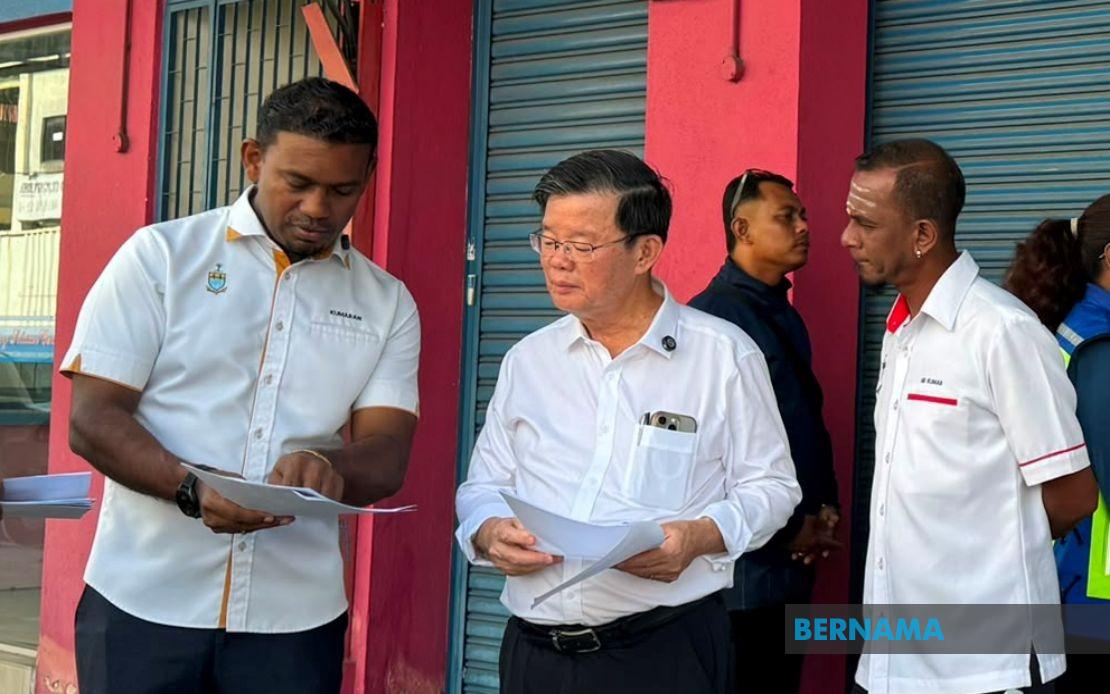
Penang will proceed without further delay in implementing its revised water tariff structure, Chief Minister Chow Kon Yeow announced, brushing aside public pressure to suspend the rate increase that came into force on July 1. The state had already deferred the implementation by nearly a year from its original scheduled date of July 30, 2025, when the National Water Services Commission (SPAN) first mandated the change, but Chow indicated this represented the final extension the government would grant.
The financial stakes driving the administration's resolve are substantial. Officials project the tariff adjustment will generate approximately RM20 million in additional annual revenue for the Penang Water Supply Corporation (PBAPP), revenue that Chow characterised as indispensable for addressing the state's mounting water infrastructure demands. The corporation faces capital requirements approaching RM2 billion solely for projects aimed at fortifying the reliability of Penang's water delivery network, with supplementary billion-ringgit investments required for initiatives involving Perak water sources.
Chow's justification rested partly on an assertion that Penang consumers continue to benefit from subsidised pricing. According to his analysis, the actual cost of producing and distributing water now exceeds RM1 per cubic metre, yet domestic households under the new structure pay approximately 65 sen per cubic metre. This discrepancy, he noted, reflects an implicit cross-subsidy arrangement whereby industrial and commercial users, charged at higher rates, effectively underwrite domestic affordability. Such mechanisms are common across Malaysian states, though their sustainability becomes problematic when infrastructure backlogs accumulate.
The tariff-setting framework itself operates within parameters established by SPAN, which applies uniform principles across all states. Water operators throughout Malaysia are entitled to seek rate reviews every three years, with adjustments theoretically justified by fluctuations in operational costs and infrastructure requirements. Penang's application of this mechanism represented a standard administrative process, though its timing proved sensitive given broader cost-of-living concerns affecting households across the nation.
Impact assessments provided by PBAPP chief executive Datuk K. Pathmanathan offered granular detail on how the increase would affect different consumer categories. Approximately 82 per cent of Penang households, those consuming up to 35 cubic metres monthly, would experience additional charges of roughly 8 sen daily or RM2.55 monthly. For business entities consuming 500 cubic metres per month, the added burden reached RM77.70 monthly. While these figures remained modest in absolute terms, their cumulative effect across the consumer base would produce the projected revenue stream.
The funding generated will specifically support what authorities termed the Water Contingency Plan 2030 (WCP 2030), an ambitious initiative addressing Penang's long-term supply security. Capital projects earmarked for the funding include construction of additional water treatment facilities at both Mengkuang Dam and Sungai Perai, physical expansion and technological upgrades at the Sungai Dua treatment complex, acquisition of property for the planned Sungai Muda facility, and development of the Macallum-Bukit Dumbar pipeline infrastructure. Each component responds to acknowledged capacity constraints and redundancy deficiencies in the current system.
Opposition to the tariff increase crystallised around concerns about household purchasing power amid broader economic pressures. Bagan Member of Parliament Lim Guan Eng articulated these concerns in a Facebook appeal requesting a one-year postponement of the 20 sen per cubic metre rate adjustment. His intervention reflected the political sensitivity surrounding utility charges in Malaysia, where public sentiment remains acutely attuned to increases affecting essential services. Lim's request, however, found no traction within the state administration.
Chow's insistence on proceeding despite such representations appears calculated to establish governmental credibility on infrastructure financing. Across Southeast Asia, water authorities struggle with chronic underinvestment partly because tariff resistance prevents revenue generation necessary for system improvements. Penang's leadership seemingly judged that deferring the increase further would exacerbate long-term supply vulnerabilities more damaging to consumer welfare than near-term rate adjustments. This represents a policy gamble that maintenance of service reliability justifies temporary affordability pressures.
The Malaysian context adds complexity to such decisions. Unlike some developed economies where water tariffs reflect full cost-recovery principles, Malaysian states typically maintain below-cost domestic rates justified as social policy. This creates structural funding deficits that eventually necessitate sudden, politically painful tariff adjustments rather than gradual increases. Penang's RM20 million annual injection, while significant, addresses only one portion of the corporation's development needs, suggesting future increases remain probable.
For Malaysian households and businesses monitoring utility charges across states, Penang's precedent carries implications. Other state governments facing similar infrastructure pressures may interpret the Penang outcome as validating tariff increases despite public resistance, potentially triggering a cascade of rate adjustments. Conversely, if the additional revenue demonstrably improves service reliability and addresses chronic water shortages evident in certain seasons, public acceptance might eventually solidify around the necessity of such adjustments.
The episode also underscores tensions between federal regulatory frameworks, established through SPAN, and state-level political accountability. While the commission determines tariff-setting principles, implementation timing and public management remain state prerogatives. Chow's approach—delaying initial implementation but ultimately enforcing it—reflects an attempt to navigate this dual responsibility, though it satisfied neither public critics nor perhaps the federal authority that had originally mandated swifter action.
Looking forward, Penang's water sector faces sustained funding pressures. The RM2 billion infrastructure need identified by PBAPP likely understates total requirements when accounting for climate variability increasing raw water scarcity and demographic expansion driving demand upward. Whether the current tariff increase, sustained across three-year intervals as regulation permits, will prove adequate remains uncertain, suggesting continued tension between consumer affordability and infrastructure necessity.

