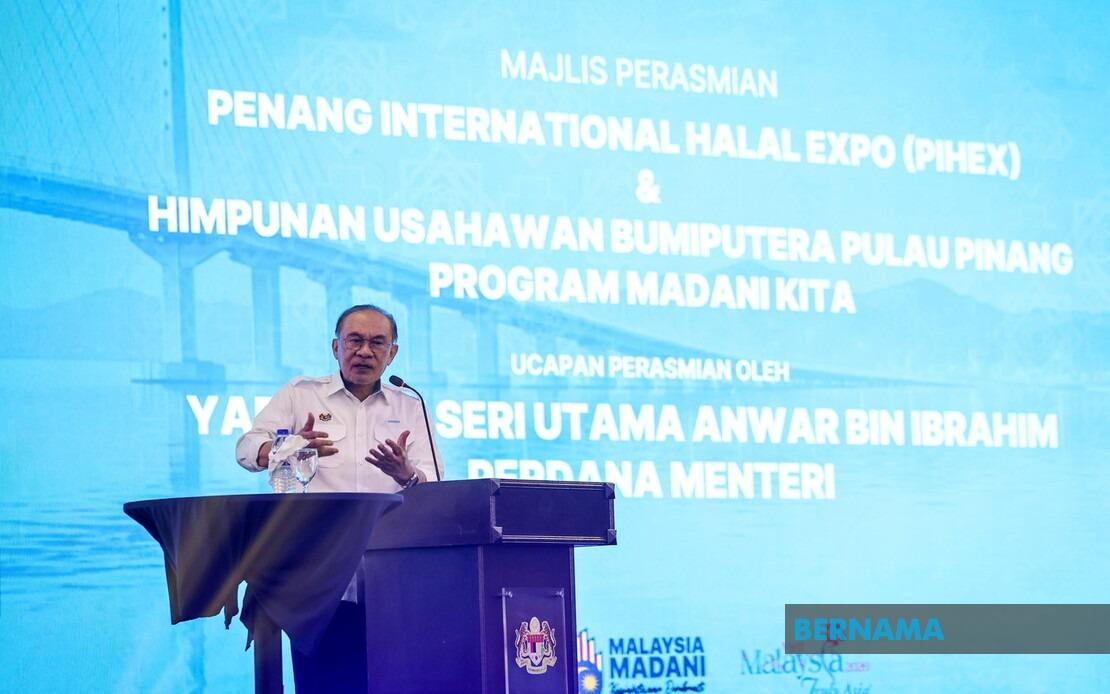
Prime Minister Datuk Seri Anwar Ibrahim has set his sights on transforming Penang into a benchmark state for Bumiputera economic participation, challenging the widely held perception that Muslim and Bumiputera communities in the northern state lag behind their counterparts elsewhere. Speaking at the opening of the Penang International Halal Trade Exhibition 2026 and the Penang Bumiputera Entrepreneurs Gathering at Seberang Perai Polytechnic in Permatang Pauh, Anwar presented data suggesting that Bumiputera economic performance in Penang actually outperforms most Malay-majority states across Peninsular Malaysia, making the reputational gap a matter of messaging rather than substance.
The disconnect between perception and reality reflects a broader challenge facing Malaysia's economic development narrative. While Penang has long been celebrated as a manufacturing and technology powerhouse, the state's success has been framed primarily through the lens of its Chinese-majority business community and foreign investment. This framing has inadvertently marginalised the contributions of Bumiputera entrepreneurs and masked genuine economic progress within Muslim and indigenous business circles. Anwar's intervention signals a deliberate pivot towards reclaiming and amplifying this narrative, recognising that economic confidence and investment flows often follow perception as much as they follow actual performance metrics.
Central to Anwar's strategy is a structural reorganisation of Penang's fragmented Bumiputera development ecosystem. Currently, multiple agencies operating under different ministries and departments pursue overlapping mandates without coordinated direction, resulting in inefficiencies and duplicated effort. The Prime Minister has instructed Penang Bumiputera Development Council (MPBPP) chairman Tan Sri Khalid Ramli to consolidate all such agencies under a single strategic framework operating through the Bumiputera Economic Development Council. This move mirrors administrative best practice seen in other economic development initiatives but represents a significant shift in how Penang approaches targeted business empowerment.
The coordination mandate carries particular weight given Malaysia's history of fragmented implementation undermining otherwise sound policy objectives. By requiring all agencies to operate from a unified strategic document rather than separate institutional agendas, Anwar aims to eliminate gaps where Bumiputera entrepreneurs slip between support programmes. He has requested a comprehensive progress report within weeks, setting a tight timeline that signals the seriousness of the directive and establishes accountability mechanisms from the outset.
Among the most concrete initiatives unveiled was a RM5 million allocation specifically designated for the Bumiputera Semiconductor Action Plan. This targeting of the semiconductor sector reflects sophisticated economic thinking about where Bumiputera firms can add value without threatening established operations. Penang's emergence as Southeast Asia's semiconductor hub—driven by companies such as Broadcom, Intel, and numerous smaller chip designers and manufacturers—has created a vast supply chain ecosystem with thousands of supporting roles. The action plan seeks to position Bumiputera companies within this high-technology supply chain rather than as competing manufacturers, a distinction that addresses concerns about market disruption while opening genuine opportunities for capability-building and revenue generation.
The semiconductor initiative carries implications beyond Penang alone. Malaysia's broader economic strategy depends on deepening participation in advanced manufacturing and technology services. Yet the sector's complexity and capital requirements have historically concentrated ownership and technical expertise among established international players and well-capitalised local firms. By deliberately supporting Bumiputera entry into specialised niches—quality assurance, precision component manufacturing, logistics optimisation, technical services—the action plan could model how inclusive economic growth operates in high-value sectors. Success in Penang would establish a template applicable to other states and industries.
Anwar's emphasis that the semiconductor initiative aims to complement rather than displace existing companies reflects political pragmatism and economic realism. Penang's semiconductor ecosystem depends on international investor confidence and the retention of established manufacturing facilities. Framing Bumiputera participation as supply-chain expansion rather than market competition allows the initiative to proceed without triggering defensive reactions from incumbent players. This constructive approach to economic restructuring could offer lessons for how Malaysia navigates the tension between targeted empowerment and open economic competition.
The halal sector represents an alternative avenue for Bumiputera economic expansion already showing tangible momentum. Data presented by Penang Deputy Chief Minister I and Penang Halal Industry Development Council chairman Datuk Dr Mohamad Abd Hamid indicated that certified halal establishments in Penang increased from 1,098 in 2024 to 1,191 in 2025, with 853 additional certificates issued through July this year. This growth reflects both genuine market expansion and increased formalisation of previously informal operations. The halal certification process requires compliance with religious and quality standards, creating entry barriers that protect certified businesses from unregulated competition while establishing quality benchmarks that international buyers recognise.
For Malaysian readers, the halal sector's growth matters particularly given the country's positioning as a global halal hub. Penang's performance contributes to Malaysia's broader Muslim business ecosystem and creates export opportunities, particularly in food manufacturing, cosmetics, pharmaceuticals, and hospitality services. As Islamic-majority nations worldwide prioritise halal compliance and as international consumers increasingly seek such assurance, Malaysian halal certification carries genuine market value. Bumiputera participation in this expanding sector aligns economic empowerment with national competitive advantage.
The PIHEX 2026 exhibition itself provides infrastructure for connecting Bumiputera entrepreneurs with suppliers, buyers, and investors. Trade exhibitions function as information markets where business opportunities become visible and relationships form. By hosting such events in Penang and actively promoting Bumiputera participation, the government creates visibility for firms that might otherwise remain outside investment and procurement networks. This infrastructural support, though less dramatic than direct financing, often proves essential for small and medium enterprise growth.
From a regional perspective, Penang's Bumiputera economic development carries significance for Southeast Asian integration. As ASEAN economies pursue inclusive growth, Malaysia's approaches to ensuring ethnic and religious communities participate in high-technology and export-oriented sectors offer potential learning for neighbours managing similar diversity. Penang, as Malaysia's most economically open state with the most ethnically heterogeneous business community, provides a testing ground for models that could inform broader regional development policy.
Anwar's initiative ultimately reflects recognition that economic statistics alone do not drive investment decisions or entrepreneurial confidence. Narratives about who succeeds, who belongs in particular sectors, and where opportunities exist shape economic behaviour powerfully. By reframing Penang's Bumiputera economic participation from a weakness requiring remediation into a strength awaiting amplification, and by backing that reframing with institutional reorganisation and targeted capital, Anwar attempts to shift both external perception and internal self-conception. Whether such narrative change translates into sustained economic gains will depend on implementation quality, ongoing support, and whether the coordinated agency framework actually overcomes the institutional silos that have historically fragmented Malaysian development efforts.

