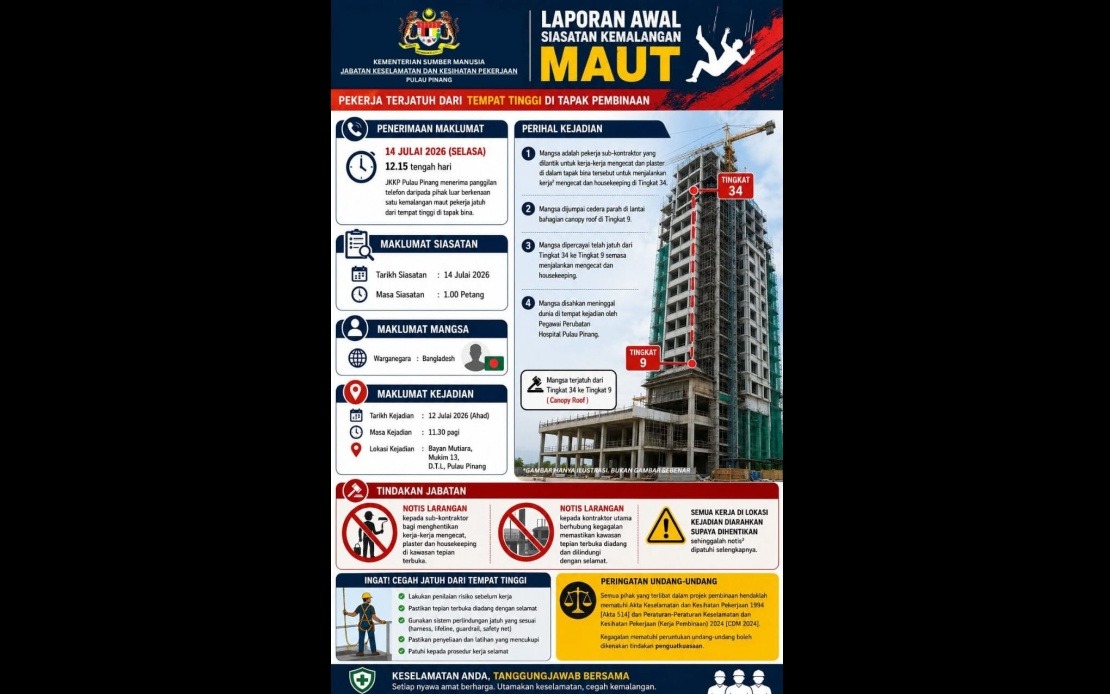
Penang's Department of Occupational Safety and Health (DOSH) has commenced a formal investigation into the death of a Bangladeshi worker who plummeted from a high-rise construction project in the Bayan Mutiara area of George Town. The incident, which occurred on July 14, represents a significant workplace fatality that has prompted immediate regulatory intervention and raised fresh concerns about safety protocols at major construction sites across the state.
The DOSH received initial notification of the accident at 12.15 pm on July 14 from an external informant, according to departmental director Hairozie Asri. A team of investigating officers was mobilised to the site without delay, beginning what appears to be a comprehensive examination of the circumstances surrounding the worker's death. The speed of the official response reflects the seriousness with which authorities treat fatal construction incidents, particularly those involving migrant workers who form a substantial portion of Malaysia's building workforce.
Preliminary findings indicate the victim was engaged by a subcontractor responsible for painting, plastering, and general housekeeping duties throughout the construction site. What makes this case particularly troubling is the dramatic distance the worker fell—he is believed to have been performing tasks on the 34th floor before being discovered with severe injuries on the canopy roof at Level 9. The extent of the fall, spanning approximately 25 floors, suggests either a catastrophic failure of safety equipment or the absence of adequate protective measures in the workplace.
Medical personnel from Penang Hospital pronounced the worker deceased at the scene, confirming the severity of injuries sustained during the fall. The death of migrant workers in Malaysia's construction sector, while statistically documented, continues to prompt questions about whether adequate safeguards and supervision exist at all levels of the industry. Bangladeshi workers represent a significant demographic within Malaysia's foreign workforce, and incidents such as this underscore the vulnerability of workers operating at the lower end of subcontracting hierarchies.
In response to the fatality, DOSH has exercised its enforcement authority by issuing multiple prohibition notices designed to prevent further incidents. The subcontractor has been explicitly instructed to halt all painting, plastering, and housekeeping operations in any open-edge areas—a critical safety measure that directly addresses the circumstances of this worker's death. The main contractor has also received a prohibition notice, expanding the scope of the regulatory response beyond just the immediate subcontracting entity responsible for the deceased worker.
Beyond these targeted restrictions, DOSH has mandated a comprehensive suspension of all work activities connected to the accident site. This blanket cessation order will remain in effect until both the main contractor and subcontractor have fully satisfied all requirements outlined in their respective prohibition notices. Such measures are designed to force compliance with established safety standards and prevent the normalisation of dangerous working practices that may have contributed to the incident.
The incident at Bayan Mutiara adds to the ongoing conversation about workplace safety in Malaysia's rapidly expanding construction sector. High-rise building projects, particularly those in Penang's commercial districts, involve complex vertical work that demands rigorous implementation of fall protection systems, safety harnesses, and regular training for workers. The fact that a worker could fall from such a significant height suggests either equipment failure, inadequate training, or systemic lapses in safety culture at the site.
For Malaysia's migrant worker population, this tragedy underscores persistent challenges in enforcement and accountability. While regulations exist to protect workers at all levels of employment, the reality often differs substantially in practice. Subcontractors operating at lower tiers of construction hierarchies sometimes operate with minimal oversight, and migrant workers frequently lack the language proficiency or institutional knowledge to report safety violations without risking employment termination or deportation.
The prohibition orders issued by DOSH represent an important enforcement mechanism, but their effectiveness ultimately depends on rigorous follow-up inspections and verification of compliance. Construction sites are dynamic environments where hazards can quickly reappear if supervisory attention lapses. The investigation into this particular incident will likely examine not only the immediate cause of the fall but also broader patterns of safety management and worker supervision that may have created conditions enabling such a catastrophic accident to occur.

