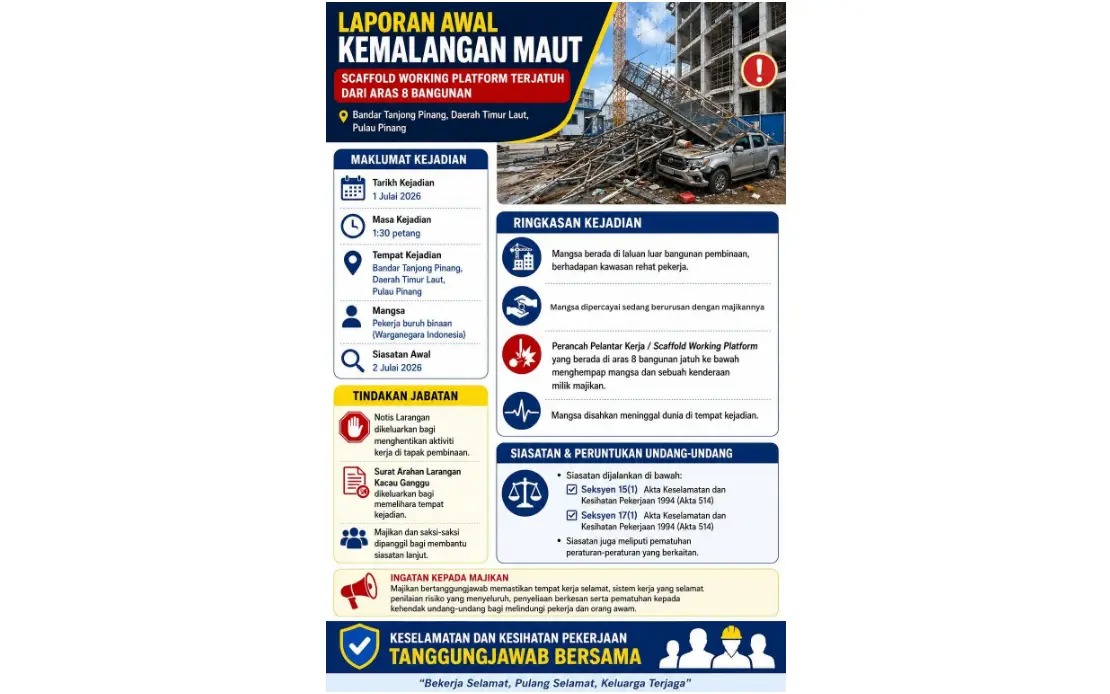
The Department of Occupational Safety and Health in Penang has moved swiftly to impose a complete work stoppage at a Bandar Tanjong Pinang construction project following a fatal incident on July 1 that claimed the life of an Indonesian construction worker. The casualty occurred when a scaffolding working platform detached from the eighth floor of a building under construction and fell to ground level, striking the worker and damaging a vehicle belonging to his employer.
According to DOSH's official statement, the fatal incident took place at approximately 1.30 pm. The victim was positioned on an external walkway in front of the workers' rest area at a lower level of the building when the platform fell, making this a significant safety breach at what appears to be a multi-storey residential or commercial development. The sudden nature of the collapse and the location of the worker suggest potential gaps in site safety protocols or equipment maintenance standards.
In response to the incident, DOSH Penang has issued what is formally known as a prohibition notice, an enforcement tool that prevents all related construction activities from resuming until the regulatory body is satisfied that conditions have been remedied. Alongside this measure, authorities have implemented a non-disturbance order that preserves the accident scene in its original condition, a critical step that allows investigators to examine structural integrity, attachment mechanisms, and maintenance records without any alterations that might compromise forensic findings.
The investigation underway focuses particularly on whether employers, contractors, and site supervisors have complied with their statutory obligations under the Occupational Safety and Health Act 1994, specifically Sections 15(1) and 17(1). These sections establish the foundational duties that employers must observe, including the provision and maintenance of safe working environments and the implementation of proper safety procedures. The regulatory framework expects construction firms to demonstrate that their scaffolding systems have been properly installed, regularly inspected, and maintained according to industry standards.
For construction operators across Penang and the broader region, the implications are substantial. DOSH has indicated that enforcement action, potentially including substantial fines or prosecutions, will be pursued if investigators discover violations of these legal provisions. The agency's willingness to deploy prohibition notices demonstrates its commitment to treating fatal incidents as serious matters requiring immediate intervention, not merely administrative follow-ups. The presence of both the victim and an employer vehicle at the accident site also raises questions about whether adequate segregation existed between working areas and rest zones where non-operational personnel might congregate.
The accident highlights recurring vulnerabilities within Malaysia's construction sector, where rapid development timelines sometimes conflict with rigorous safety implementation. Penang, experiencing sustained economic growth and urban expansion, has seen multiple construction projects simultaneously advancing across George Town, the northern corridor, and new development zones. When safety protocols are inadequately enforced or shortcuts are taken under schedule pressure, incidents like this scaffolding collapse can occur with tragic consequences. The death of a foreign worker also underscores the responsibility that employers bear toward migrant labourers who may have limited familiarity with local safety standards or language barriers preventing clear communication of hazard information.
DOSH's statement emphasised that employers, developers, main contractors, and subcontractors must ensure that all work activities are comprehensively planned and executed with safety as a central consideration rather than an afterthought. This reminder appears particularly directed toward the extensive use of subcontracting arrangements in Malaysian construction, where responsibility can become diffused across multiple tiers if contractual relationships do not explicitly assign accountability for safety outcomes. The primary contractor bears ultimate responsibility for site safety, but this authority must be clearly communicated downward to all subcontractors and workers.
Scaffolding platforms represent temporary but essential infrastructure on construction sites, and their failure can occur through multiple pathways: inadequate initial assembly, insufficient maintenance, overloading beyond design specifications, damage from weather or impact that goes undetected, or the use of components that do not meet relevant standards. The investigation will likely determine which of these factors contributed to the platform falling from the eighth floor. Investigators will examine maintenance records, inspection logs, engineer certifications, and the qualifications of personnel responsible for installation and ongoing oversight.
The ramifications extend beyond the immediate site. Construction projects statewide may face enhanced inspection scrutiny from DOSH as the agency responds to this incident by demonstrating enforcement presence. Insurance providers and project managers will increasingly demand documentation of safety compliance, and bonding companies may adjust their risk assessments for projects in Penang. The incident serves as a stark reminder that construction safety is not merely a regulatory compliance exercise but a matter of preserving human life.
For Malaysian workers and their families, this case illustrates the real dangers present in high-rise construction and the importance of unions, worker representatives, and government oversight in maintaining standards. The involvement of an Indonesian worker also highlights ASEAN labour mobility dynamics, wherein workers from other member states work in Malaysia's construction sector, often under conditions where communication about safety requirements may be compromised by language differences or unfamiliarity with local regulatory frameworks.
As investigations proceed, DOSH will collect testimony from witnesses present at the site, review employer training records to verify that workers received adequate instruction in hazard recognition, and assess whether the employer maintained comprehensive incident reporting procedures. The prohibition notice will remain in effect until investigators and DOSH management are satisfied that remedial actions have addressed the underlying safety deficiencies that permitted this incident to occur. For the broader construction industry in Penang and Malaysia, the message is unambiguous: safety cannot be subordinated to schedule pressures, and regulatory enforcement will follow incidents where evidence suggests non-compliance with established occupational health and safety standards.

