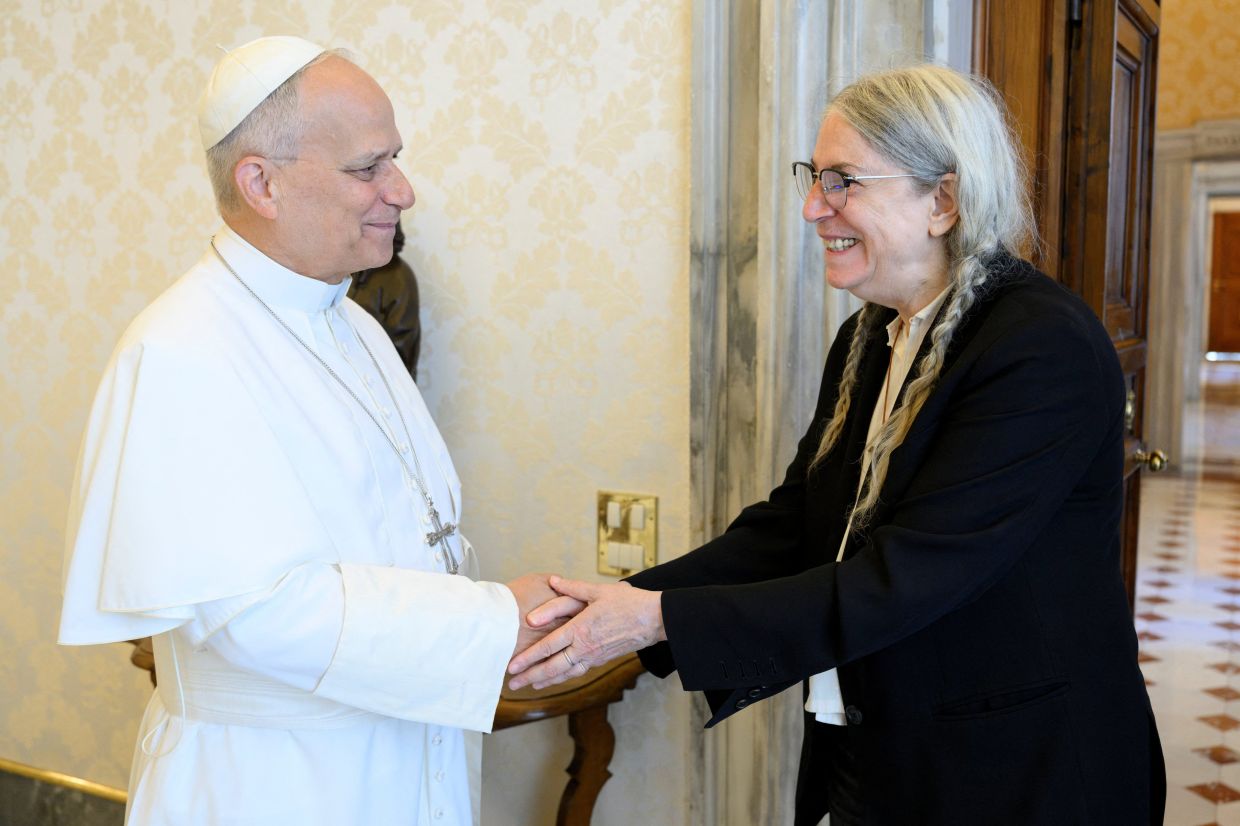
Rock and roll icon Patti Smith came face-to-face with Pope Leo XIV on Friday at the Apostolic Palace, a moment that left the legendary artist visibly moved and struggling to articulate her emotions. The brief greeting—simply "Hi"—belied the deeper connection that would unfold during what became an extended and intimate audience. Smith, dressed characteristically with a crucifix necklace and her signature braided hairstyle, embodied the artistic spirituality that has increasingly drawn her into Vatican circles over recent years.
Smith's deepening relationship with the Holy See has been facilitated by Rev Antonio Spadaro, the Vatican's undersecretary for culture, who has become an instrumental bridge between the secular music world and the Church's institutional leadership. Though Smith has long maintained that she does not practise Catholicism, her attraction to the Vatican's spiritual and cultural mission has grown substantially. Her previous connection to Pope Francis, whom she greatly admired for what she characterised as his "gentle, open, and steadfast sense of humanity," appears to have naturally extended to his successor, suggesting that the values she responds to transcend individual pontiffs and reflect deeper theological currents within the modern Church.
The meeting lasted approximately forty minutes, according to Spadaro's account, transforming what might have been a ceremonial obligation into something far more meaningful. Spadaro's description of the encounter as feeling "like a conversation between two people discovering they were old friends" captures an atmosphere of genuine recognition rather than formal protocol. The two participants—both shaped by Chicago's cultural legacy—found common ground in their shared commitment to memory, music, and visionary thinking that encompasses both historical reflection and contemporary hope.
Smith's artistic contributions to the Vatican's cultural agenda have become increasingly prominent. Earlier this year, on May 8—notably Pope Leo's election anniversary—she performed during the opening ceremony of the Holy See's pavilion at the Venice Biennale, one of the world's most prestigious contemporary art exhibitions. This platform reflected the Church's recognition of Smith's symbolic importance as an artist whose work bridges secular and spiritual concerns, making her a valuable cultural ambassador during this pivotal moment in the papacy's relationship with the creative world.
The pontiff demonstrated familiarity with Smith's musical catalogue, praising one of her compositions as "marvelous," suggesting that the Vatican leadership takes seriously the intersection of popular culture and spiritual expression. This willingness to engage directly with rock music—a genre historically viewed with suspicion by Church authorities—signals a broader institutional openness that characterises Pope Leo's early leadership. For Malaysian and Southeast Asian readers observing the Vatican from afar, this moment illustrates how religious institutions worldwide are reassessing their relationship with contemporary artistic expression and secular culture.
Smith's previous encounters with papal leadership span more than a decade. She first met Pope Francis in 2013 and performed for him in 2014, developing an artistic relationship that continued until Francis's death on April 21, 2025. Her response to his passing demonstrated the profound personal connection she had cultivated, as she published a poem comparing the late pope to a dandelion—"humble yet strong"—and mourned that "nature and poetry and the suffering shall miss their champion." This public expression of grief underscored how deeply she had integrated her spiritual sensibility with her artistic practice.
The Friday audience with Pope Leo represents both continuity and evolution in Smith's Vatican engagement. Rather than viewing the papal transition as a disruption, she has evidently found resonance with the new pontiff's approach, suggesting that the institutional values she responds to—centred on cultural openness, humanitarian concern, and spiritual depth—persist across changes in leadership. For observers of Church politics, Smith's swift and comfortable transition from Pope Francis to Pope Leo indicates that the latter is successfully maintaining the former's reputation for accessibility and engagement with the secular world.
Smith's parting words—a simple "Bye. Bye."—stood in stark contrast to her initial hesitancy, suggesting a departure markedly warmer than the arrival. This subtle shift in emotional register, captured by Spadaro's observation, hints at the transformative nature of the encounter. What began with barely articulated greeting evolved into an exchange substantial enough to warrant the extended time allocation and to generate the kind of personal warmth typically reserved for close associates.
The Vatican's broader cultural strategy emerges more clearly through Pope Leo's sequential encounters with artistic figures this week. On Wednesday, July 29, the pontiff attended a concert honouring him performed by world-renowned tenor Andrea Bocelli, suggesting a deliberate pattern of engagement with high-profile musicians and artists. These parallel events indicate that the Church leadership is consciously building relationships with influential cultural figures, likely recognising that such connections carry weight in shaping public perception and demonstrating the Church's relevance to contemporary creative communities.
For the regional context, Smith's Vatican presence carries particular significance. In Southeast Asia, where Catholicism represents an important but minority faith, the image of a globally celebrated secular artist finding common cause with Church leadership challenges conventional narratives about religion's marginalisation in contemporary culture. Smith's example—demonstrating that one need not be formally religious to engage meaningfully with spiritual institutions—may resonate with audiences across Malaysia and the broader region who harbour questions about the relationship between faith, art, and modern identity.
The encounter between Smith and Pope Leo also underscores an important dimension of papal diplomacy often overlooked in conventional political analysis. While much attention focuses on the pope's statements on geopolitical issues or economic policy, these quiet artistic exchanges build cultural capital and demonstrate the Church's ability to converse authentically with voices outside its institutional structure. Smith's willingness to engage with the Vatican on her own terms—without converting, without abandoning her artistic independence—models a form of interfaith and secular-spiritual dialogue increasingly necessary in plural societies.

