Dataran Putrajaya became a sea of Malaysian flags on August 31 as tens of thousands of citizens converged on the Federal Government's administrative capital to mark the nation's 69th National Day. The sprawling plaza, packed with families, youth groups, and community organisations representing Malaysia's diverse ethnic and religious tapestry, embodied the celebratory spirit that has long characterised the annual observance of Merdeka Day. The gathering reflected the continued resonance of independence narratives across successive generations, even as contemporary Malaysia grapples with complex political and economic challenges that periodically test national cohesion.
The celebrations carried the thematic underpinning of "Malaysia MADANI: Kesejahteraan Dinikmati"—a phrase encapsulating the government's vision of widespread prosperity and social wellbeing across the nation. This framing proved significant, as it positioned the festivities not merely as historical commemoration but as affirmation of an aspirational national project. For Malaysian policymakers and political observers, such messaging attempts to anchor public sentiment around shared developmental goals, particularly as the country navigates post-pandemic economic recovery and evolving regional geopolitical dynamics that directly affect Southeast Asia's stability and prosperity prospects.
Putrajaya's selection as the host venue for the 69th National Day continued a pattern of centralising major national celebrations within the purpose-built administrative centre. The choice represented Putrajaya's eighth instance of hosting the main festivities since 2003—a frequency underscoring the deliberate governmental strategy of reinforcing the Federal Territory's symbolic importance as the locus of national governance and unity messaging. This concentration contrasts with earlier decades when celebrations rotated more broadly across state capitals, raising questions among observers about whether centralised pageantry adequately engages peripheral communities or inadvertently privileges metropolitan populations in participation narratives.
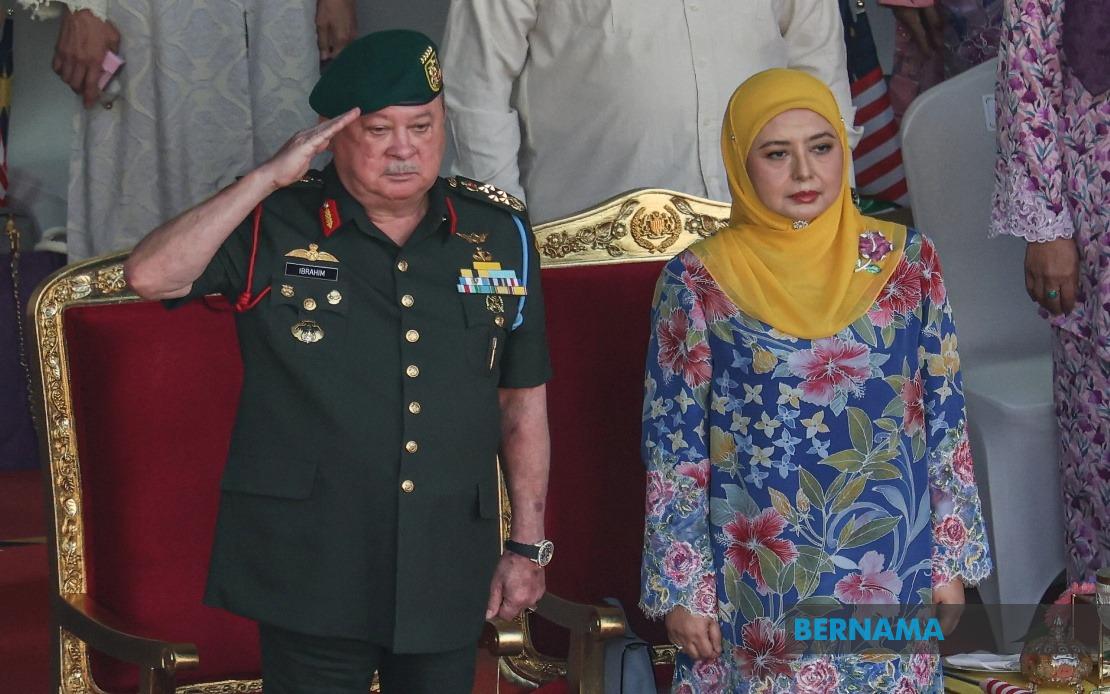
The ceremonial dimensions commenced with Prime Minister Datuk Seri Anwar Ibrahim and his spouse Datuk Seri Dr Wan Azizah Wan Ismail arriving at 7.53 am, establishing the political hierarchy within the proceedings. Their early presence signalled executive engagement with the ceremonial apparatus, positioning the leadership within a carefully choreographed framework of national pageantry. The arrival of Their Majesties Sultan Ibrahim and Raja Zarith Sofiah at precisely 8 am elevated the symbolic weight further, as the monarchy's presence traditionally confers constitutional legitimacy and transcendent unity messaging upon state-level events in Malaysia's constitutional framework.
The ceremonial programme deployed multiple registers of national symbolism and emotional appeals to cultivate patriotic sentiment. Five military helicopters bearing the Jalur Gemilang executed a coordinated flypast upon the royal arrival, combining technological modernity with nationalist iconography in a visual spectacle designed for mass consumption. The 14-gun salute fired by the 41st Battery of the Royal Artillery Regiment carried explicit numerical significance, with each volley representing one of Malaysia's constituent states—a symbolic conflation of sovereignty with territorial integrity that resonates through the ritual calendar of Malaysian nationalism.
The recitation of the Rukun Negara—Malaysia's national philosophical principles encompassing belief in God, loyalty to the monarch, respect for the constitution, rule of law, and mutual respect—occupied central ceremonial space. Led by Malaysian Fire and Rescue Department Deputy Commissioner Datuk Abdul Razak Muda alongside 69 uniformed personnel and supported by sign language interpretation, this collective articulation of foundational values aimed to transcend sectional interests and affirm shared normative commitments. The deliberate inclusion of 69 participants mirrored the numerical commemoration of years since independence, embedding mathematical resonance within performative unity rituals.
The septuple utterance of "Merdeka" that followed the Rukun Negara recitation represented perhaps the most emotionally charged moment within the programme, triggering spontaneous displays of patriotic fervour as thousands of attendees waved miniature versions of the national flag. This climactic invocation—harking directly to the declaration of independence itself—generated a visceral connection between contemporary celebration and historical founding moment. For younger generations without lived experience of the pre-independence period, such ceremonial repetition attempts to transmit historical consciousness and nationalist attachment through performative and emotional channels.
The attendance of Deputy Prime Minister Datuk Seri Dr Ahmad Zahid Hamidi, Communications Minister Datuk Seri Fahmi Fadzil (serving as main committee chairman for the 2026 National Day and Malaysia Day celebrations), Cabinet colleagues, and foreign diplomatic representatives illustrated the multilayered political and international dimensions embedded within national commemoration. The presence of foreign delegations underscored the government's intent to project stable governance, constitutional order, and national pride to international audiences—particularly significant amid regional scrutiny of Malaysia's political stability and institutional resilience. For neighbouring Southeast Asian nations, Malaysia's successful hosting of centripetal national celebrations provides reassurance regarding governmental capacity and territorial integrity.
The deliberate representation of Malaysia's ethnic and religious pluralism throughout the ceremony—manifested through diverse participant demographics, the inclusion of sign language interpretation ensuring accessibility for persons with hearing impairments, and the participation of multiple uniformed services—reflected contemporary Malaysian nationalism's rhetorical commitment to inclusivity. Yet scholars and political analysts have increasingly questioned whether performative multiculturalism within state ceremonies adequately addresses underlying structural inequalities, intercommunal tensions, and competing historical narratives that periodically surface in Malaysian public discourse. The threshold question remains whether such ceremonial unity can substantively undergird political cohesion when material resource distribution and identity recognition remain contested domains.
The thematic emphasis on Malaysia MADANI's promise of equitable prosperity acquires particular relevance within Malaysia's present developmental context. Economic pressures stemming from global supply chain reconfiguration, rising living costs, and uneven distributional outcomes across regions and demographics have periodically strained the national consensus upon which post-independence governance has rested. National Day celebrations thus function not merely as historical commemoration but as periodic opportunities for governmental messaging regarding future trajectories and renewed commitment to foundational nationalist principles. The success of such messaging depends substantially upon whether successive political administrations can translate ceremonial rhetoric into tangible policy outcomes that demonstrably improve living standards across diverse Malaysian communities.
For Southeast Asian observers more broadly, Malaysia's National Day observances carry implications extending beyond domestic political theatre. Malaysia's position as one of the region's most economically developed nations and a cornerstone of ASEAN institutional architecture means that its internal political stability and national cohesion directly influence regional cooperation frameworks, investment climates, and collective responses to transnational challenges ranging from maritime security to pandemic preparedness. The patriotic fervour displayed at Dataran Putrajaya thus resonates beyond Malaysia's borders, signalling to regional partners and international investors the persistence of effective state capacity and institutional legitimacy. Conversely, any fracturing of such ceremonial unity might transmit concerning signals about governance resilience to external stakeholders assessing the viability of Malaysia's regional and international commitments.

