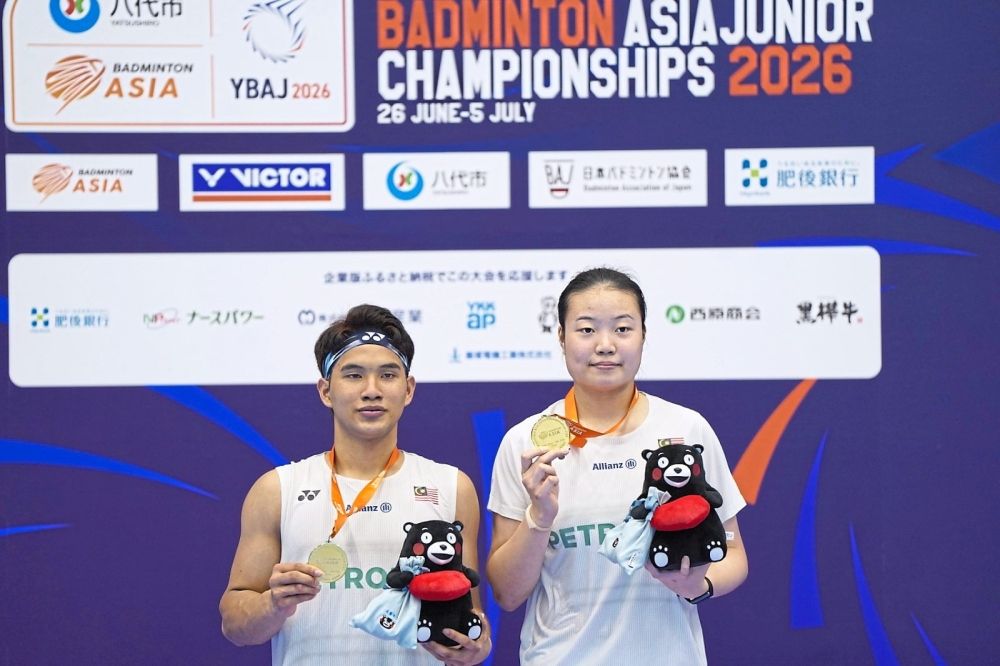
Ahmad Redzuan Zulwaqqarizal-Low Zi Yu have ended Malaysia's nearly two-decade championship drought in mixed doubles at the Asian Junior Badminton Championships, claiming gold in Yatsushiro, Japan with a composed performance against China's Zheng Weigang-Li Menghan. The victory, secured 21-15, 22-20 in 43 minutes, represents a watershed moment for Malaysian junior badminton and signals emerging strength in a discipline where the nation had fallen silent since Tan Wee Kiong and Woon Khe Wei triumphed in Kuala Lumpur back in 2007.
The Malaysian duo's ascent to the championship podium was anything but inevitable. In the decisive second game, Redzuan and Zi Yu edged tantalizingly close to victory, arriving at match point with just two points separating them from glory. Yet their Chinese opponents mounted a fierce resistance, clawing back from the brink to force the contest into a third set. The psychological test that followed proved decisive—maintaining focus and composure when momentum hung in the balance allowed the Malaysians to seize control at the critical juncture and ultimately secure the title.
Zi Yu attributed the triumph squarely to her and her partner's capacity for restraint and tactical patience throughout the encounter. Speaking after the match, the 15-year-old emphasized that when the scoreline reached 20-20 in the second game, it was their superior mental discipline that made the difference. "It was a tough match. I think we were more patient than they were," she reflected, underscoring how badminton at the highest junior level is as much a battle of wills as of shot-making. The support from Malaysian teammates already eliminated from their own competitions added an intangible dimension to their victory, their courtside encouragement providing an emotional anchor when pressure mounted.
For Redzuan, the achievement carries particularly poignant significance. The Terengganu shuttler's journey to this title has been marked by persistent setbacks that would have tested the resolve of many younger athletes. His competitive debut at these championships came in 2023 in Yogyakarta, where he competed in both boys' doubles and mixed doubles only to exit early from both disciplines. Rather than propelling him forward, that first campaign proved a false start. The subsequent two editions—Yogyakarta in 2024 and Surakarta in 2025—repeated the pattern of early disappointment, suggesting he might be destined to join the numerous junior hopefuls whose promise never materializes at continental level.
The breakthrough in Yatsushiro, therefore, represents vindication of Redzuan's persistence through multiple years of championship heartbreak. In his third attempt at these prestigious championships, he finally translated preparation into results, demonstrating that longevity in junior badminton sometimes depends less on precocious talent than on the capacity to absorb failure and return stronger. His own assessment of the performance revealed an athlete acutely aware that execution during a championship final represents only a snapshot of his overall development. "I'm satisfied with the way I played because I was able to execute what I had worked on in training," he noted, yet immediately pivoted to acknowledging the gaps that remain. This balance between satisfaction and humility suggests a player possessing the mental maturity necessary for sustained progress in professional badminton.
Zi Yu's contribution to the mixed doubles title came alongside a girls' doubles bronze medal, marking her as a standout performer across multiple disciplines at these championships. Her partnership with Genevie Lim in the girls' event fell short of the ultimate prize, losing 21-16, 17-21, 17-21 to Japan's second seeds Aoi Banno-Yuzu Ueno in the semi-finals. The loss, while disappointing, should not overshadow her overall championship impact. Managing the cognitive and physical demands of competing in two separate events simultaneously—each with different partners, tactical nuances, and pressure points—represents a substantial challenge for any competitor, let alone a 15-year-old.
What facilitates Zi Yu's ability to juggle dual commitments is the competence of her partners in both disciplines. She emphasized that neither Redzuan in mixed doubles nor Genevie Lim in girls' doubles requires extensive hand-holding or tactical micromanagement, allowing her to concentrate on optimizing her own contribution rather than compensating for partner weaknesses. This interdependence within doubles formats means that elite junior doubles specialists increasingly need to cultivate multiple partnerships simultaneously, a demand that separates genuine championship-caliber players from those capable only of success within narrow competitive contexts.
The broader context of Malaysia's junior badminton landscape has shifted considerably since the last mixed doubles championship victory in 2007. The intervening years witnessed both the relative decline of Malaysian badminton in certain junior disciplines and the parallel rise of regional competitors, particularly from China and Indonesia. The nation's recent revival in men's singles at senior level has not yet translated systematically into junior success across all categories. This makes the Redzuan-Zi Yu breakthrough particularly valuable—it reestablishes Malaysian competitiveness in a category the nation once dominated and signals that the junior pipeline retains capacity to produce continent-wide champions.
The tournament results across other categories illustrated the dominance of regional powerhouses. Hong Tianyue of China secured the men's singles title, while the Taiwanese combination of Huang Tzu-yuan and Lin Sheng-ming claimed men's doubles gold. Women's singles remained within Chinese borders via Yin Yiqing's victory, and women's doubles returned to Japan through Aoi Banno-Yuzu Ueno's partnership. Against this backdrop of concentrated excellence among established badminton nations, Malaysia's mixed doubles victory assumes heightened significance—it represents the nation reasserting itself within a field where incremental improvements and generational transitions rapidly reshape competitive hierarchies.
Looking forward, both Redzuan and Zi Yu face the challenge of translating junior championship success into sustained excellence as they transition toward senior-level competition. The pathway from junior to professional badminton is notoriously unforgiving, with many youthful champions failing to maintain their trajectory once confronting the physical demands and tactical sophistication of the senior game. Yet their composure under pressure, ability to recover from deficit situations, and demonstrated capacity to execute training methodologies in live competition suggest they possess the foundational attributes necessary for continued advancement.
Malaysia's badminton administration and coaching structures will now bear responsibility for nurturing this talent through the critical transition years ahead. International exposure, training opportunities abroad, and mentorship from successful senior players all contribute to facilitating junior success at the professional level. The 19-year gap since Malaysia's last mixed doubles championship at this level indicates a systemic challenge in sustaining excellence across generations rather than isolated individual failures. Should Redzuan and Zi Yu continue their developmental trajectory, they could catalyze a broader resurgence in Malaysian junior badminton and supply the next generation of senior competitors required to restore the nation's standing in a sport where it once claimed genuine regional preeminence.

