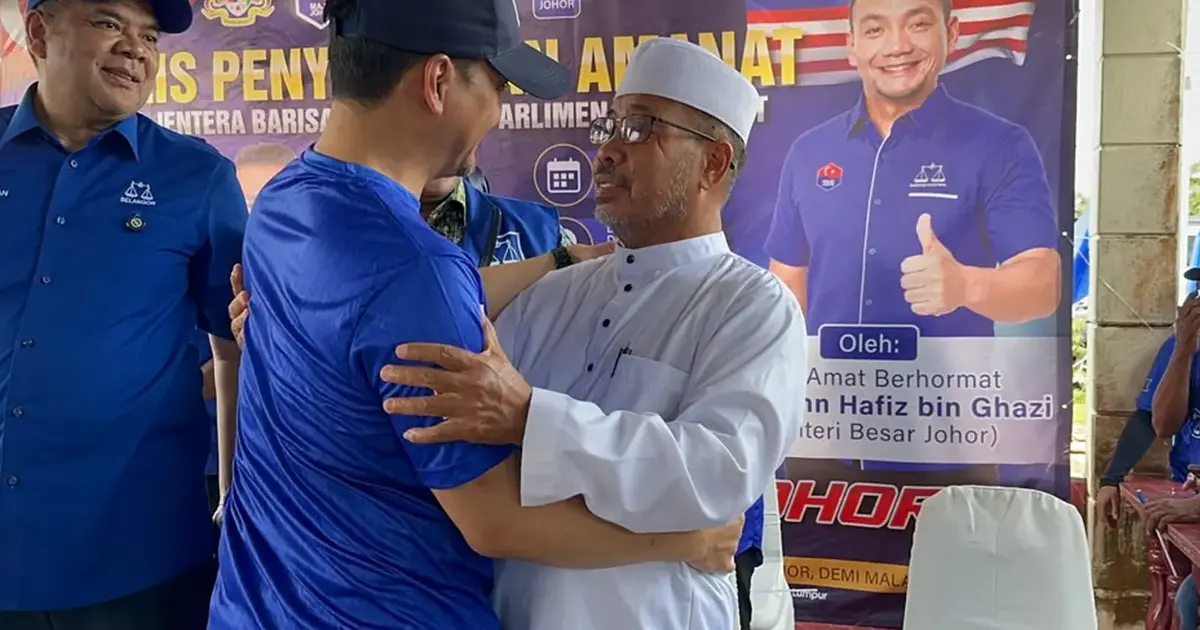
Johor Menteri Besar Onn Hafiz has expressed gratitude for the attendance of Pakatan Angkat Suara (PAS) leaders at a coalition campaign event held in Batu Pahat, describing himself as visibly moved by their participation. The gesture represents a notable moment in the intricate dynamics of Johor's political landscape, where coalition partners must carefully balance competing interests and regional loyalties ahead of electoral contests.
Bersatu, the party that represents Perikatan Nasional (PN) within the broader Barisan Nasional (BN) framework, is the primary political force contesting in Batu Pahat, fielding candidates in two of the three available seats in this Johor constituency. This arrangement reflects the complexities of Malaysia's coalition politics, where larger parties must accommodate smaller allies while managing limited electoral opportunities across different regions. The presence of PAS leaders at the gathering, despite their party's absence from the ballot in Batu Pahat, underscores the importance of maintaining visible unity within the coalition structure.
The event itself served as a platform for BN to consolidate its messaging and rally support ahead of electoral rounds. Such gatherings typically involve speeches from party leaders, community engagement activities, and displays of solidarity that are carefully documented for media consumption. In Malaysian politics, the attendance of leaders from ostensibly separate parties at coalition events carries symbolic weight far beyond the immediate venue, signalling to grassroots members and the broader electorate that the alliance remains cohesive despite operating under distinct party banners.
Onn Hafiz's public acknowledgement of PAS's participation reflects the political sensitivity required when managing coalition relationships in Johor, one of Malaysia's most electorally significant states. The Menteri Besar's role extends beyond state administration to serving as a key figure in coordinating BN's electoral strategy across the state, making his statements about party cooperation meaningful to both internal party dynamics and external observers assessing coalition stability. His expressed appreciation appears designed to reinforce the narrative that BN's various components remain unified in purpose despite operating through different organizational structures.
The three-seat composition of Batu Pahat reflects Malaysia's electoral geography, where constituencies are carved to represent varied population distributions and demographic compositions. Bersatu's selection as the PN representative contesting two seats demonstrates confidence in the party's ability to secure votes in this particular area, possibly based on previous electoral performance, demographic alignment, or local party organizational strength. The decision to have PAS leaders participate in campaign activities despite not fielding candidates suggests a coordinated strategy to maximize voter outreach and consolidate support across the coalition's voter base.
PAS's willingness to appear publicly at BN events in constituencies where they do not contest carries strategic implications for the party's positioning within the broader coalition architecture. By supporting Bersatu and other BN components in certain areas while contesting aggressively in others, PAS can claim to be acting as a cooperative partner while maintaining its distinct identity and electoral footprint. This arrangement has become standard practice in Malaysian coalition politics, allowing parties to demonstrate solidarity without surrendering significant electoral opportunities or influence within the broader alliance.
For BN more broadly, securing visible support from component parties across different constituencies helps present a unified front against opposition forces while managing the inherent tensions that arise from multiple parties competing for limited resources and voter attention. In Johor, where BN has maintained strong electoral dominance but faces emerging challenges from both PN forces operating independently and opposition coalitions, maintaining internal cohesion becomes strategically crucial. The Batu Pahat event exemplifies the kind of careful choreography required to achieve such unity.
The significance of Onn Hafiz's remarks extends to what they suggest about Johor's political trajectory under his leadership. His emphasis on coalition unity, particularly regarding PAS's participation, indicates a deliberate effort to position Johor as a model of stable BN governance where component parties work harmoniously toward common electoral and administrative objectives. Such messaging becomes important in countering any perceptions of factionalism or internal disputes that might undermine voter confidence in the coalition's ability to govern effectively at the state level.
PAS's broader participation in BN campaign activities across Johor raises questions about the party's evolving strategy within Malaysia's fluid political landscape. The party has historically balanced relationships with multiple coalitions, and its visible support for BN in certain constituencies may reflect calculations about electoral prospects, voter sentiment in specific areas, and the advantages of maintaining a cooperative relationship with the ruling coalition. Understanding these tactical decisions requires attention to local campaign dynamics and demographic factors specific to each constituency.
Looking ahead, the cooperation evident in the Batu Pahat event sets the tone for how BN anticipates managing its campaign throughout Johor and potentially across other states where the coalition contests elections. The ability to maintain visible unity while respecting the distinct electoral interests of component parties will likely determine BN's overall electoral performance and its capacity to govern effectively in coalition partnerships moving forward. For Malaysian observers tracking coalition stability and electoral trends, such moments provide valuable indicators of the health and durability of political alliances under contemporary pressure.

