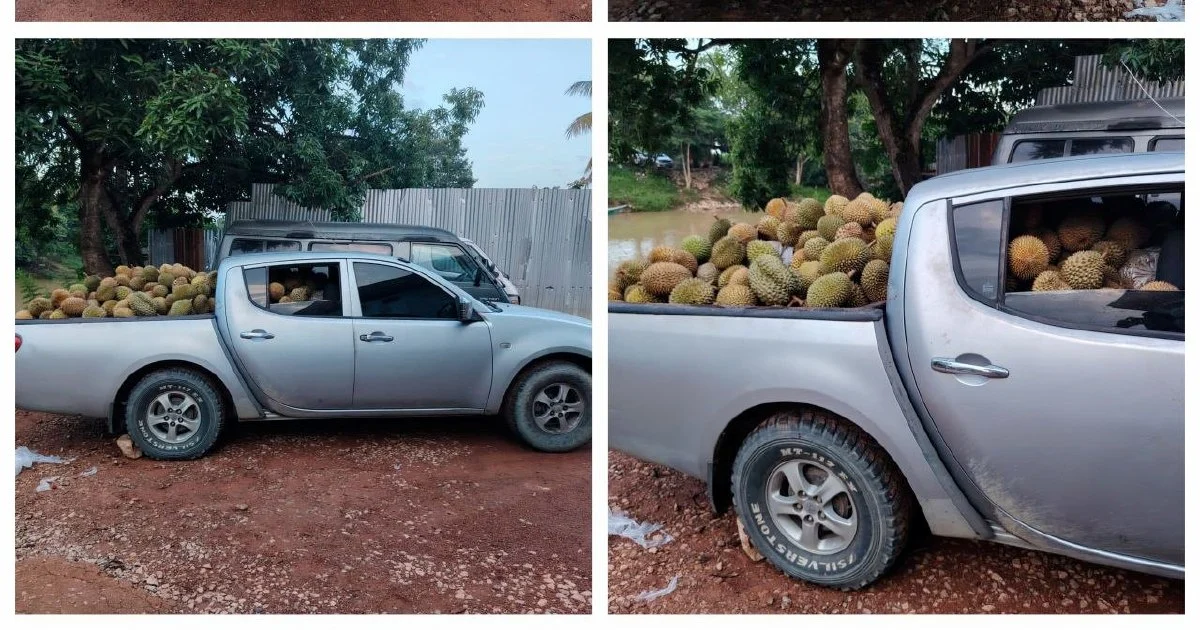
A young driver's attempt to earn modest daily income through part-time work took a dramatic turn when authorities apprehended him with a substantial cache of suspected smuggled durians in Rantau Panjang last night. The 22-year-old man, who had accepted work promising between RM60 and RM70 in daily wages, now faces serious legal consequences following the discovery of 700 kilograms of the controversial fruit during an enforcement operation.
The arrest highlights a persistent vulnerability in Malaysia's border regions, where agricultural smuggling networks frequently recruit economically vulnerable workers to transport contraband goods across state lines and international boundaries. Rantau Panjang, situated along the Kelantan-Thailand frontier, has long served as a flashpoint for such illicit activities. Enterprising smugglers exploit the financial desperation of young workers, offering seemingly straightforward employment that masks involvement in organised trafficking operations. For many individuals in economically disadvantaged communities, the promise of daily earnings—however modest—often outweighs consideration of legal consequences.
Durian smuggling represents a peculiar but significant challenge for Malaysian authorities. Thailand and other regional producers compete vigorously in international markets, and illicit cross-border trade undermines legitimate domestic producers and disrupts official supply chains. The fruit's distinctive odour and high value create lucrative opportunities for trafficking networks. Authorities consistently intercept large quantities at border checkpoints, suggesting that yesterday's 700-kilogram seizure represents merely one successful interdiction among countless attempted smuggling runs that may escape detection.
The driver's involvement in this incident raises broader questions about how criminal syndicates systematise recruitment and operational security. By employing expendable personnel for transportation duties—individuals unlikely to possess detailed knowledge of the supply chain's full scope—smuggling networks insulate senior operatives from direct criminal liability. Young workers often absorb disproportionate legal risk whilst the architects and financiers of smuggling enterprises remain shielded. This structural exploitation characterises many transnational trafficking operations throughout Southeast Asia, where economic inequality creates persistent pools of vulnerable labour.
From a regulatory perspective, Rantau Panjang's continued emergence as a smuggling venue suggests that existing border enforcement mechanisms require strengthening. Authorities maintain checkpoints and conduct patrols, yet determined traffickers continue devising routes and timing strategies to circumvent detection. Enhanced coordination between Malaysian and Thai customs agencies, investment in detection technology, and intelligence-driven operations represent potential means of disrupting these networks. However, without addressing the underlying economic drivers that compel young workers to accept such dangerous employment, enforcement alone will prove insufficient.
The incident also illuminates market dynamics within Malaysia's agricultural sector. Durian production commands substantial attention within both domestic and export-oriented economic planning. Smuggling operations that introduce cheaper foreign product distort pricing mechanisms and unfairly disadvantage Malaysian producers who operate within regulatory frameworks. Consumer demand for affordable durians inadvertently incentivises illicit trade channels. This economic reality complicates straightforward law-enforcement responses and requires coordinated approaches incorporating consumer education, producer support, and supply-chain transparency initiatives.
For residents of border communities like Rantau Panjang, yesterday's arrest reinforces a familiar pattern. Periodic interdictions receive media attention, but underlying vulnerabilities persist. Young people facing limited employment opportunities continue evaluating informal work arrangements that prioritise immediate income over deferred legal risks. Without tangible economic alternatives and credible pathways toward sustainable livelihoods, border-region communities will remain recruitment grounds for trafficking networks operating across multiple commodity sectors.
The case also reflects shifting operational sophistication among Southeast Asian smuggling organisations. Rather than relying exclusively on traditional overland routes, trafficking networks have increasingly professionalised their logistics and transportation systems. Large-volume seizures indicate that organisations operate at scales suggesting significant capital investment and complex supply-chain management. A 700-kilogram interception implies preceding successful runs and subsequent distribution infrastructure awaiting delivery. This organisational maturity demands corresponding evolution in law-enforcement responses, particularly regarding intelligence gathering and asset-tracking capabilities.
Moving forward, this incident presents an opportunity for targeted interventions beyond simple enforcement. Authorities might leverage the driver's testimony to map supply-chain relationships and identify higher-level operatives responsible for orchestrating the smuggling operation. Enhanced community engagement in border areas could yield intelligence regarding trafficking patterns and recruitment tactics. Educational campaigns highlighting legal consequences and alternative employment pathways might discourage participation among vulnerable populations. Regional cooperation frameworks should facilitate information-sharing regarding known trafficking networks and their modus operandi.
Ultimately, the 22-year-old driver's arrest embodies a tragic intersection of youthful economic vulnerability and organised criminal exploitation. What commenced as a search for daily employment has culminated in serious criminal charges with potentially severe consequences. His experience illustrates why effective responses to smuggling must extend beyond border checkpoint enforcement to encompass employment opportunity creation and community-level prevention strategies throughout Malaysia's frontier regions.

