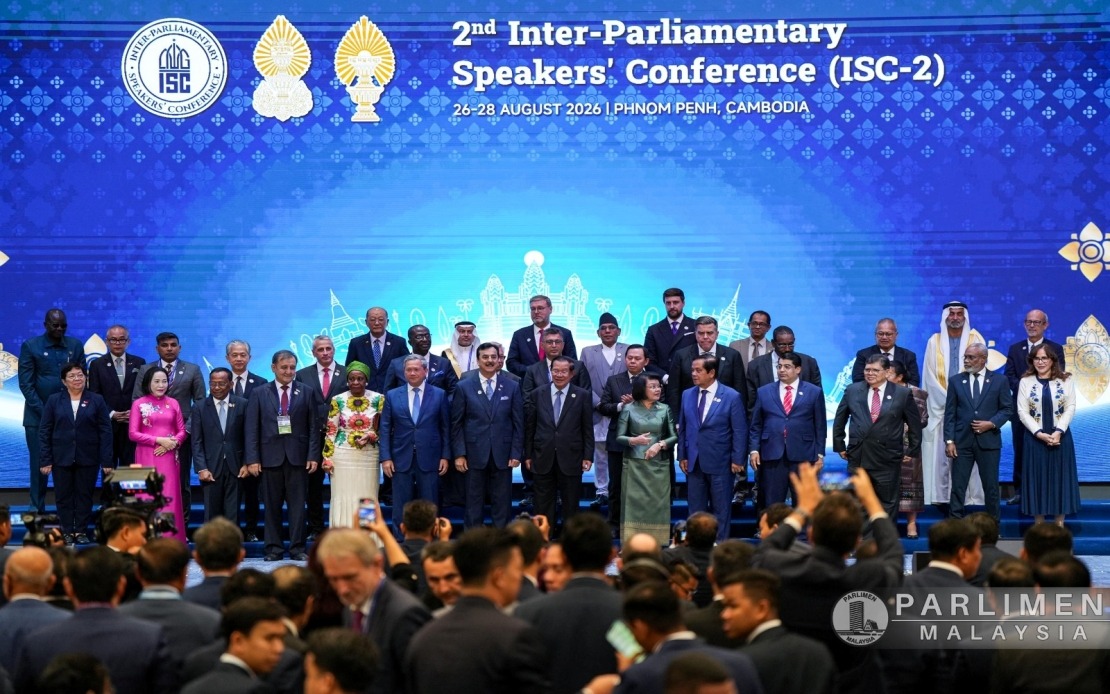
Legislatures around the world should assume a more active and complementary role to their governments in tackling international conflicts, geopolitical instability and emerging global crises, according to Dewan Rakyat Speaker Tan Sri Dr Johari Abdul. Speaking from Phnom Penh on Friday, Johari stressed that the burden of addressing such challenges should not fall exclusively on executive branches, signalling a broader institutional shift in how nations might tackle transnational problems in an increasingly fractious world.
Johari's remarks came during his attendance at the Second Inter-Parliamentary Speakers' Conference, a three-day gathering held in Cambodia's capital from August 26 to 28. The conference, co-hosted by Cambodia's National Assembly and Senate, drew parliamentary leaders from numerous countries around the theme "Solidarity for Peace and Shared Prosperity: Strengthening International Law and Resolving Conflicts Peacefully." The event represents an attempt by regional and global legislative bodies to carve out a substantive space in diplomatic processes that have traditionally been dominated by foreign ministries and executive decision-makers.
The Malaysian speaker's argument centres on a fundamental principle often overlooked in international relations: that elected legislatures possess unique institutional insights and popular legitimacy that executive officials may lack. Johari contended that while governments frequently approach disputes from narrower political calculations, parliaments often maintain broader perspectives grounded in their constituents' lived experiences. This divergence, he suggested, need not be a source of friction but rather an asset when channelled constructively. The synergy between legislative and executive branches, he argued, ultimately enhances a nation's capacity to build safer, more stable international environments.
The strategic value of parliamentary engagement becomes particularly acute when official diplomatic channels cool or freeze entirely. Johari highlighted how legislative networks can maintain continuity of dialogue during periods when bilateral governmental relations become strained or hostile. This parallel channel of communication proves invaluable because it preserves the possibility of continued conversation and understanding even amid serious political disagreements between states. In an era of escalating geopolitical competition, such alternative conduits for dialogue serve as potential conflict de-escalation mechanisms that might prevent misunderstandings from hardening into confrontation.
Johari's emphasis on parliamentary diplomacy carries specific resonance for Southeast Asia, where the Association of Southeast Asian Nations has built its entire diplomatic architecture on multilateral consultation and consensus-building rather than adversarial processes. He noted that ASEAN's foundational principles—rooted in respect for dialogue, non-interference and peaceful dispute resolution—have enabled the region to avoid the kinds of military conflicts that have plagued other parts of the world. Malaysia, as an ASEAN member, views parliamentary cooperation as an extension of these same principles, allowing legislatures to reinforce the consensus-seeking culture that underpins regional stability.
The human dimensions of modern conflict featured prominently in Johari's remarks, reflecting a growing recognition among policymakers that abstract geopolitical calculations often obscure devastating ground-level consequences. Displacement of entire populations, denial of educational opportunities to children, and the fracturing of community bonds through violence represent costs that statistics alone cannot capture. By involving parliaments—institutions directly accountable to populations affected by conflict—the diplomatic process becomes more grounded in these human realities. Legislators, answerable to constituents harmed by or vulnerable to conflict, bring a practical advocacy perspective that can temper abstract strategic considerations.
The foundations for lasting peace, according to Malaysia's position articulated by Johari, must rest on unwavering commitment to international law, respect for state sovereignty, territorial integrity and commitment to peaceful dispute settlement mechanisms. These principles transcend any single region but hold particular importance in Southeast Asia, where unresolved territorial disputes and competing maritime claims could easily escalate without firm commitment to rules-based approaches. By strengthening parliamentary advocacy for these principles, nations can embed respect for international law more deeply into their political cultures, making violations more domestically costly for any government that contemplates them.
The inter-parliamentary conference structure itself represents an institutional innovation in global governance, creating peer networks among legislators that operate somewhat independently of formal governmental channels. This distinction matters because elected representatives often possess greater flexibility than diplomats bound by strict governmental mandates. The informal nature of many parliamentary exchanges allows for creative problem-solving and frank discussions that might prove politically impossible in formal government-to-government contexts. Over time, consensus built among parliaments can generate political pressure on governments to adopt negotiated solutions that might otherwise appear domestically unacceptable.
Regional implications of this parliamentary engagement model extend across Southeast Asia and beyond. Indonesia will host the third Inter-Parliamentary Speakers' Conference in 2025, following Pakistan's hosting of the inaugural gathering earlier that year. This rotation among nations demonstrates commitment to building sustainable institutional structures for legislative cooperation. For Malaysia and other Southeast Asian nations, participation in these conferences represents an opportunity to shape emerging norms around parliamentary involvement in international peace processes, potentially creating templates that could be adapted to specific regional challenges such as maritime disputes or transnational security concerns.
The broader principle underlying Johari's advocacy—that democratic legislatures must reclaim a more authoritative voice in international affairs—challenges decades of diplomatic practice that has gradually concentrated foreign policy decision-making within executive branches. While governments retain responsibility for implementing foreign policy, Johari's vision suggests that parliaments should exercise greater influence over the substantive direction and values embedded in that policy. This rebalancing could produce more durable international agreements and commitments, since legislative involvement typically requires broader domestic political consensus than executive decisions alone.
For Malaysian policymakers and regional leaders, the speaker's interventions signal that Kuala Lumpur sees parliamentary diplomacy as a legitimate and potentially powerful tool for advancing Malaysian interests in a multipolar Asia. Rather than ceding international engagement entirely to formal diplomatic apparatus, national legislatures can operate as complementary actors, building relationships and consensus that strengthen subsequent governmental negotiations. This approach aligns with Malaysia's traditional preference for inclusive, consensus-driven processes and offers a mechanism through which smaller and medium-sized nations can amplify their influence in international affairs.

