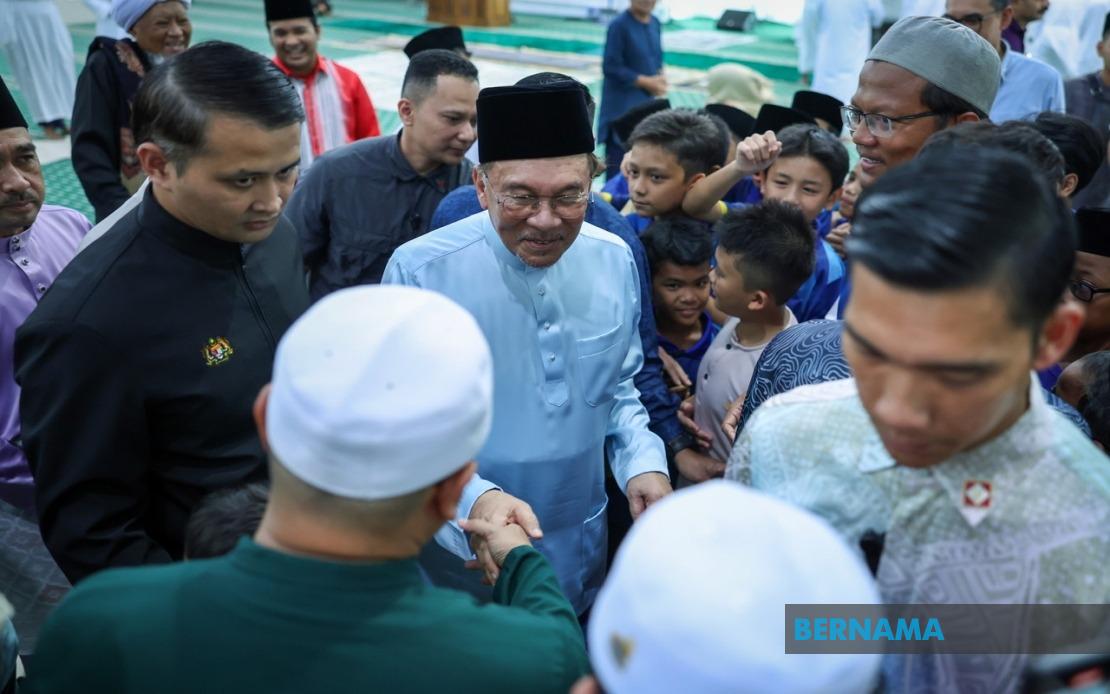
Prime Minister Datuk Seri Anwar Ibrahim has made clear that government funding designated for parliamentary constituencies exists primarily to serve residents rather than as a personal prerogative of elected representatives, a stance he reiterated while addressing the media in Alor Gajah following Friday prayers at Masjid Ar-Rasyidin on August 7.
The funding mechanism, according to Anwar, is designed to facilitate tangible improvements in living standards across constituencies through targeted investment in public infrastructure and community services. These allocations are channeled toward essential projects that directly benefit residents, spanning everything from educational institutions and religious facilities to critical drainage infrastructure and other pressing local requirements. The Prime Minister emphasised that the policy framework ensures resources reach the people they serve, rather than accumulating in the hands of individual political representatives.
In articulating this position, Anwar provided concrete examples of how the allocation system functions in practice. He explained that when a constituency receives RM2 million in government funding, that sum should be directed towards specific community assets and improvements such as schools, religious educational institutions, mosques, and essential maintenance work on local drainage systems. This approach, he stressed, reflects the government's commitment to distributing resources according to demonstrable community needs rather than political affiliation or hierarchical position.
The clarification came in response to mounting complaints from several Members of Parliament who had alleged that the government had reduced or withheld funding from their constituencies. These claims suggested a political dimension to fund distribution, with opposition MPs appearing to face differential treatment. Anwar's statement appears designed to counter such assertions by establishing that constituency allocations operate according to predetermined policy rather than as a tool for political reward or punishment.
Remarkably, the Prime Minister went further in suggesting that even opposition MPs would not face exclusion from the allocation system. He explicitly stated that if an MP has transitioned to opposition ranks, the government would ensure that funds meant for their constituency flow directly to constituents through alternative mechanisms, bypassing the MP entirely if necessary. This declaration signals an attempt to depoliticise the allocation process, presenting it as independent of parliamentary allegiances.
Anwar noted that this allocative principle represents established government policy with considerable historical precedent. According to his account, Members of Parliament who have previously served in government would already be familiar with this framework and its operational parameters. This assertion suggests the approach is neither novel nor controversial within parliamentary circles, though recent complaints indicate that clarity on implementation remains wanting.
The remarks were made in the presence of Minister in the Prime Minister's Department (Religious Affairs) Senator Dr Zulkifli Hasan and Melaka Police chief Datuk Dzulkhairi Mukhtar, lending official weight to the statement. The public articulation of this position, delivered to reporters rather than in parliamentary setting, suggests the government views clarification of allocation principles as sufficiently important to warrant direct media engagement.
For Malaysian constituents and observers of governance, the statement raises important questions about resource equity and the mechanisms through which government development funds reach local communities. The tension between individual MPs as political representatives and constituents as the ultimate beneficiaries represents a recurring challenge in parliamentary democracies. Anwar's framing suggests that the government intends to prioritise direct constituent benefit, though the practical implementation of such an approach—particularly in cases where MPs resist or obstruct resource distribution—remains unclear.
The allocation controversy also reflects broader tensions within Malaysia's current political landscape, where coalition dynamics remain fluid and questions of fund distribution carry significant political weight. Opposition-aligned constituencies have long complained of differential treatment in resource allocation, a concern that extends beyond mere perception to substantive policy implications for local development outcomes. The Prime Minister's assurance that opposition MPs will not result in constituent disadvantage attempts to address this longstanding grievance, though scepticism may persist pending demonstrated implementation.
Separately, Anwar briefly addressed staffing changes within his party structure, noting that PKR deputy president Nurul Izzah—who is also his daughter—had requested temporary relief from her position to address other commitments. He characterised the arrangement as a leave of absence rather than a permanent departure, emphasising her continued party engagement despite her reduced formal responsibilities. This personnel matter, while secondary to the allocations discussion, underscores ongoing organisational adjustments within the ruling coalition.
The broader implication of Anwar's allocation clarification concerns governance transparency and the removal of perceived political discretion from resource distribution mechanisms. Whether through direct constituent channels, local government structures, or community organisations, the government appears committed to establishing institutional pathways for allocation that function independently of individual MPs. Such mechanisms, if properly implemented, could serve to strengthen democratic accountability by ensuring that all constituents—regardless of their representative's political affiliation—benefit equitably from government development spending. For Malaysia and the region, this approach potentially offers a model for depoliticising resource distribution, though execution will ultimately determine its effectiveness.

