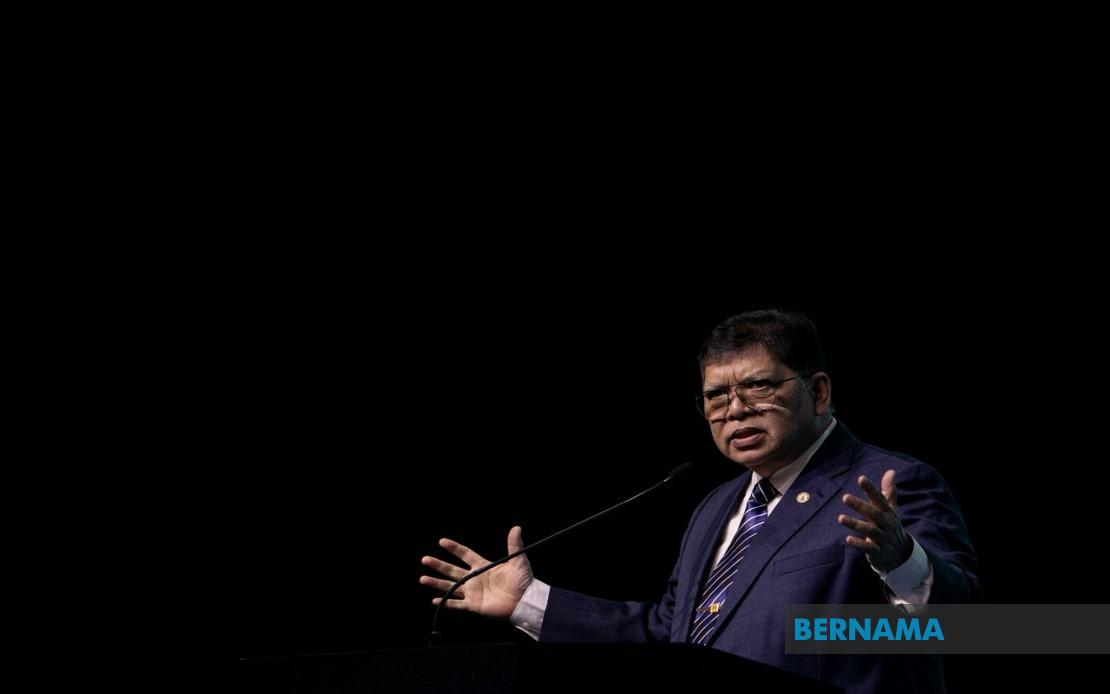
Dewan Rakyat Speaker Tan Sri Johari Abdul has outlined an ambitious framework centred on three distinct initiatives aimed at cultivating robust democratic institutions and lasting political stability in Malaysia. Speaking as a panellist at the 8th World Conference on Islamic Thought and Civilisation in Ipoh, Johari positioned the Sekolah Parlimen programme, the National Service Training Programme (PLKN), and the Youth Parliament as interconnected pillars designed to nurture a generation equipped not merely to inherit democratic structures, but to actively safeguard and strengthen them. His remarks underscore a deliberate shift in how Malaysian policymakers conceptualise democratic education—moving beyond theoretical instruction to hands-on experiential learning that immerses young citizens in the mechanics of governance.
The Sekolah Parlimen initiative represents the foundational element of this strategy. Under the programme, secondary school students aged 16 to 17, predominantly head boys and head girls selected from institutions across the country, undertake immersive visits to the Parliament building. During these tours, participants witness live parliamentary debates from the public galleries, gaining direct exposure to substantive political discourse and legislative processes in action. Johari emphasised that this direct exposure serves a critical pedagogical function—demonstrating to young Malaysians that democracy remains vibrant and operational within their national institutions, rather than an abstract concept confined to textbooks. By presenting democracy as a living, functioning reality rather than a distant ideal, the programme combats cynicism and disengagement among youth who might otherwise dismiss parliamentary processes as irrelevant to their lives. The speaker noted that nearly 2,000 students from over 1,000 schools have participated thus far, with deliberate prioritisation given to rural institutions where such exposure might otherwise prove inaccessible.
Johari's personal commitment to the initiative reflects its perceived importance within his vision for democratic renewal. He disclosed that he meets with every cohort of visiting students twice weekly, a hands-on engagement that personalises the experience and signals to participants that senior democratic institutions genuinely value their input and questions. This direct interaction between parliamentary leadership and young citizens creates a feedback loop where students perceive themselves as stakeholders in democratic processes rather than passive observers, potentially translating into higher civic participation in adulthood.
The PLKN component addresses democratic stability from a different angle, focusing on social cohesion and national unity as prerequisites for effective governance. Over its 45-day duration, the mandatory national service programme brings together young Malaysians from diverse ethnic, religious, socioeconomic, and geographic backgrounds in shared quarters. Johari characterised PLKN as fundamentally a "sociological incubator for unity," suggesting that exposure to difference, combined with shared experiences and objectives, naturally cultivates mutual understanding and appreciation. While military-style training constitutes a visible element of the programme, Johari's framing emphasises its deeper social function: the experience enables participants to understand their neighbours, appreciate diverse perspectives, and recognise common ground across Malaysia's plural society. In a nation with the complexity and diversity of Malaysia, such structured cross-community interaction serves as a counterweight to geographical and communal self-segregation that might otherwise fragment national cohesion.
The Youth Parliament represents perhaps the most innovative element of Johari's triptych, fundamentally reconfiguring how young citizens engage with electoral politics. Departing from Malaysia's first-past-the-post electoral system, the Youth Parliament employs proportional representation, permitting candidates aged 18 to 30 to contest elections and form political parties. This deliberate structural difference from national electoral arrangements serves distinct pedagogical and developmental objectives. Young participants must grapple with the mechanics of party formation, develop coherent manifestos, and articulate their policy visions to diverse constituencies. The proportional representation model forces participants to think critically about representation itself—how to aggregate and express the diverse preferences within heterogeneous society, rather than pursuing winner-take-all majority building. By engaging in these processes within a bounded, youth-focused arena, participants acquire political literacy and civic confidence that may inform their subsequent engagement with formal democratic institutions.
Johari's emphasis on critical thinking rather than rote learning indicates a pedagogical philosophy that privileges analytical capacity over predetermined outcomes. The Youth Parliament deliberately challenges participants to articulate what their party stands for and what policy objectives it pursues, cultivating habits of intellectual rigour and coherent political reasoning. This contrasts sharply with political socialisation models that emphasise passive acceptance of existing institutional arrangements or inherited partisan loyalties.
Taken together, these three initiatives reflect a comprehensive vision of democratic development spanning multiple life stages and developmental objectives. Sekolah Parlimen targets younger teenagers at a critical juncture when civic attitudes crystallise, employing direct exposure to parliamentary processes to normalise democratic engagement. PLKN operates across late adolescence, addressing social fragmentation and cultivating intercommunal understanding essential for stable plural democracy. The Youth Parliament targets young adults, providing practical experience in political organising and competition. Each programme addresses distinct but complementary dimensions of democratic citizenship—institutional literacy, social cohesion, and political efficacy respectively.
The emphasis on rural prioritisation within Sekolah Parlimen reflects recognition that democratic engagement and institutional access remain unevenly distributed across Malaysia's geography. Rural students typically encounter lower-quality civics instruction and minimal practical exposure to parliamentary institutions, potentially reinforcing perceptions of distance between peripheral communities and centralised political power. By actively recruiting rural school cohorts, the programme attempts to democratise democratic education itself, ensuring that institutional literacy transcends urban privilege.
Johari's articulation of these programmes carries broader significance for Malaysian politics at a moment when democratic institutions face scepticism from multiple directions. Declining youth engagement in formal electoral processes, intersecting with concerns about political polarisation and communal tensions, have prompted soul-searching among institutional guardians regarding democracy's long-term viability. By positioning youth engagement and civic education as central to political stability rather than peripheral nice-to-haves, Johari's framework recognises that democratic sustainability depends fundamentally on generational reproduction of democratic commitment and competence.
The speaker's explicit linking of these youth-focused initiatives to good governance and political stability suggests a theoretical proposition worthy of examination: that institutional stability flows not merely from constitutional design or leadership character, but from the cultivation across successive generations of populations equipped to navigate democratic processes with sophistication and commitment. This inverts models that treat democracy as a top-down institutional delivery, instead positing it as an ongoing practice requiring continuous cultivation of appropriate civic capacities and dispositions.
For Malaysia specifically, these initiatives carry particular salience given the nation's experience with periodic political turbulence, communal tensions, and generational disconnect regarding institutional legitimacy. By investing substantially in democratic education and youth political engagement, policymakers signal confidence in democracy's adaptability and resilience, while simultaneously attempting to preempt disaffection before it solidifies into sustained alienation from formal institutions. Whether these programmes generate the intended effects remains a question for systematic evaluation, but their conception and implementation reflect serious engagement with the challenge of sustaining democratic practice across generational transitions.

