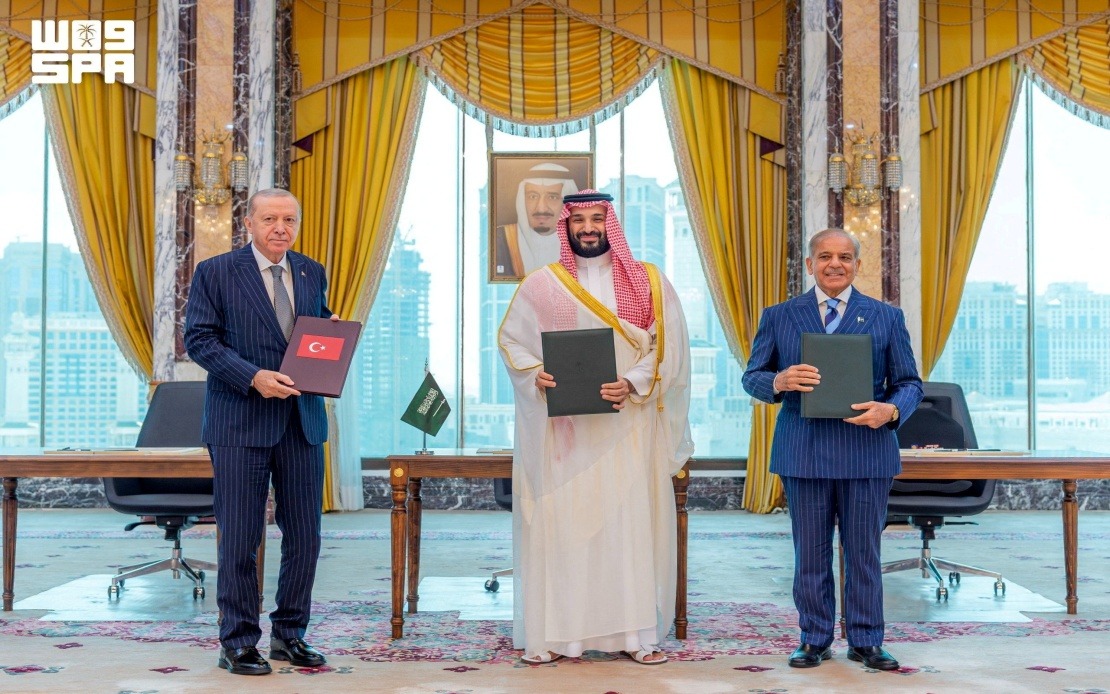
Pakistan, Saudi Arabia and Türkiye cemented a landmark security partnership on Friday when their leaders signed a sweeping collective defence agreement in Makkah, marking a significant realignment of strategic interests among three of the Muslim world's most influential powers. Saudi Crown Prince Mohammed bin Salman bin Abdulaziz Al Saud, Pakistan Prime Minister Shehbaz Sharif and Turkish President Recep Tayyip Erdogan inked the Joint Defence Agreement at Al Safa Palace, creating a trilateral framework designed to coordinate military responses and strengthen deterrence across the Islamic Middle East and South Asia.
The accord represents a substantial escalation in formality compared to existing bilateral arrangements, establishing that any armed assault directed at one member state shall automatically be considered an aggression against the entire alliance. This mutual guarantee fundamentally alters the security calculations of all three nations and signals their determination to present a united front against external threats. The language mirrors commitments typically found in traditional military alliances, though its application within a regional context adds particular weight given the geopolitical tensions that characterise both the Middle East and South Asia.
Beyond the headline security guarantee, the agreement commits the three nations to comprehensive defence collaboration spanning military training, technology transfer, joint exercises, and integrated operational planning. This multifaceted approach suggests the partners intend to move beyond rhetorical solidarity towards practical interoperability that would enable rapid coordinated response capabilities. The provision for enhancing all dimensions of defence cooperation implies investment in shared infrastructure, intelligence sharing protocols, and possibly joint weapons development initiatives that could reshape regional military capabilities.
For Pakistan, the accord builds upon an existing September foundation established through its separate bilateral defence agreement with Saudi Arabia, which itself enshrined mutual obligations in the event of external attack. The new trilateral framework exponentially expands these commitments by incorporating Türkiye's considerable military resources and regional influence. As one of the world's nine nuclear weapons states, Pakistan brings both deterrent capacity and significant security responsibilities to the alliance, making the agreement's implications unusually consequential for global non-proliferation frameworks.
Saudi Arabia's deputy public diplomacy minister, Rayed Krimly, sought to contextualise the pact as purely defensive while explicitly denying aggressive intent, stating through social media that the arrangement enables joint capability development, enhanced strategic deterrence, and coordinated threat assessment without threatening regional neighbours or escalating existing disputes. This framing reflects sensitivity to potential criticism from states such as Iran, which may perceive the alliance as directed against its interests, or from Gulf Cooperation Council members concerned about Saudi strategic autonomy.
The agreement's emphasis on collective security reflects broader aspirations articulated in the joint statement concerning shared commitment to stability and prosperity across expansive geographic zones encompassing Southwest Asia, the Middle East and potentially extending to the Indian Ocean region and beyond. This language suggests the signatories contemplate threats extending across multiple domains and geographical frontiers, from maritime security concerns to terrorism and regional proxy conflicts.
For Malaysian observers and Southeast Asian policymakers, this development carries significant implications for understanding power dynamics within the larger Muslim-majority world and the potential restructuring of traditional alliance systems. The pact demonstrates that influential Islamic nations are willing to formalize security arrangements that transcend geographical proximity, potentially creating template relationships for other regional coalitions. The precedent could influence how Southeast Asian states, particularly Malaysia as a significant Muslim-majority nation, calibrate their own international security partnerships and regional diplomatic strategies.
The timing of this agreement also warrants consideration alongside concurrent Middle Eastern tensions, the ongoing consequences of Afghan withdrawal, maritime security challenges in international waterways frequented by Malaysian and other Asian commercial vessels, and broader competition between major powers seeking influence across Asia. The trilateral arrangement positions its members as stakeholders in multiple regional equilibria simultaneously, complicating traditional bilateral approaches to security diplomacy.
Türkiye's participation adds North Atlantic and Black Sea dimensions to what might otherwise remain a purely Gulf-and-South Asian concern, potentially creating transnational security linkages that could affect European and Russian calculations regarding Middle Eastern stability. This geographic spanning suggests the alliance may develop into something more architecturally ambitious than initially apparent, with implications for NATO partners and regional competitors.
The explicit denial that the pact threatens regional security or escalates tensions indicates awareness among the signatories that other powers may interpret the agreement as provocative. Such defensive posturing is typical of alliance formation statements yet reflects genuine concern about international reaction, particularly from states not included in the framework. The next phase will involve monitoring implementation through military exercises, defence minister meetings, and practical cooperation initiatives that will reveal whether this agreement remains primarily symbolic or constitutes a genuinely integrated security mechanism.
For regional stability and for Malaysian strategic interests, this development underscores the ongoing importance of maintaining flexible, non-aligned positions while building constructive relationships across multiple power blocs. The agreement also highlights how rapidly geopolitical configurations can shift as regional powers pursue enhanced security through institutional mechanisms, a pattern that Southeast Asian nations must navigate with careful attention to their own security interests.

