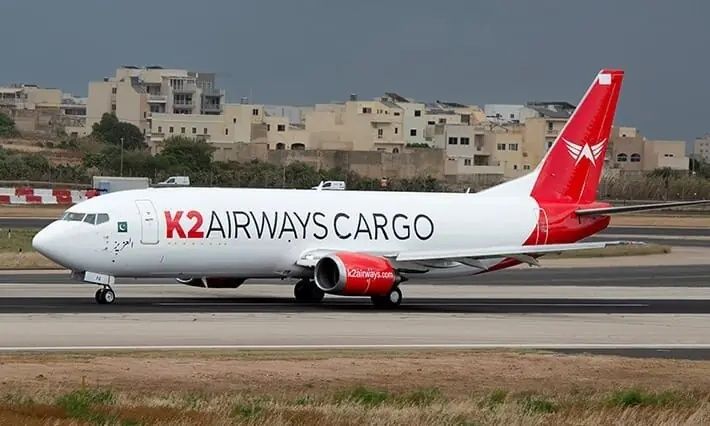
Pakistan launched a comprehensive search operation on Wednesday for a K2 Airways Boeing 737-400 cargo aircraft that disappeared during its approach to Karachi from the United Arab Emirates, with Prime Minister Shehbaz Sharif declaring the plane had crashed into the Arabian Sea carrying five crew members. The disappearance marks another tragedy for a nation grappling with persistent aviation safety challenges and renews concerns about the condition and operational standards of Pakistan's commercial fleet.
The aircraft encountered difficulties during its descent toward Karachi International Airport on Tuesday evening after reporting a malfunction in its navigational system. According to the Pakistan Airports Authority, radar data captured the moment the plane began descending rapidly before contact was abruptly severed approximately 155 nautical miles west of Karachi at 21:21 local time. The sequence of events leading to the loss of communication suggested the pilot may have attempted to recover altitude before the aircraft experienced a final, catastrophic descent into the Arabian Sea.
Flightradar24, the global flight-tracking platform, provided additional perspective on the aircraft's final moments, revealing a troubling pattern of altitude fluctuations. The data indicated an initial loss of elevation, followed by a recovery attempt, and then a sudden and severe descent that ended communication. This erratic altitude behaviour typically points to significant technical or structural failure, though investigations remain preliminary at this stage. The dual descent pattern is particularly concerning as it suggests the crew may have recognised problems and taken corrective action before losing control entirely.
Responding swiftly to the crisis, Prime Minister Shehbaz Sharif instructed Pakistan's civil aviation authorities, navy and air force to deploy all available resources in rescue and recovery operations. A source familiar with the matter confirmed that both Pakistani naval vessels and merchant ships had joined the search effort, supplemented by military aircraft scanning the Arabian Sea. The coordination between multiple agencies reflects the scale and urgency authorities are according to the operation, though prospects for finding survivors dimmed as hours passed without any signal from the aircraft.
K2 Airways, the operator of the missing plane, is a private cargo airline based in Pakistan that manages both domestic and international scheduled and charter services. The airline operates in a segment of aviation that has expanded significantly across South Asia as e-commerce and supply chain demands have grown, yet the sector often operates with less stringent regulatory oversight than passenger carriers. The company's choice of an ageing aircraft for cargo operations is not uncommon in this industry, where older planes unsuitable for passenger service find extended commercial life hauling freight.
The Boeing 737-400 involved in the incident was manufactured in 1999, making it a two-decade-old airframe that has undergone multiple ownership changes and operational transformations. The aircraft initially served as a passenger plane for Russia's Aeroflot and Indonesia's Garuda Indonesia before being refurbished and reconfigured for cargo operations in 2012. Such conversions involve substantial modifications to the interior, removal of passenger seating systems, and installation of cargo handling equipment—modifications that, when performed improperly or inadequately maintained, can create structural vulnerabilities.
This incident arrives amid a broader pattern of aviation safety concerns that have shadowed Pakistan's aerospace sector for years. The country experienced several catastrophic crashes during the past decade, including the December 2016 crash near Rawalpindi that killed 47 people and the May 2020 Pakistan International Airlines crash in Karachi that killed 97 passengers and crew. These tragedies exposed systemic issues ranging from pilot fatigue and insufficient maintenance protocols to gaps in regulatory oversight and enforcement. The recurring nature of such incidents suggests deep-rooted problems within the industry's operational culture and infrastructure.
International aviation authorities have also scrutinised Pakistan's safety standards. The European Union, the world's most stringent aviation regulator, imposed a comprehensive ban on Pakistan's national carrier from European airspace in 2020 over persistent safety and licensing deficiencies. Although the EU lifted this ban in 2024 following improvements, the previous four-year restriction underscored serious concerns about Pakistan's ability to enforce aviation standards. The ban's lifting reflects progress, yet questions linger about whether systemic improvements have been genuine and sustained across the entire aviation sector, including private operators like K2 Airways.
For Malaysia and Southeast Asia, this tragedy carries particular resonance given the region's reliance on air cargo operations and the interconnected nature of aviation safety standards across the Indian Ocean region. Malaysian carriers operate frequently across South Asian airspace and maintain partnerships with Pakistani operators. The incident raises important questions about maintenance standards, crew training protocols, and regulatory consistency among South Asian airlines that share regional flight corridors. These concerns extend beyond Pakistan to the broader challenge of maintaining uniform safety standards across an economically diverse region.
The investigation into K2 Airways' specific operational practices will likely reveal details about maintenance schedules, crew qualifications, and aircraft inspection records. Pakistani aviation authorities face pressure to demonstrate that lessons from previous crashes have been institutionalised and that oversight mechanisms function effectively. The presence of an ageing aircraft in the carrier's fleet, combined with reported navigational system failures, will prompt scrutiny of the company's maintenance culture and spare parts management. For regional carriers and regulators, the incident underscores the persistent tension between operational economics and safety investment in the aviation sector.
As search efforts continue, the tragedy reinforces uncomfortable truths about aviation in developing economies. The pressure to reduce costs, maintain fleet utilisation, and compete with better-resourced international competitors often creates environments where safety investments are deferred. Pakistan's aviation industry, despite improvements mandated by international pressure, continues operating in this challenging landscape. The five crew members aboard K2 Airways Flight 9701 represent another toll on a nation struggling to reconcile its ambitions as a regional aviation hub with the substantial investments required to maintain rigorous safety standards across its commercial fleet.

