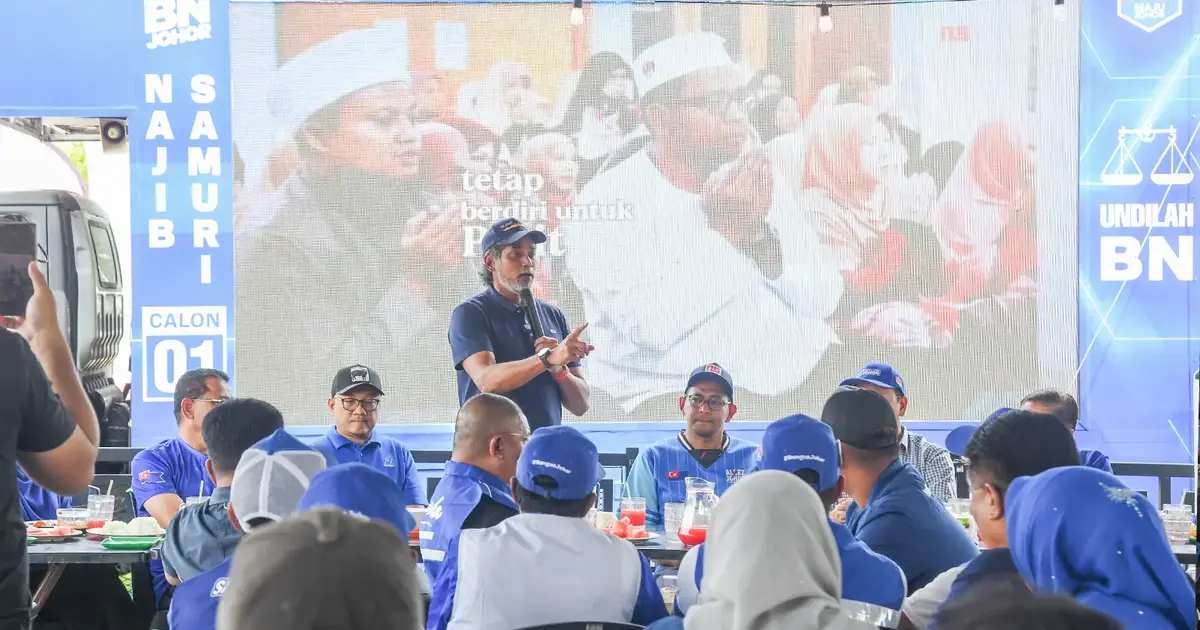
Khairy Jamaluddin, the former Umno Youth chief, has raised the bar for any potential debate between Pakatan Rakyat and Johor's Barisan Nasional leadership, insisting that PH must present a candidate of equivalent stature to Onn Hafiz Ghazi if such a confrontation is to take place. The statement reflects ongoing political manoeuvring in Malaysia's most strategically important southern state, where questions of legitimacy and leadership credentials remain central to electoral appeals.
Onn Hafiz, who holds the dual position of Johor Barisan chairman and incumbent menteri besar, occupies one of the most powerful positions in Malaysian state politics. His role encompasses both the administrative machinery of state government and leadership of the ruling coalition at ground level, giving him considerable advantage in any public engagement. Khairy's insistence that PH match this level of seniority underscores the political significance that such debates carry in contemporary Malaysian politics, where public appearances and rhetorical prowess increasingly shape voter perceptions ahead of state elections.
The debate demand, whether it materialises or not, reflects deeper anxieties within the Malaysian political establishment about the legitimacy of leadership and the right to speak for state interests. By stipulating that only a prospective menteri besar candidate can engage with Onn Hafiz, Khairy is essentially claiming that executive-level authority is a prerequisite for meaningful political discourse at the state level. This argument carries implications beyond mere spectacle, suggesting that opposition figures lacking demonstrated administrative responsibility should not occupy the same rhetorical platform as sitting executives accountable to the electorate.
For Pakatan Rakyat in Johor, the challenge presents a complex strategic calculation. The coalition has not held power in the state since 2008, and its organisational strength has been fragmented across internal divisions and factional disputes. Identifying and promoting a credible menteri besar candidate would require PH to project internal unity and a coherent vision for state governance. Yet such a public identification could also crystallise opposition attacks and invite scrutiny of the candidate's administrative experience and policy platform from the moment of announcement.
The political context of Johor remains distinctive within Malaysia's federal system. The state has long served as Barisan Nasional's electoral fortress, and control over its state government has been essential to BN's overall parliamentary majority on several occasions. Recent national political upheaval has created openings for opposition advance even in traditionally secured territories, yet Johor remains comparatively resilient for the ruling coalition. Any debate format would therefore carry symbolic weight about the trajectory of Johor politics and whether genuine two-way electoral competition has truly emerged in the state.
Khairy's intervention also reflects the internal dynamics of Umno and Barisan at present. As a prominent party voice and former youth leader, Khairy's public statements carry weight within Umno circles and among broader conservative constituencies. His demand for parity in debate participants serves to reinforce Barisan's claim to superior governance legitimacy and administrative readiness. The statement positions Onn Hafiz as the natural default holder of Johor's executive authority, against which opposition alternatives must prove themselves.
Debate formats in Malaysian politics have gradually evolved as electoral competition has intensified and media coverage has become more sophisticated. Television and online platforms now enable direct confrontation between political figures in ways that were uncommon two decades ago. Yet the question of who is eligible to participate in high-stakes public debate remains contested. Khairy's position aligns with a more traditional view that only holders of or serious contenders for executive office should occupy the same speaking platform, rather than party officials or policy experts speaking in representative capacity.
The practical implications for Pakatan Rakyat are significant. If the coalition accepts Khairy's implicit challenge and identifies a menteri besar candidate for such a debate, it commits that individual to high visibility and intensive public scrutiny. If PH declines, it risks being characterised as unwilling to subject its leadership to direct comparison with Onn Hafiz and Barisan. Either path contains political risks, suggesting that the debate demand itself may serve as a constraint on PH's strategic flexibility in Johor more effectively than the debate itself would.
For Malaysian political observers and Johor voters, the exchange illustrates the competitive intensity that has returned to state-level politics in recent years. The transition from single-party dominance to contested electoral environments requires established players like Barisan to articulate new justifications for their continued grip on power. Claiming superior administrative capacity and legitimacy to lead high-level political discourse represents one such justification, though it carries inherent risks if opposition figures successfully demonstrate their own competence and policy vision in public settings.
Looking ahead, the real test will be whether such a debate actually occurs and what format it takes. Khairy's demand for equivalent-level participation might ultimately prove instrumental in preventing any debate at all, should PH determine that the political costs of identifying and exposing a menteri besar candidate outweigh the benefits of confronting Onn Hafiz directly. The stakes in Johor state politics continue to rise, and rhetorical dominance has become as important as administrative performance in shaping electoral outcomes.

