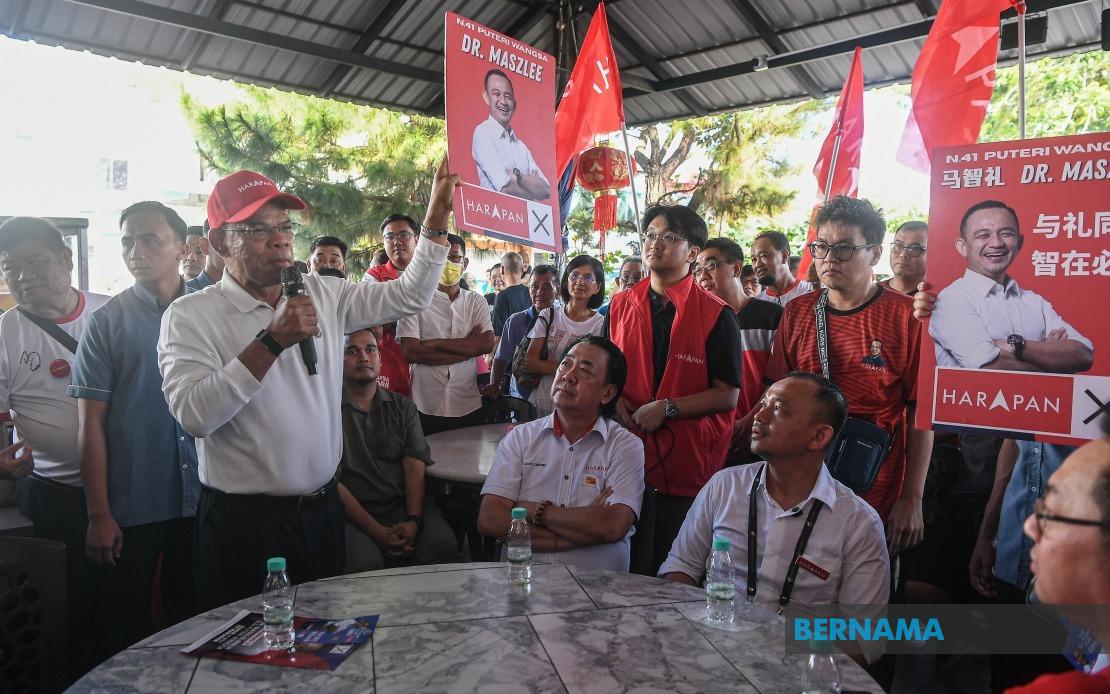
Pakatan Harapan is riding a wave of expanding public support in the Johor state election campaign, a surge the coalition attributes squarely to the precision and strategic focus of its ground operations. PH secretary-general Datuk Seri Saifuddin Nasution Ismail outlined how the 56 contested state seats have been systematically categorised according to priority tiers, allowing the coalition to concentrate resources where they matter most. This differentiated approach recognises that electoral dynamics vary sharply across constituencies, requiring tailored campaign messages and organisational intensity to match local conditions and voter profiles.
The methodology underpinning PH's strategy centres on acknowledging that not all seats present equal opportunities or challenges. Constituencies such as Puteri Wangsa and Johor Lama, or Larkin and Endau, operate within fundamentally different social, economic, and political contexts. By assigning priority grades to each area, PH directs campaign energies toward seats where the coalition's messaging is most likely to resonate and convert undecided voters. This granular approach contrasts with broader, one-size-fits-all campaign templates that dominate many political contests and represents a maturation of PH's electoral playbook following its 2022 national victory.
Saifuddin Nasution, also serving as PKR's joint election director, highlighted that PH's expanding support has been materially aided by strategic miscalculations from competing coalitions. The Islamic Party of Malaysia (PAS) opted to contest only 11 of the 56 seats, a decision that effectively channelled PAS supporters toward Barisan Nasional candidates in the remaining 45 constituencies. This bifurcation within the opposition vote complicates the anti-PH vote consolidation and creates openings for PH to capture seats where opposition unity might otherwise have proven formidable. From PH's perspective, this development represents an unforced error by rivals that inadvertently reshapes electoral geometry in the coalition's favour.
In stark contrast, PH pursued transparency by announcing its seat distribution well in advance and committing to a manifesto perceived as realistic and implementable. The coalition fielded candidates in all 56 seats, comprising 20 representatives from PKR, 19 from Amanah, and 17 from DAP. This blanket coverage symbolises PH's confidence and projects an image of comprehensive engagement with Johor's electorate, distinguishing the coalition from rivals perceived as strategically hedging their bets. The clarity surrounding PH's positioning, according to Saifuddin Nasution, has translated into sustained electoral momentum by offering voters a coherent alternative without ambiguity about PH's scope or intentions.
The momentum further benefited from a high-profile appearance involving former UMNO Supreme Council member Datuk Dr Mohd Puad Zarkashi, who participated in a series of discussions with Prime Minister Datuk Seri Anwar Ibrahim at Felda Ulu Tiram. The presence of a former UMNO insider lending credibility and engagement to PH's leadership narrative served as an intangible asset, signalling that PH's brand of governance enjoys cross-factional resonance beyond its core constituency. Such symbolic gestures, when amplified through campaign communications, reinforce perceptions of PH as a unifying force capable of attracting previously sceptical segments of the electorate.
In the Puteri Wangsa constituency, PH fielded Dr Maszlee Malik as its candidate—a selection Saifuddin Nasution characterised as reflecting quality and strategic importance. Describing Maszlee as an asset essential to PH's capacity to govern Johor following an anticipated electoral mandate, PH is clearly positioning this particular contest as emblematic of the calibre of candidates the coalition is advancing statewide. Such emphasis on candidate quality speaks to PH's broader narrative that the coalition represents not merely a political alternative but a superior administrative option grounded in competence and vision.
The Johor state election encompasses a notably crowded contest environment, with 172 candidates vying for 56 seats across the state. This density of competition underscores how effectively differentiating PH's messaging and efficiently deploying campaign assets becomes decisive. The electoral calendar compounds this pressure: early voting occurred on July 7, with polling day scheduled for July 11, compressing the campaign window and rewarding those coalitions that have prepared ground infrastructure and voter identification methodologies in advance. PH's seat-grading system suggests the coalition entered this compressed timeline with superior organisation and targeting precision.
Regionally, the Johor election carries significance extending beyond the state itself. As Malaysia's southernmost peninsula state and historically a stronghold of Barisan Nasional, any major shift toward PH represents a substantial realignment of the nation's political landscape. A PH victory would consolidate the coalition's position following its 2022 federal breakthrough and demonstrate sustained momentum. Conversely, a BN recovery in Johor would signal that PH's national appeal possesses ceiling effects and that traditional coalitions retain resilience in established strongholds. The election thus functions as a crucial indicator of trajectories shaping Malaysian politics over coming years.
For observers across Southeast Asia, the Johor contest illustrates broader patterns in democratic competitions where precision targeting, message discipline, and strategic opposition missteps increasingly determine outcomes. In an era of fragmented media environments and multiple competing platforms, coalitions that effectively segment electorates and tailor campaigns to granular constituencies demonstrate electoral advantages. PH's emphasis on systematic categorisation and differentiated approaches mirrors methodologies employed by successful political operations across the region, suggesting a globalisation of campaign best practices within emerging democracies.
The expansion of PH's Johor support trajectory, according to Saifuddin Nasution's characterisation, reflects not merely voter volatility or temporary enthusiasm but rather the cumulative effect of disciplined strategy, competitor missteps, and the presentation of a coherent alternative governance narrative. Whether this momentum translates into an outright PH government in Johor will crystallise on July 11, but the coalition's organisational sophistication and strategic clarity have already shaped the contest in its favour.

