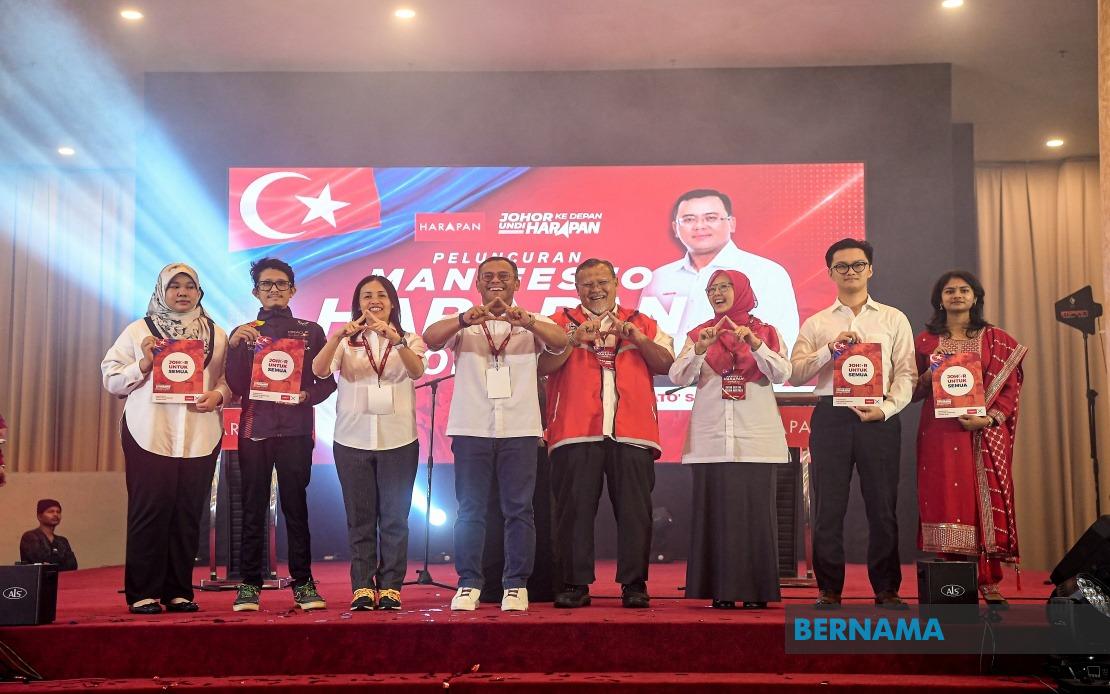
Pakatan Harapan is banking on its gubernatorial record in Johor to convince voters to grant the coalition another term in the state election scheduled for July 11. Speaking at the launch of PH's manifesto in Johor Bahru on July 3, Johor PH chairman Aminolhuda Hassan underscored that the coalition had not merely made pledges during its previous tenure but had actually followed through on them, a claim he argues should carry considerable weight as Johor residents prepare to cast their ballots.
The centrepiece of Aminolhuda's appeal centres on the coalition's 100-day manifesto following the 14th General Election, when PH governed the state. According to the Johor Amanah chairman, all ten major initiatives outlined in that programme were successfully executed, demonstrating a level of governmental competence that voters should factor into their electoral calculus. This emphasis on implementation rather than mere rhetoric represents a deliberate strategic choice by PH to differentiate itself in a political landscape often characterised by unfulfilled campaign commitments.
Among the tangible achievements cited were the imposition of a two-term ceiling on the office of Menteri Besar, a reform intended to prevent indefinite consolidation of executive power. The coalition also introduced the Johor Health Card, a universal healthcare initiative designed to broaden access to medical services beyond traditional insurance frameworks. These headline initiatives were complemented by structural reforms such as the implementation of open tender systems for government procurement, a move pitched as enhancing transparency and reducing opportunities for patronage.
The package of social welfare measures formed another pillar of PH's claimed accomplishments. These included provision of ten cubic metres of free water monthly for designated eligible households, a takaful insurance scheme extending financial protection to senior citizens, and financial incentives for young people contemplating marriage. Additionally, the coalition provided licence fee exemptions for street hawkers, a 50 per cent discount on outstanding rental arrears for residents of People's Housing Project units, and higher education scholarships aimed at widening tertiary access for lower-income families.
The vertical government quota represented an attempt to democratise bureaucratic hiring by mandating recruitment mechanisms that incorporated broader societal representation. These measures collectively sought to address quality-of-life issues affecting ordinary Johor residents, particularly those in lower income brackets, suggesting a governance philosophy centred on expanding material accessibility rather than purely administrative restructuring.
Aminolhuda's message to Johor voters has been unambiguous: turnout on July 11 will be decisive, and the choice before them involves determining which coalition deserves the mandate to govern. By framing the election as a referendum on performance rather than merely personality or rhetoric, PH leadership appears intent on shifting the terms of electoral discourse toward questions of competence and implementation.
The timing of PH's manifesto launch carries strategic significance. With the election barely a week away, the coalition sought to saturate the electoral space with messaging about past achievements while simultaneously unveiling its forward agenda. This doubled approach aims to provide voters with both retrospective validation of PH's previous governance and prospective confidence in its future programme.
Several senior PH figures lent weight to Aminolhuda's statements at the manifesto launch. These included Datuk Seri Amirudin Shari, a member of the PH Presidential Council, alongside PKR secretary-general Datuk Dr Fuziah Salleh and state party representatives Teo Nie Ching of DAP and Datuk Seri Dr Zaliha Mustafa of PKR. This visible assembly of coalition leadership served multiple purposes: it demonstrated organisational unity ahead of polling day, signalled commitment to the Johor campaign as a crucial electoral battleground, and reinforced internal party messaging about collective responsibility for manifesto implementation.
Aminolhuda's references to Prime Minister Datuk Seri Anwar Ibrahim's federal leadership further attempted to connect voter sentiment at the national and state levels. This invocation of federal achievements seeks to create a narrative of progressive governance spanning multiple governmental tiers, potentially encouraging voters inclined toward continuity at the national level to extend that preference to the state election.
The coalition is contesting all 56 state assembly seats, signalling determination to pursue majority control rather than selective strategic competition. This comprehensive approach carries electoral risk and requires substantial organisational capacity, but it also communicates confidence and commitment to comprehensive state transformation.
For Malaysian and regional observers, the Johor contest represents a significant test case for PH's broader political sustainability. The coalition rose to prominence on promises of reform and clean governance following the 2018 upheaval, yet subsequent years have witnessed internal fractures, leadership transitions, and electoral reversals. Johor's status as Malaysia's second-most populous state and a traditional electoral bellwether makes its outcome potentially indicative of broader voter sentiment regarding PH's performance in fulfilling its governance mandate.
The emphasis on delivering previous pledges also reflects broader anxieties within Malaysian electoral politics regarding governmental accountability. Voters across the peninsula have grown increasingly skeptical of campaign promises, particularly following periods when political transitions created high expectations that proved difficult to sustain. By directing attention to past implementation records, PH implicitly acknowledges this skepticism and attempts to address it through documented evidence rather than renewed pledges alone.
As polling day approaches, the coalition's strategy hinges substantially on whether Johor voters perceive the claimed accomplishments as sufficiently valuable to merit continued governance. The election will ultimately determine whether voters view PH's track record as a compelling argument for continuity or whether other political considerations—including dissatisfaction, alternative offerings, or demographic shifts—override the coalition's performance-based appeal.

