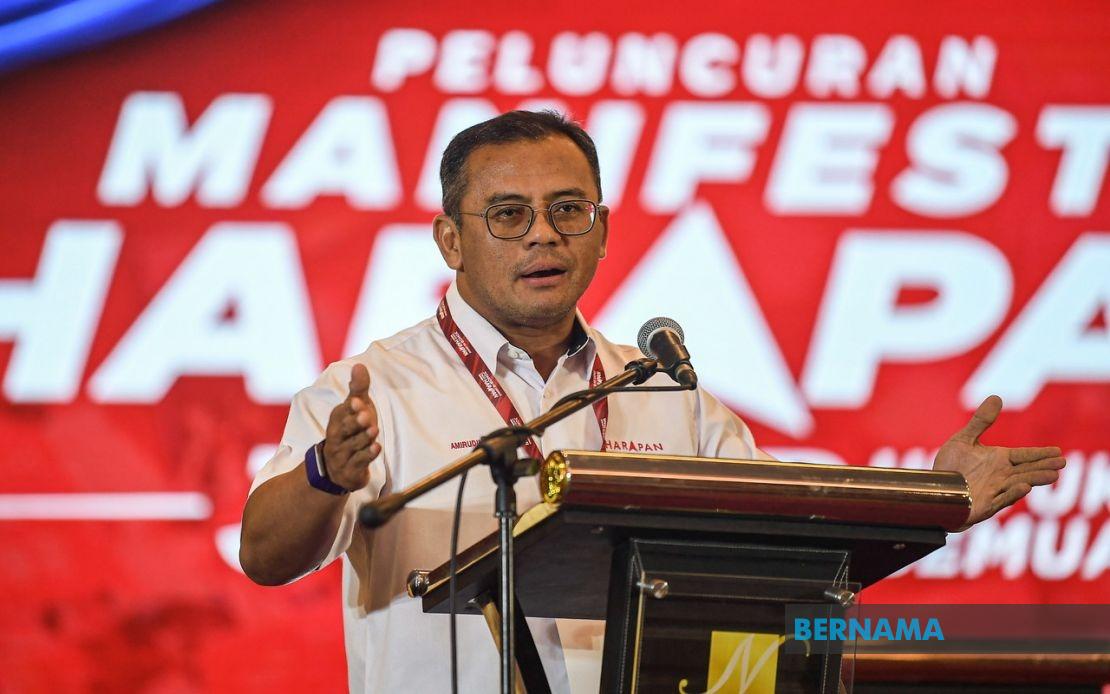
As Pakatan Harapan gears up for the 16th Johor state election, the coalition is placing economic performance at the centre of its campaign strategy. Datuk Seri Amirudin Shari, a key figure in the PH Presidential Council and Selangor's Menteri Besar, outlined the administration's economic credentials during the launch of the coalition's "Johor for All" manifesto in Johor Bahru on July 3, positioning federal achievements alongside state-level successes to build momentum among voters.
Amirudin's remarks underscore a broader narrative that PH is constructing around the MADANI Government's economic stewardship since returning to power. He highlighted the strengthening of the Malaysian ringgit to levels not seen in 16 years as a marker of restored investor confidence and macroeconomic stability. This currency appreciation carries symbolic weight in Malaysian politics, traditionally viewed as an indicator of competent governance and investor sentiment toward the nation's fundamentals. The administration under Prime Minister Datuk Seri Anwar Ibrahim has made currency stability a focal point, arguing it reflects successful management during a period of global economic uncertainty.
Beyond the ringgit's performance, the PH leadership is emphasizing sustained investment inflows and consistent growth in national Gross Domestic Product as evidence of their economic model's effectiveness. These claims are designed to counter opposition narratives that might suggest instability or mismanagement. For Malaysian voters evaluating which coalition to support, such macroeconomic indicators often serve as proxies for overall government competence, even if their immediate personal impact may be indirect.
The coalition has also strategically highlighted the economic contributions of PH-governed states, particularly Penang and Selangor. Together, these two states account for nearly 40 per cent of Malaysia's national economic output, a fact Amirudin emphasised to demonstrate the coalition's capacity to govern effectively at scale. This regional strength could translate into political legitimacy, as voters in Johor may perceive that electing a PH state government would align them with the country's economic powerhouses.
Selangor's economic trajectory serves as the centrepiece of this argument. The state's economy was valued at RM432 billion according to the Department of Statistics' 2022 assessment, but a report released just prior to the manifesto launch revealed growth to RM460 billion—an expansion of RM28 billion in a single year. Amirudin noted pointedly that this figure doubles Johor's economic size, an implicit suggestion that voting for PH could position Johor similarly on the path to accelerated economic development. For a state that has historically viewed itself as economically competitive, such a comparison carries political weight.
The timing of Amirudin's remarks reflects PH's strategic calculation that economic messaging resonates with Johor voters, many of whom witnessed the state's relative economic stagnation under previous administrations. By contrasting Selangor's rapid growth with Johor's current economic scale, the coalition is implicitly offering a development model that could appeal to voters seeking tangible improvements in state-level prosperity and investment.
However, the emphasis on aggregate state-level economic figures also raises questions about distribution and equity that opposition parties are likely to exploit. While Selangor's economy has grown substantially, not all residents have proportionally benefited, and questions about inclusive growth and equitable distribution of economic gains remain contested political terrain. For Johor voters, the relevant question may not simply be whether the state's economy grows, but whether such growth translates into employment opportunities, wage increases, and improved public services in their own communities.
The MADANI Government's framing also reflects an attempt to shift electoral discourse in Johor away from identity-based or parochial concerns toward developmental priorities. By foregrounding economic performance and investment attraction, PH is seeking to appeal to a cross-community voter base united by pragmatic concerns about livelihood and opportunity. This represents a calculated pivot from some of the coalition's earlier political positioning.
For Southeast Asian observers, Malaysia's Johor election illustrates how contemporary electoral competition increasingly hinges on economic messaging and performance metrics. As regional economies face external headwinds from global monetary tightening and geopolitical tensions, incumbent coalitions across the region are leveraging macroeconomic indicators to justify continued governance. Johor's voters will ultimately decide whether Amirudin's economic narrative proves compelling enough to expand PH's electoral base in a state where the coalition has historically faced stronger competition than in Penang or Selangor.

