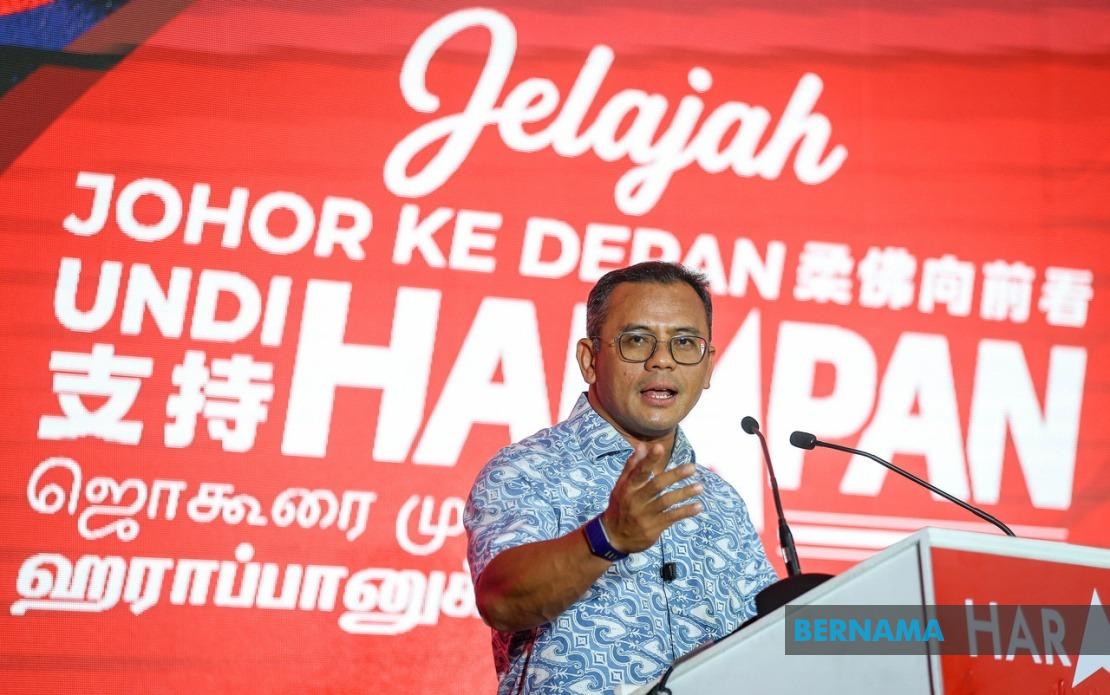
Pakatan Harapan is entering Johor's forthcoming state election with a platform centred on redistributing economic opportunities across the southern state, rather than seeking to upend existing stability, according to coalition representatives campaigning in the constituency. PKR vice-president Datuk Seri Amirudin Shari, who also serves as Selangor's Menteri Besar and the ruling coalition's election director, made these remarks during a campaign stop in Batu Pahat ahead of the July 11 polling date, positioning the party's participation as a constructive contribution to Johor's future rather than destabilisation.
The coalition's central argument rests on a diagnosis of structural imbalance within Johor's economy. Amirudin characterised the state as possessing substantial untapped potential, yet pointed to administrative shortcomings that have resulted in development clustering within specific districts rather than spreading across the full geographic expanse. The disparity in living standards between prosperous Johor Bahru and more peripheral areas such as Segamat exemplifies this concentration, he suggested, necessitating governance reform to ensure equitable distribution of growth across the northern, eastern, and western regions of the state.
This geographic inequality translates into tangible income disparities that Amirudin highlighted as a core concern for PH's electoral platform. Rather than framing the problem in abstract policy terms, the PKR leader pointed to the gap between Johor Bahru district and Segamat as emblematic of broader regional inequities that require corrective governmental intervention. By emphasising that "Johor is more than just Johor Bahru," Amirudin sought to broaden the coalition's appeal beyond the state capital and appeal to constituencies that have experienced slower development trajectories relative to the southern peninsula's economic hub.
A critical element of PH's critique concerns the relationship between investment levels and actual employment generation. The coalition cited data showing Johor attracting RM101 billion in investments during the previous year, a figure that exceeds Selangor's RM83 billion. Yet despite this investment advantage, Johor generated substantially fewer jobs than Selangor, with Amirudin estimating that Johor created fewer than 30,000 to 40,000 positions compared with Selangor's 60,000 new jobs. This disparity suggests that existing state administration has failed to convert capital inflows into meaningful livelihood opportunities for the labour force.
The jobs crisis carries particular significance for younger demographics in border regions. Amirudin identified commuting to Singapore as a survival strategy adopted by substantial numbers of Johor residents unable to secure adequate local employment, pointing to this cross-border daily migration pattern as indicative of systemic economic underperformance. A PH-governed state, he argued, would reverse this trend through strategic alignment of high-impact investments with federal government support mechanisms, specifically leveraging the Johor-Singapore Special Economic Zone to generate better-remunerated employment locally and reduce dependence on Singapore-based work.
The Johor-Singapore Special Economic Zone emerges as a central plank in PH's development strategy for the state. Rather than treating this bilateral economic initiative as a static arrangement under current administration, the coalition positions itself as capable of maximising its potential through coordinated federal-state cooperation. By channelling investments through this framework, PH contends that it can create employment opportunities with wage levels competitive with regional standards, thereby addressing both the quantity and quality dimensions of the job creation challenge.
Amirudin's rhetoric emphasises openness and inclusive governance as necessary preconditions for unlocking Johor's capabilities. The concept of Johor as the "Jewel of the South"—a designation intended to inspire both Malaysian national pride and regional confidence—underpins PH's messaging about transforming administrative approach. This aspirational framing suggests that technical policy adjustments alone are insufficient; rather, a philosophical reorientation toward transparent, consultative leadership is required to shift state development patterns.
Amanah deputy president Datuk Seri Dr Mujahid Yusof's presence at the campaign event underscored the multi-party nature of the coalition's Johor strategy. The participation of both PKR and Amanah representatives reflects the broader PH alliance's coordinated approach to the southern state contest, signalling unified messaging across component parties regarding development priorities and governance philosophy.
PH's comprehensive challenge to Johor's incumbent administration carries implications extending beyond state-level politics. For Southeast Asian observers and Malaysian voters in other states, the Johor campaign articulates persistent regional disparity concerns affecting states across the peninsula. The coalition's emphasis on employment quality and geographic equity addresses grievances that transcend Johor's boundaries, potentially resonating with voters elsewhere confronting similar patterns of uneven development and emigration to higher-wage jurisdictions.
The timing of these policy announcements corresponds with the party's total commitment to the contest. PH is fielding candidates across all 56 state assembly seats, indicating a determined bid to seize control rather than contest selectively. Early voting is scheduled for July 7, with main polling on July 11, providing a compressed campaign window within which PH must consolidate support for its development alternative. The coalition's emphasis on sustainable, inclusive growth positioning itself against current arrangements represents a substantive ideological distinction that will shape voter choice in the state election.

