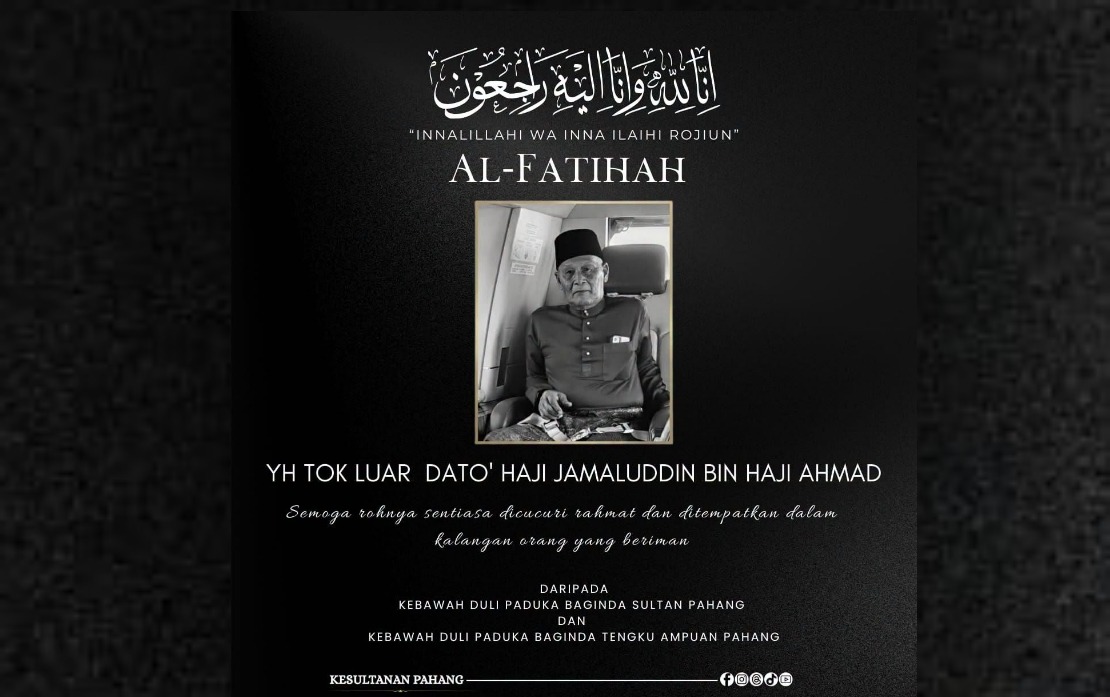
The Sultan of Pahang Al-Sultan Abdullah Ri'ayatuddin Al-Mustafa Billah Shah and Tengku Ampuan of Pahang Tunku Azizah Aminah Maimunah Iskandariah have expressed their sympathies following the death of Tok Luar Datuk Jamaluddin Ahmad on June 28. The prominent figure, whose passing was widely felt across Pahang, succumbed at Tengku Ampuan Afzan Hospital at 6.48 am, prompting the royal household to issue a formal statement acknowledging his contributions to the state.
Through a message posted on the official Kesultanan Pahang Facebook page, the royal couple emphasised their profound sorrow at losing someone they characterised as a steadfast pillar of the Pahang Sultanate institution. Such public expressions of condolence from the reigning monarch and his consort carry significant weight in Malaysian protocol, signalling not merely personal sympathy but institutional recognition of an individual's standing and service to the state. This gesture underscores the special bond that exists between Pahang's royal family and those who have dedicated themselves to supporting the sultanate's traditions and governance.
Jamaluddin's reputation as a loyal devotee of the Pahang Sultanate suggests a lifetime of service or advocacy on behalf of royal prerogatives and state interests. The title "Tok Luar" typically denotes an individual of considerable age and respect within Pahang society, often reserved for elders who have earned standing through decades of involvement in community and institutional affairs. The attachment of the Datuk honour further confirms his status as a recipient of royal recognition for his contributions to Pahang's social and institutional landscape.
In their formal statement, the royal household invoked Islamic prayers and blessings customary in Malay-Muslim protocol, requesting that Jamaluddin's soul be showered with divine mercy, his transgressions forgiven, and his virtuous deeds accepted by the Almighty. The reference to placement "among the faithful and righteous servants of Allah" reflects the Islamic framework through which the Pahang court expresses its spiritual wishes for the deceased. Such formulations are standard in official condolences issued by Malaysia's royal households, bridging the ceremonial and the deeply personal.
Beyond the immediate expression of grief, the Sultan and Tengku Ampuan directed their thoughts toward the bereaved family, expressing hope that they would be granted the emotional and spiritual fortitude necessary to navigate their bereavement. This dimension of the royal message serves a dual purpose: it acknowledges the family's specific loss while simultaneously reinforcing the extended support that the institution itself can provide during periods of family tragedy. In the Malaysian context, such assurances from the throne carry both symbolic and practical implications, as royal patronage can facilitate access to state resources and social recognition during times of distress.
The timing and prominence of this public condolence speak to Jamaluddin's integration into Pahang's upper social circles and his recognition as someone worthy of formal royal acknowledgment. Not all deaths in the state receive such official notices from the Sultan's office, suggesting that Jamaluddin held a position of particular esteem within Pahang society. This could reflect decades of service in formal capacities, involvement in state-level ceremonies and traditions, or sustained engagement with the sultanate's charitable and cultural initiatives.
For Pahang residents and those invested in the state's institutional life, such public gestures reinforce the continuing relevance and active engagement of the sultanate in community affairs. While Malaysia's constitutional monarchy limits the Sultan's executive authority in most domains, the Pahang ruler retains significant symbolic and ceremonial influence, particularly in matters touching on cultural preservation, Islamic affairs, and state tradition. The issuance of formal condolences represents an exercise of that symbolic authority, affirming the monarchy's awareness of and involvement in the lived experiences of respected members of the broader state community.
The statement's emphasis on Jamaluddin's loyalty and support for the sultanate institution reflects an important dimension of Pahang's political culture, wherein institutional loyalty and personal devotion to the royal household remain valued attributes. In a federation where state governments and federal authorities sometimes operate in tension, maintaining robust support networks within the sultanate hierarchy continues to matter for questions of legitimacy, continuity, and cultural cohesion. Individuals like Jamaluddin, understood through the prism of institutional loyalty, help anchor the sultanate to the broader Pahang public.
Deathe of figures like Tok Luar Datuk Jamaluddin Ahmad create moments of reflection across Pahang about generational continuity, the transition of institutional knowledge, and the evolving relationship between traditional sultanate structures and contemporary state administration. His passing represents the loss of someone who likely bridged older traditions and institutional practices with more modern governance frameworks. Such figures often serve as repositories of historical memory and procedural knowledge that cannot be easily replicated through documentation or formal training.
The careful religious language and references to divine mercy embedded in the royal condolence reflect broader patterns in how Malaysia's Islamic monarchy navigates its dual role as both temporal and spiritual guardian for Muslim subjects. While the Sultan of Pahang operates within constitutional bounds limiting his political executive authority, his capacity to pronounce on matters of faith, tradition, and proper conduct remains substantial, particularly regarding rites of passage such as death and bereavement. The formal condolence thus functions as a reaffirmation of the Sultan's role as keeper of state religious and cultural norms.
Moving forward, the significance of this condolence may extend beyond the immediate family to inform discussions within Pahang about succession planning within influential circles and the preservation of institutional knowledge among those close to the sultanate. The death of a generation of Tok Luars and similar respected elders often prompts broader community conversations about who will assume their mantle and how new leaders can maintain the links between sultanate, society, and tradition that such figures have historically maintained. In this sense, Jamaluddin's passing marks not merely the loss of an individual but potentially a transition point in Pahang's institutional evolution.

