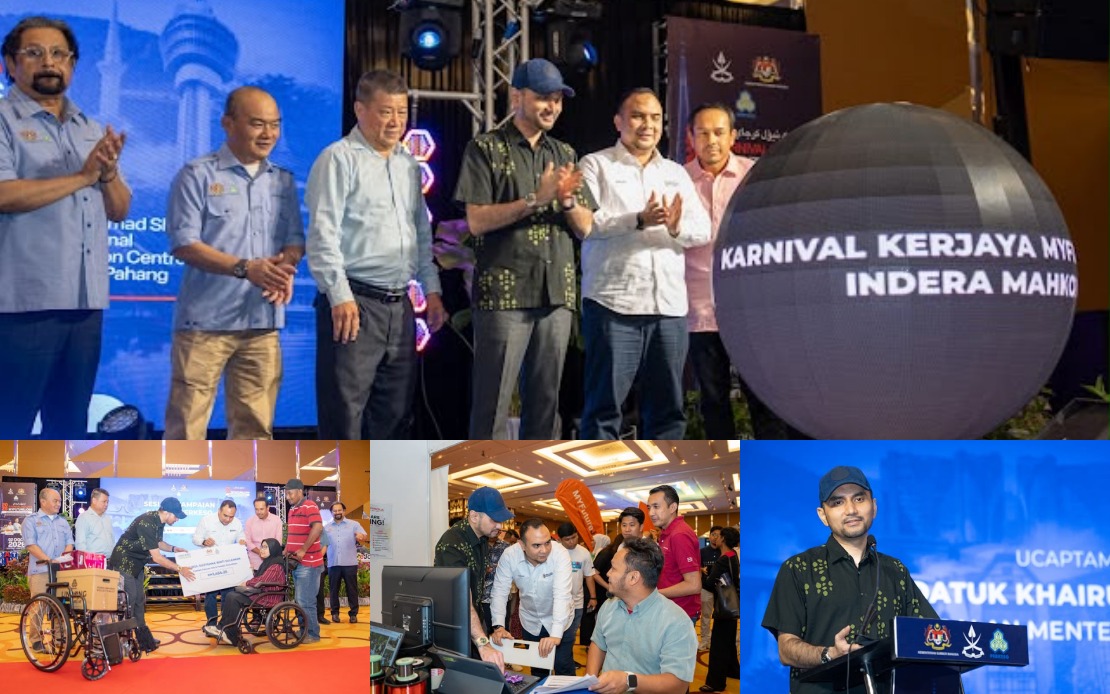
Pahang has emerged as the employment leader across Malaysia's east coast, recording a labour force participation rate of 65.3 per cent during the first quarter of 2026 alongside an exceptionally low unemployment rate of 1.9 per cent. The achievement reflects the cumulative impact of coordinated government strategies aimed at tightening labour market conditions and expanding job access across the region. Deputy Human Resources Minister Datuk Khairul Firdaus Akbar Khan highlighted this progress while officially opening the Indera Mahkota MyFutureJobs Career Carnival 2026 in Kuantan, underscoring the effectiveness of employment-focused policy frameworks that have reshaped workforce dynamics in recent years.
Central to Pahang's labour market success is the MYFutureJobs platform, administered by the Social Security Organisation (PERKESO), which has functioned as a critical bridge between job seekers and employers across diverse economic sectors. The minister framed this infrastructure as embodying a sustained governmental commitment to reducing national unemployment through systematic job matching and placement services. For young people in particular, the initiative presents tangible pathways into formal employment, addressing a demographic cohort that has historically faced barriers to labour market entry. The government's investment in this mechanism reflects recognition that passive labour markets require active institutional support to function effectively, especially in regional economies where geographic dispersion can limit job discovery.
The scale of PERKESO's operational footprint in Pahang demonstrates the ambition underlying this employment strategy. Between 2023 and late July 2026, the platform facilitated employment for 26,877 job seekers throughout the state, a figure underscoring how sustained institutional effort translates into measurable outcomes for thousands of workers. This success was underpinned by a network of 1,277 interview sessions and career events organised across Pahang during the same period, indicating the labour force infrastructure now embedded within the state. The Indera Mahkota carnival alone dangled 6,000 job opportunities from 30 employers spanning multiple industries, demonstrating how concentrated recruitment drives can temporarily amplify job availability for geographically concentrated populations.
Portal registration numbers reveal the growing awareness and uptake of MYFutureJobs among Pahang residents. The platform recorded 11,857 registered job seekers in 2026 specifically, signalling accelerating participation as the initiative becomes more entrenched within community awareness. Over the entire period, more than 10,000 vacancies were advertised through the system, creating a cumulative pool of opportunities that extends beyond individual recruitment events. These figures suggest that the platform has matured beyond novelty status into a normalized component of how Pahang residents approach employment, indicating substantial behavioural shift toward government-managed labour market matching.
Beyond pure placement, Khairul Firdaus articulated a complementary emphasis on workforce development and skills enhancement. The ministry has progressively integrated training programmes alongside job-matching services, recognising that employment access alone proves insufficient if workers lack competencies demanded by evolving industries. This framework acknowledges that labour market participation requires not just opportunity but capability—workers must possess or rapidly acquire the technical and interpersonal skills that employers increasingly demand. By positioning training as integral to employment services rather than supplementary, the government has widened its labour market intervention beyond vacancy-filling toward genuine workforce capability expansion.
The Sahabat MADANI initiative, launched formally at the Kuantan event by Prime Minister's political secretary Datuk Ahmad Farhan Fauzi, represents a complementary governance approach emphasizing volunteerism and community mobilization. Rather than treating employment as a purely transactional government-citizen relationship, Sahabat MADANI frames job creation within a broader ethos of mutual community responsibility and social cohesion. The initiative enlists young volunteers as conduits between governmental programmes and grassroots communities, effectively decentralizing programme delivery while simultaneously cultivating civic engagement among youth. This hybrid model—combining professional employment services with volunteer-driven community outreach—reflects sophisticated governance thinking that recognizes employment extends beyond wage-earning into questions of social integration and community participation.
Pahang has already recruited 2,000 Sahabat MADANI members, fulfilling its initial enrollment target and establishing a volunteer infrastructure across the state. However, Ahmad Farhan's remarks made clear that membership expansion remains an ongoing priority, with organisers seeking to deepen the volunteer cohort supporting employment and community programmes. These volunteers function simultaneously as community assistants and as informal intelligence networks for government, helping administrators understand grassroots conditions and programme impact. For rural and remote communities within Pahang, volunteer networks potentially compensate for geographic disadvantages that might otherwise isolate residents from metropolitan-concentrated employment services. The initiative's emphasis on reaching hard-to-access areas directly addresses a persistent regional equity concern.
The convergence of Pahang's employment metrics with national policy implementation offers instructive lessons for understanding Malaysian labour market dynamics more broadly. The state's outperformance reflects not extraordinary local conditions but rather effective application of standardized national programmes adapted to regional contexts. This suggests that labour force participation gaps between Malaysian states correlate significantly with differential implementation intensity and programme awareness rather than fundamental economic capability differences. States investing more heavily in PERKESO coordination, career carnival frequency, and volunteer mobilization appear to achieve superior outcomes, implying that employment outcomes remain partially policy-endogenous—responsive to governmental effort and strategic focus.
For Southeast Asian observers, Pahang's experience demonstrates how state-administered labour platforms can achieve measurable participation improvements when embedded within broader community engagement structures. Malaysia's integration of PERKESO's professional services with the Sahabat MADANI volunteer movement reflects recognition that labour markets function most effectively when combining institutional expertise with community legitimacy. Unlike purely technocratic employment services, which can feel distant to workers in peripheral regions, hybridized models anchoring professional job-matching within volunteer community structures may prove more effective at reaching and engaging culturally diverse populations. This represents an experiential model potentially adaptable across Southeast Asia's diverse labour market contexts.
Looking forward, sustaining Pahang's labour force participation gains requires continued governmental investment in both PERKESO infrastructure and volunteer coordination. The state's achievement of 65.3 per cent participation and 1.9 per cent unemployment positions it advantageously within regional comparisons, but these gains prove contingent on sustained programme funding and policy attention. Demographic projections suggesting continued youth population growth across Malaysia mean that employment demand will intensify rather than diminish, requiring system expansion rather than consolidation. The challenge for policymakers involves scaling successful interventions from accomplished states like Pahang into less-developed regional labour markets while maintaining programme quality and community trust.
The broader Malaysian context of 2026 reveals a government consciously prioritizing employment as a political and social good extending beyond simple poverty reduction. The alignment between PERKESO's professional apparatus and the MADANI initiative's community engagement reflects deliberate policy design emphasizing inclusivity and social cohesion within economic programmes. As Southeast Asian economies navigate automation pressures and sectoral shifts, Malaysia's investment in accessible, geographically distributed employment services provides a model emphasizing state capacity combined with community partnership. Pahang's metrics, while impressive, ultimately represent institutional outcomes reflecting human choice and governmental prioritization—demonstrating that labour market outcomes remain substantially within policy reach rather than determined by ineluctable economic forces.

