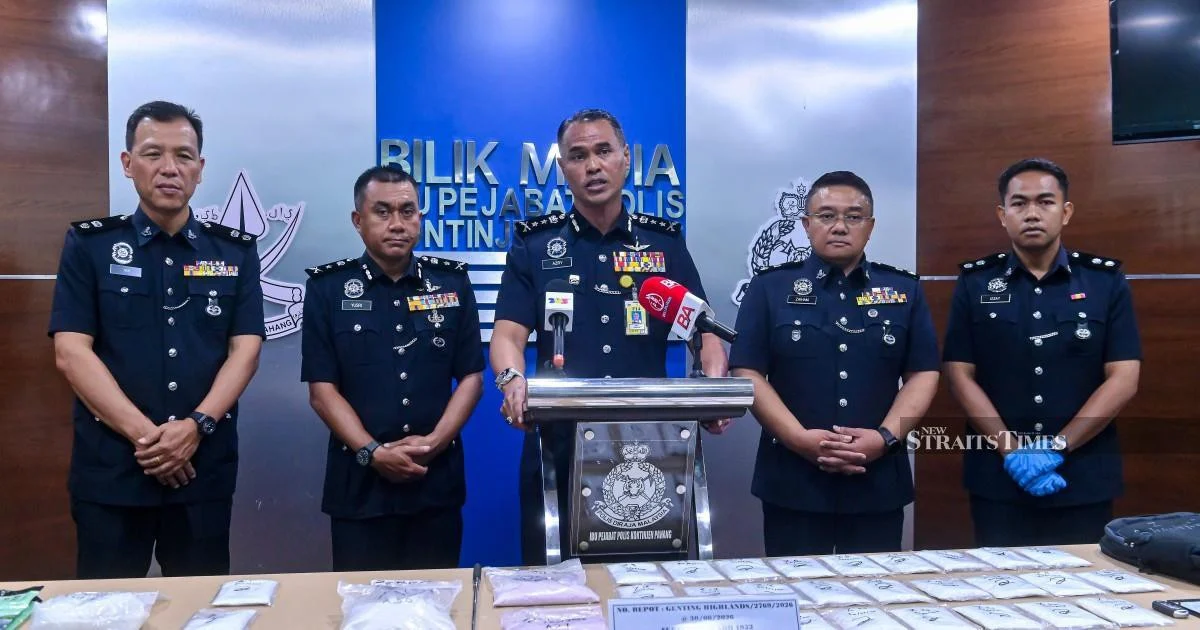
Authorities in Pahang have concluded a major three-day enforcement drive targeting illegal drug distribution networks, culminating in the arrest of 333 suspects and the seizure of drugs, currency and motor vehicles valued at over RM500,000. The operation, which saturated all 11 districts of the state, represents a comprehensive effort to dismantle trafficking infrastructure at both retail and mid-level dealing points.
Operation Hawk, as the enforcement campaign was designated, reflects escalating concern among Malaysian narcotics enforcement agencies regarding the persistence and resilience of drug supply chains despite years of focused interdiction work. The scale of this initiative—with 333 individuals detained for investigation—signals that the Royal Malaysia Police and state narcotics agencies view Pahang as a significant throughway for illicit substances moving through the corridor connecting Kuala Lumpur and the eastern coastal states.
The seizure of controlled drugs alongside cash and vehicles indicates that police operations are increasingly targeting the entire infrastructure of trafficking rather than merely apprehending low-level street dealers. When enforcement teams recover both narcotics and monetary assets, they disrupt the financial flows that sustain distribution networks and make restitution more difficult for arrested dealers seeking rapid bail. Vehicles used in trafficking logistics also become unavailable for rapid redistribution, creating operational friction for criminal syndicates.
Pahang's geographical position makes it a natural transit zone for drug trafficking. The state straddles major highways connecting the Klang Valley to Terengganu, Kelantan, and further into Thailand and southern Thailand's porous borders. Criminal networks exploit this landscape by establishing distribution nodes in smaller towns and suburban areas where enforcement presence is traditionally lighter than in federal territories or Selangor. The comprehensive sweep across all 11 districts—including major urban centres like Kuantan, Temerloh, and Raub, as well as smaller administrative zones—suggests police intelligence had identified a distributed network rather than concentrated trafficking hubs.
The successful coordination required to execute simultaneous or rapid-sequence operations across such a geographically dispersed territory demonstrates improved interagency communication and resource deployment. Malaysian narcotics enforcement has historically struggled with fragmentation between federal-level Narcotics Bureau units, state police contingents, and local drug enforcement teams. Operations achieving this scale typically require weeks of intelligence gathering, asset mapping, and coordinated scheduling to prevent suspect networks from scattering when operations commence.
From a Southeast Asian perspective, such enforcement actions contribute to regional attempts to combat the broader drug epidemic affecting the peninsula. Thailand, while facing its own significant trafficking issues, has reciprocal intelligence-sharing arrangements with Malaysian authorities regarding cross-border smuggling routes. The arrest of 333 individuals, while significant within Malaysian enforcement statistics, remains modest relative to the estimated volume of drugs circulating through the region annually, underscoring the massive scope of the challenge.
The specific quantification of seized assets at over RM500,000 warrants scrutiny. This valuation typically encompasses street-level retail value of narcotic substances rather than acquisition cost to traffickers, meaning the actual economic disruption to criminal enterprises may be lower than the figure suggests. Additionally, police valuations of seized drugs can vary significantly based on purity assessment and pricing methodologies, making year-on-year comparisons problematic without standardised measurement protocols.
Pahang's concentrated enforcement efforts may have secondary effects on trafficking patterns across the region. If major distribution hubs have been disrupted, dealers may relocate to neighbouring Terengganu or Kelantan, potentially creating temporary spikes in enforcement activity there as criminal logistics reorganise. Alternatively, trafficking networks may temporarily reduce visibility by consolidating operations or shifting supply methods, making quantification of true enforcement impact difficult in the weeks immediately following the operation.
The arrest figures alone raise questions about processing capacity within Pahang's criminal justice system. With 333 individuals requiring investigation, charging decisions, bail hearings, and court proceedings, state prosecutors and judicial infrastructure will face significant demand. This can paradoxically slow case progression if resources become saturated, potentially allowing some accused persons to secure bail and resume activities during trial preparation phases—a recognised vulnerability in Malaysian drug enforcement.
Operation Hawk's success will ultimately be measured not by raw statistics but by whether it produces longer-term disruption to trafficking networks, whether arrested individuals are successfully prosecuted and convicted, and whether drug availability and street prices in Pahang subsequently shift. Initial seizures and arrests represent enforcement activity; actual impact requires follow-through in investigation, prosecution, and sustained pressure on reconstituting networks.
The operation underscores Malaysia's continued commitment to visible narcotics enforcement, a politically sensitive issue given public concern over drug-related crime and addiction. However, enforcement-centric strategies alone have proven insufficient across Southeast Asia to reverse trafficking trends, suggesting that successful counter-narcotics approaches require complementary demand-reduction initiatives, community engagement, and treatment infrastructure development—elements often less visible than headline-grabbing arrests and seizures.

