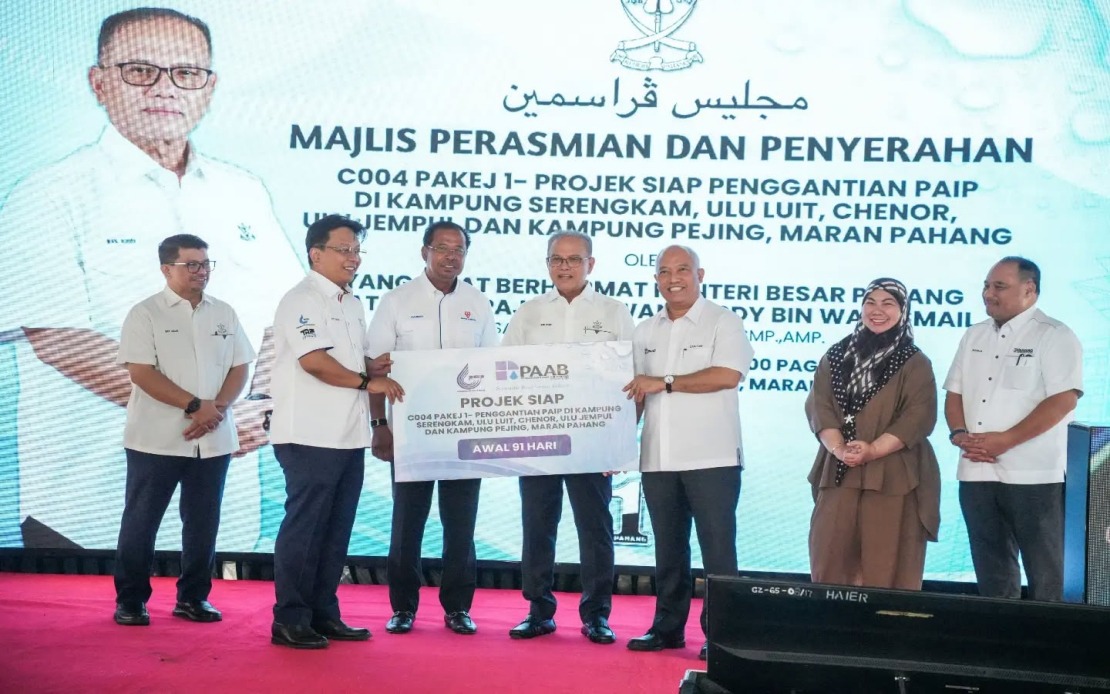
Residents of Maran in Pahang can finally breathe easier as Pengurusan Aset Air Berhad (PAAB) officially handed over a comprehensive water infrastructure project that promises to end chronic supply problems plaguing the district for the better part of two decades. The RM11.19 million pipe replacement initiative, which concluded three months ahead of schedule, represents a significant intervention in resolving one of the region's most persistent service delivery challenges. The ceremony at the Chenor Water Treatment Plant drew senior government figures including Pahang Menteri Besar Datuk Seri Wan Rosdy Wan Ismail, underscoring the political priority attached to fixing water supply deficiencies in the state.
The scale of the undertaking demonstrates the severity of Maran's water infrastructure crisis. PAAB has replaced approximately 29.6 kilometres of aging and deteriorating pipes across multiple localities, including Kampung Serengkam, Ulu Luit, Pejing, Ulu Jempul and the particularly troubled Chenor sub-district. This targeted approach addresses the root causes of persistent supply disruptions rather than applying temporary patches. The project directly benefits nearly 10,000 residents who have endured frequent water shortages, particularly during seasonal peaks and religious holidays when demand surges.
Beyond simply restoring supply, the initiative tackles interconnected infrastructure problems that have compounded Maran's water challenges. The replacement of corroded pipes significantly reduces non-revenue water, the technical term for water lost through leakage before reaching consumers. For Malaysian water utilities, non-revenue water remains a persistent efficiency challenge, with some states losing 30 per cent or more of treated water to deteriorating distribution networks. By stabilising pressure throughout the system, the project also mitigates the cascading failures that occur when burst pipes compromise water quality and availability during high-demand periods, such as the dry season when groundwater reserves naturally deplete.
The completion ahead of schedule reflects improved project management capacity within PAAB's operations, a critical factor for infrastructure delivery in Malaysia's ambitious water sector transformation agenda. The organisation, established in 2006 under the Water Services Industry Act, functions as the federal government's primary vehicle for implementing the National Water Services Industry Restructuring Plan. With Pengurusan Air Pahang Berhad (PAIP) as the local operator, the partnership demonstrates how centralised asset management can drive progress in state-level water systems. PAAB is wholly owned by Minister of Finance Incorporated and falls under the purview of the Ministry of Energy Transition and Water Transformation, ensuring alignment with national policy objectives.
The Maran project, while significant for its immediate beneficiaries, represents merely one component of a much larger infrastructure expansion across Pahang. Over the next three years, PAAB and PAIP are collaborating on additional investments designed to create a more comprehensive and sustainable water delivery network throughout the state. One parallel initiative targets the Jengka Utama Water Treatment Plant, where electrical system upgrades will resolve supply disruptions affecting the Felda Jengka settlement. This work addresses a distinct challenge from aging pipes, highlighting how Malaysia's water infrastructure deficiencies stem from multiple causes requiring targeted solutions.
Elsewhere in Pahang, PAAB is simultaneously implementing a RM35.7 million project to replace 76.2 kilometres of deteriorating pipes in Jerantut and Lipis, connecting communities around Pulau Tawar and Kuala Tahan. This initiative dwarfs the Maran project in scope, reflecting the statewide scale of infrastructure renewal requirements. A third concurrent project involves replacing 11 kilometres of water pipes in Felda Keratong at a cost of RM13 million, specifically targeting efficiency improvements in the Rompin district's water supply system. These overlapping initiatives reveal how systematically PAAB is addressing Pahang's water infrastructure backlog.
The financial commitment underpinning these efforts is substantial. As of July this year, PAAB had allocated RM1.17 billion for water supply infrastructure projects across Pahang. Of this amount, RM69.79 million has been spent on completed projects, while RM66.94 million supports ongoing construction. Notably, RM981.04 million remains earmarked for projects still in planning and design phases, indicating that major infrastructure investments lie ahead. For Malaysian and Southeast Asian readers tracking regional development priorities, this allocation pattern signals serious government intent to modernise water delivery systems rather than merely treating immediate crises.
These investments must be understood within the broader context of Malaysia's water sector transformation agenda. The federal government has committed to creating a more resilient, efficient and sustainable water infrastructure system capable of supporting economic development while managing environmental constraints. Pahang, as one of Malaysia's largest states by area, faces particular challenges in extending reliable water services across dispersed communities. The Maran project demonstrates how targeted capital investment, combined with improved asset management practices, can overcome chronic service delivery problems that have persisted despite previous policy initiatives.
For residents of Maran specifically, the benefits extend beyond the convenience of reliable water access. Improved water supply stability directly supports public health, education quality and economic productivity. When communities experience frequent water shortages, schools struggle to operate effectively, households face elevated health risks, and commercial activities—from small food businesses to larger manufacturing operations—encounter operational constraints. The RM11.19 million investment therefore represents an important catalyst for broader socioeconomic development in the district, addressing what development economists recognise as a foundational prerequisite for progress.
The project's early completion carries additional significance for infrastructure planning in Malaysia. Delivering major utilities projects ahead of schedule is relatively uncommon in the Malaysian context, where cost overruns and timeline delays have characterised numerous infrastructure initiatives. PAAB's performance in Maran suggests that improved procurement practices, clearer project scoping and enhanced contractor management are yielding tangible results. These operational lessons may prove valuable as the organisation and its state partners embark on the RM981 million worth of planned initiatives, where consistent delivery becomes crucial for maintaining political momentum behind continued investment.
Looking forward, the success of Maran's pipe replacement project may serve as a template for addressing similar challenges elsewhere in Southeast Asia. Many regional countries face comparable water infrastructure deficiencies stemming from aging distribution networks, rapid urbanisation outpacing system capacity, and climate variability affecting both supply and demand patterns. Malaysia's visible commitment to systematic infrastructure renewal, demonstrated through PAAB's coordinated approach across multiple Pahang districts, represents a regional development model worth monitoring. As climate impacts intensify and competition for water resources increases, the ability to deliver reliable water services becomes increasingly central to national competitiveness and social stability.

