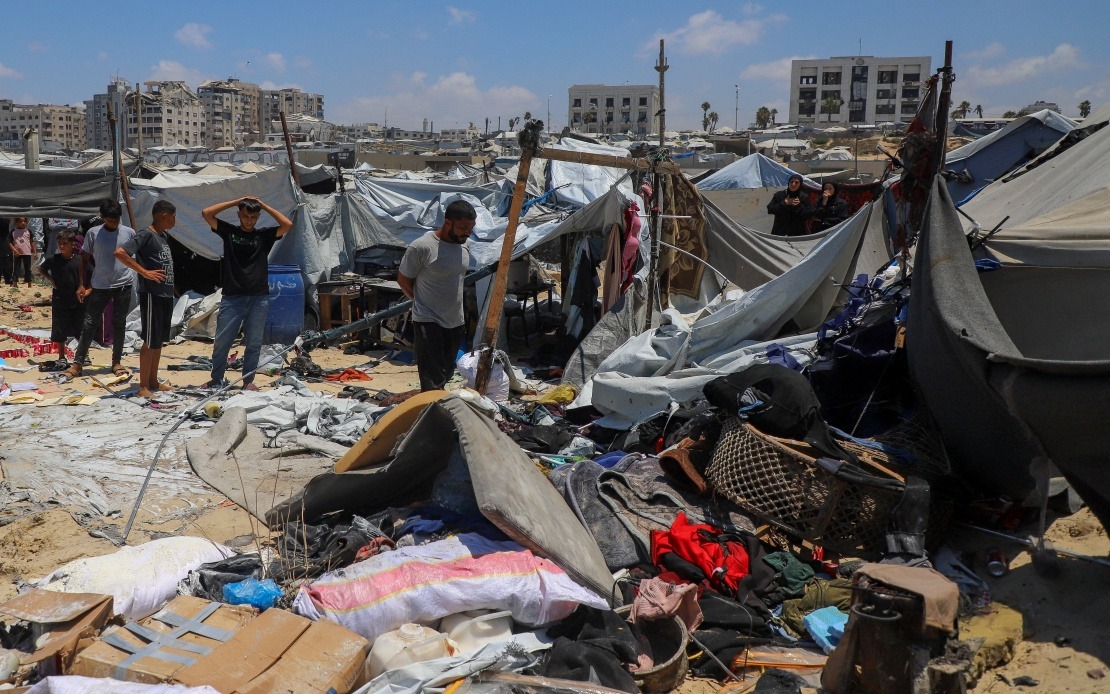
The scale of destruction in the Gaza Strip has reached unprecedented levels, with a Palestinian government weekly situation report revealing that Israeli military operations have demolished more than 90 per cent of the territory while occupation forces have secured control over approximately 80 per cent of the war-affected region. The assessment, released Monday by the Palestinian Government Communication Centre at the Prime Minister's Office, provides a stark accounting of the humanitarian and infrastructural toll following sustained military campaigns. The findings underscore the scale of destruction unfolding in one of the world's most densely populated areas, carrying implications for regional stability and humanitarian concerns that extend beyond Palestinian territories into the broader Middle Eastern landscape.
During the week of June 29 to July 6, Israeli military operations intensified significantly across three major population centers in Gaza. The heaviest activity concentrated on Khan Younis, Rafah, and Gaza City, where coordinated military maneuvers resulted in documented Palestinian casualties. Medical sources on the ground reported eight deaths during this seven-day period alone, though the full casualty toll and injury count remain subject to ongoing verification. The intensity of operations in these urban centers reflects a systematic approach to territorial consolidation, as forces move through densely populated residential areas where civilians remain concentrated.
Beyond direct combat operations, the Palestinian government report documented widespread destruction of civilian infrastructure and residential properties. Systematic shelling of inhabited neighborhoods combined with deliberate home demolitions has displaced additional Palestinian families already displaced by earlier phases of conflict. These actions represent a continuation of tactics that have compounded the humanitarian crisis, leaving civilians without shelter and straining already-depleted resources for emergency housing and relief assistance. The displacement pattern mirrors earlier stages of the conflict, suggesting a sustained strategy targeting civilian populations and infrastructure simultaneously.
Military operations have extended beyond the Gaza Strip into the occupied West Bank, where Israeli occupation forces conducted extensive raids throughout the week. Major Palestinian cities including Ramallah, Nablus, Hebron, Bethlehem, Jenin, Qalqilya, Tulkarem, and occupied Jerusalem experienced coordinated military incursions involving home invasions, arbitrary detention, movement restrictions, and strategic road closures. These operations fragment Palestinian territorial control and restrict freedom of movement, creating parallel systems of constraint across occupied territories. For Malaysian observers, the West Bank operations illustrate how territorial control extends through interconnected security measures that affect civilian governance and economic activity.
Parallel to official military operations, Israeli colonial settler militias have conducted independent attacks targeting Palestinian communities and assets. The Palestinian government report documented arson targeting a cafeteria in al-Lubban ash-Sharqiya village, physical assaults against Palestinian shepherds east of Bethlehem, attempted livestock theft, and strategic blockades of village access points including the entrance to Burqa. These militia actions, often operating with limited intervention from occupation authorities, create a second layer of coercive pressure against Palestinian civilians. The targeting of shepherds and livestock reflects efforts to displace Palestinians from agricultural and pastoral livelihoods, compounding economic displacement beyond direct military destruction.
Agricultural destruction has emerged as a significant but often underreported dimension of the conflict's impact on Palestinian livelihoods. The Palestinian Ministry of Agriculture documented systematic damage to farming assets during the reporting week, with particular emphasis on olive cultivation across the West Bank. Over 2,559 olive trees were uprooted, burned, or damaged, concentrated primarily in the Salfit, Jenin, and Nablus governorates where agricultural production represents critical economic activity for rural communities. The targeting of agricultural infrastructure carries long-term consequences beyond immediate economic loss, as olive groves require years to mature and represent cultural heritage alongside economic assets.
The agricultural destruction has affected at least 125 individual farmers, creating economic dislocation across extended family networks dependent on farm income. Documented direct losses from the week's agricultural destruction reached approximately US$11.78 million, a substantial sum for communities with limited economic alternatives and restricted market access due to security restrictions. These losses accumulate across months of reported incidents, creating cumulative economic devastation in rural areas already suffering from mobility restrictions and employment limitations. For Southeast Asian agricultural-dependent economies, the pattern illustrates how conflict destroys not merely crops but the productive capacity and economic structures supporting rural populations.
The convergence of military destruction, settler militia attacks, and targeted agricultural damage reflects a multifaceted approach extending beyond conventional warfare into economic and livelihood disruption. The Palestinian government's systematic documentation of these incidents provides accountability records while highlighting the layered nature of pressure applied to civilian populations. The 90 per cent destruction figure, while alarming, represents cumulative damage across the broader conflict period rather than solely recent operations, yet the continuing intensity of military activity suggests ongoing destruction throughout the territory.
For Malaysia and Southeast Asian observers, these developments carry implications extending beyond humanitarian concern. The scale of destruction and territorial control consolidation affect regional dynamics, Palestinian political stability, and humanitarian burdens that could influence international responses and regional tensions. The documentation of specific incidents and economic losses establishes evidentiary records relevant to international accountability mechanisms and humanitarian law discussions. Understanding the extent of destruction and control consolidation provides context for assessing the trajectory of the conflict and potential humanitarian consequences requiring regional attention and international engagement focused on civilian protection and reconstruction capacity.

