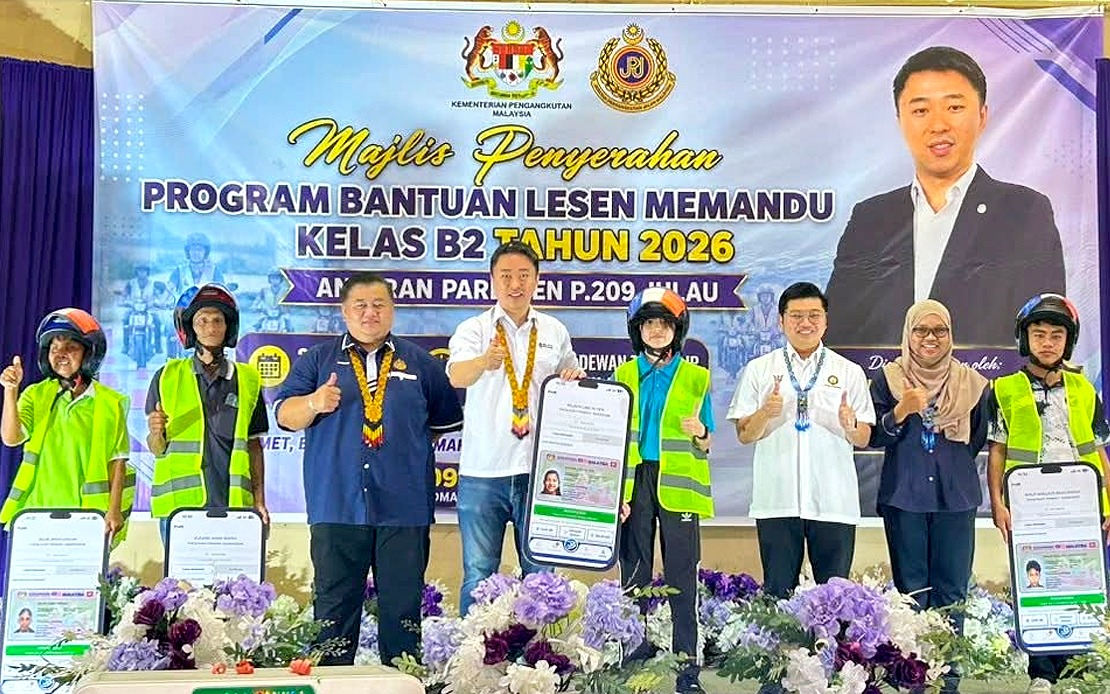
The Driving Licence Assistance Programme in Sarawak's Julau parliamentary constituency concluded this week with 885 participants receiving their Class B2 Probationary Driving Licences, granting them eligibility to purchase petrol at government-subsidised rates. The initiative represents a targeted effort to formalise motorcycle ownership in remote rural communities while simultaneously providing tangible economic relief through fuel price support, addressing dual concerns of road safety and household financial strain in agricultural regions.
The closing ceremony at Julau Closed Stadium was officiated by Datuk Larry Sng Wei Shien, the Member of Parliament for Julau and chairman of the Malaysian Timber Industry Board, with Sarawak Road Transport Department director Norizan Jili also in attendance. The programme's completion marks a milestone in extending transport regulation and subsidy access to communities where motorcycles serve as essential rather than optional transport, particularly for workers accessing smallholdings, orchards, and other rural livelihoods scattered across difficult terrain.
For many participants, the primary motivation centred on securing access to subsidised fuel rather than licensing compliance alone. Bajik Undum, aged 57 from Rumah Ajau in Ulu Kuntau, Pakan, articulated this directly, explaining that she previously purchased unsubsidised petrol for her motorcycle despite using it regularly to reach her orchard and transport produce to market. The cost differential between subsidised and non-subsidised fuel has become increasingly significant as petroleum prices continue their upward trajectory, placing operational expenses beyond the reach of smallholder farmers operating on thin margins.
Bajik, recognised as the oldest female participant in the programme, underscored that the licence addresses multiple practical concerns simultaneously. Beyond the immediate savings from accessing cheaper fuel, the legitimacy of holding a valid Class B2 licence reduces anxiety during routine police roadblocks and vehicle checks. For agricultural workers whose daily routes may cross multiple jurisdictions or checkpoints, the psychological and financial burden of enforcement interactions has represented a genuine operational risk—one now mitigated through formal licensing.
The economic dimension becomes sharper when examining the circumstances of other beneficiaries. Kudang Jenggi, the oldest male participant at 64 years old, works as a bird's nest house caretaker in Bayong, Sarikei, and described his transition to licensed riding as conferring both confidence and cost advantages. His commute to work, visits to family, and errand-running all depended on his motorcycle, yet without a valid licence he remained vulnerable to penalties and unable to claim subsidised fuel benefits despite the routine operational costs his livelihood incurred.
Daniel Padong, aged 45 from Rumah Pom in Ulu Amot, Pakan, operates an oil palm smallholding that requires daily access by motorcycle, placing him in a category of rural workers for whom transport is inseparable from income generation. Recent petrol price increases had begun to squeeze his daily operational budget significantly, making the subsidy eligibility a material improvement to his economic position. For smallholders working on commodities with volatile pricing, securing controllable cost reductions becomes strategically important to maintaining viability.
The programme itself reflects broader Malaysian government policy targeting rural welfare and formalisation of informal transport practices. Rural Malaysia has historically accommodated motorcycle use without formal licensing among populations where enforcement capacity remains limited and alternative transport options are unavailable. By coupling licensing assistance with direct subsidy benefits, the programme creates incentive alignment—individuals gain concrete personal advantage from obtaining legal status rather than perceiving licensing as purely regulatory burden.
For Sarawak specifically, where vast distances, challenging terrain, and dispersed populations characterise many constituencies, motorcycle transport occupies a functional role distinct from urban contexts. The Julau constituency, encompassing several river valleys and isolated settlements, represents exactly the geography where such programmes address genuine mobility challenges. The intervention thus transcends simple regulatory compliance to become genuine rural development policy, recognising that transport formalisation and economic support must advance together in remote areas.
The 885 participants completing the programme constitute a substantial portion of Julau's licensed motorcycle-using population, suggesting the initiative captured significant pent-up demand for both licensing and subsidy access. The apparent enthusiasm and gratitude expressed by participants indicate that the programme design successfully addressed a genuine barrier preventing voluntary compliance—removing or reducing the cost of obtaining a licence removes friction that had previously pushed rural workers toward informal arrangements.
Looking forward, the completion of this cohort may inform expansion or replication across other rural Sarawak constituencies. Similar challenges—dispersed populations reliant on motorcycle transport, subsidy eligibility barriers, and enforcement gaps—characterise numerous parliamentary seats throughout the state. The demonstrated success in mobilising 885 participants suggests administrative capacity exists to scale the approach to other regions facing analogous conditions.
The programme also highlights how rural policy effectiveness often depends on combining regulatory objectives with material benefits. Mandating licensing without addressing the associated costs creates resistance; conversely, offering subsidies without licensing requirements leaves regulatory gaps. By linking the two—requiring a licence to access cheaper fuel—the programme harnesses self-interest toward both safety and formalisation goals, suggesting a policy model potentially valuable beyond Julau's boundaries.

