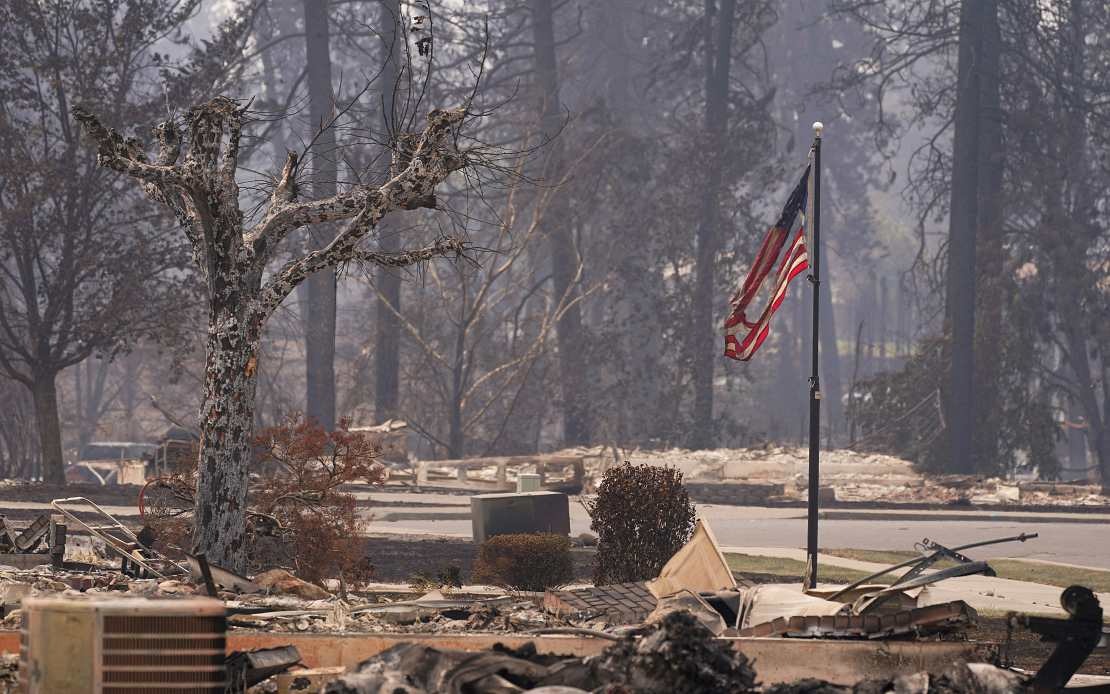
Catastrophic wildfires sweeping across Washington state have forced more than 65,000 people to abandon their homes as flames continue to consume vast tracts of land and residential properties. The American Red Cross confirmed the scale of the evacuation on Monday, while preliminary assessments from emergency officials indicate that the fires have already destroyed more than 700 structures, predominantly located across Spokane County. The unfolding disaster represents one of the state's most significant mass evacuations in recent memory, leaving thousands of families displaced and uncertain about the fate of their properties.
Law enforcement has moved swiftly in the investigation, with Spokane County Sheriff John Nowels announcing that a 37-year-old man identified as Aaron F. Farinacci was arrested on Monday afternoon and charged with first-degree arson. Farinacci was taken into custody with bail set at $1 million, and investigators have linked him to the Old Trails Fire, one of the multiple blazes currently threatening communities across the region. The arrest marks a significant development in understanding the origins of at least one of the destructive fires, though authorities continue to investigate the causes of other active blazes in the area.
The fires nearest to Spokane and Stevens counties have already consumed 8,026 acres since Saturday, according to data from interagency tracking system InciWeb, yet remain completely uncontained. Fire incident management teams report that marginally improved weather conditions over recent days have allowed crews to establish better positions along fire lines, offering some cautious optimism for containment efforts. However, the percentage of containment remains at zero, underscoring the volatile and unpredictable nature of the disaster as flames continue to advance through densely forested terrain and populated areas.
The threat extends well beyond the immediate Spokane area, with larger fires posing even graver risks to surrounding communities. The Sinlahekin fire has explosively grown to 85,000 acres since being triggered by lightning on July 26, deploying more than 820 personnel in desperate suppression efforts. This massive blaze similarly shows zero containment, meaning firefighters remain in a purely defensive posture, focused on protecting structures and evacuation routes rather than expanding the perimeter of control. Northwest of Leavenworth, the Little Giant Fire has scarred the landscape for 51,298 acres within the Okanogan-Wenatchee National Forest, further stretching already thin firefighting resources across the state.
Governor Bob Ferguson reported that authorities have successfully located and accounted for nearly all individuals who requested assistance during evacuations. However, officials remain in contact attempts with 14 people whom they have not yet verified as safe, though Ferguson emphasized these individuals are not considered missing persons. Rather, the state's emergency management teams are conducting routine welfare checks to ensure their wellbeing during the crisis. Reassuringly, the governor confirmed that no deaths have been confirmed at this stage of the disaster, though the rapidly evolving situation means that assessment could change as officials gain fuller picture of impacts across all affected areas.
The scale of evacuation across Washington reflects the unprecedented ferocity of multiple simultaneous fires during a particularly volatile fire season. For regional observers and disaster management professionals, the situation illustrates vulnerabilities in modern American infrastructure when extreme weather patterns coincide with large residential populations in fire-prone zones. The involvement of arson charges adds a criminal dimension to what would otherwise be characterized as a natural disaster, raising questions about fire prevention, community safety protocols, and the adequacy of early warning systems.
For Southeast Asian readers accustomed to monsoon-driven fire seasons in countries like Indonesia and Malaysia, the Washington fires offer a sobering reminder of how different climatic regions experience distinct wildfire patterns. While equatorial zones typically see fires concentrated during dry seasons aligned with monsoonal cycles, North American summers increasingly generate unpredictable fire conditions driven by heat domes and drought. The scale of evacuations—65,000 people—dwarfs most disaster scenarios in the region and highlights the exponential challenges facing emergency services when fires threaten sprawling suburban and exurban development patterns characteristic of American landscape planning.
The arrest of Farinacci underscores law enforcement's rapid investigative response, though it also raises broader questions about fire prevention education and community awareness. In densely populated fire-prone regions, intentional fire-setting remains a recurring threat alongside natural ignition sources. The investigation will likely inform future safety campaigns and enforcement strategies, particularly as climate change extends fire seasons and increases ambient temperatures that facilitate rapid fire spread across vulnerable landscapes.
Emergency response coordination involving the American Red Cross, county sheriffs, state forestry agencies, and federal fire management teams demonstrates the multi-layered mobilization required during large-scale disasters. The successful accounting for nearly all evacuees reflects established protocols and communication systems, yet the challenge of locating 14 individuals illustrates how chaotic conditions can create information gaps even amid coordinated response efforts. As fires continue burning and weather patterns remain uncertain, officials acknowledge that the situation remains fundamentally unstable and subject to rapid deterioration or improvement depending on meteorological and operational factors.

