Negeri Sembilan's security apparatus is preparing for an unprecedented early voting exercise tomorrow, with the Election Commission facilitating ballots for over 22,000 military and police personnel ahead of the state election proper. The decision to allow uniformed services and their families to vote four days before the scheduled August 1 polling day reflects logistical realities in conducting elections across a geographically dispersed defence and law enforcement establishment. This arrangement, while routine in Malaysian electoral practice, underscores the administrative complexity of managing simultaneous voting across multiple institutional bases.
The breakdown reveals 16,884 military personnel and their spouses will utilise the early voting facilities, while 5,455 police officers and family members will do the same. This two-to-one ratio of armed forces to civilian police voters reflects the significant military presence in Negeri Sembilan, a state where defence installations have historically influenced the demographic and political landscape. The sheer numbers involved—collectively representing a politically engaged population segment whose voting patterns often prove decisive in closely contested seats—underscores why election officials have structured this process with meticulous attention to logistics and accessibility.
The Election Commission has established 38 early polling centres throughout the state, demonstrating considerable preparatory effort to accommodate dispersed security personnel. Notable venues include the Army Basic Training Centre in Port Dickson, the Negeri Sembilan police contingent headquarters, Sendayan Air Base in Seremban, and the Nilai District Police Headquarters. This distribution across major military and police installations ensures minimal disruption to operational duties while maximising voter participation. All centres will open uniformly at 8 am, though closing times will vary according to location-specific requirements, a flexibility that acknowledges the different operational schedules across defence establishments.
Weather patterns present an additional variable that election officials must navigate. The Malaysian Meteorological Department forecasts predominantly clear morning conditions across most of Negeri Sembilan, providing favourable conditions for the morning voting period. However, Port Dickson faces a more challenging meteorological outlook, with predictions of heavy rain and thunderstorms that could affect voter turnout at the Army Basic Training Centre. Afternoon conditions across the state are expected to deteriorate significantly, with heavy rain forecast across nearly all of Negeri Sembilan. These weather considerations, while seemingly incidental, carry real implications for voter participation rates and the logistical demands on polling centre staff managing weather-related contingencies.
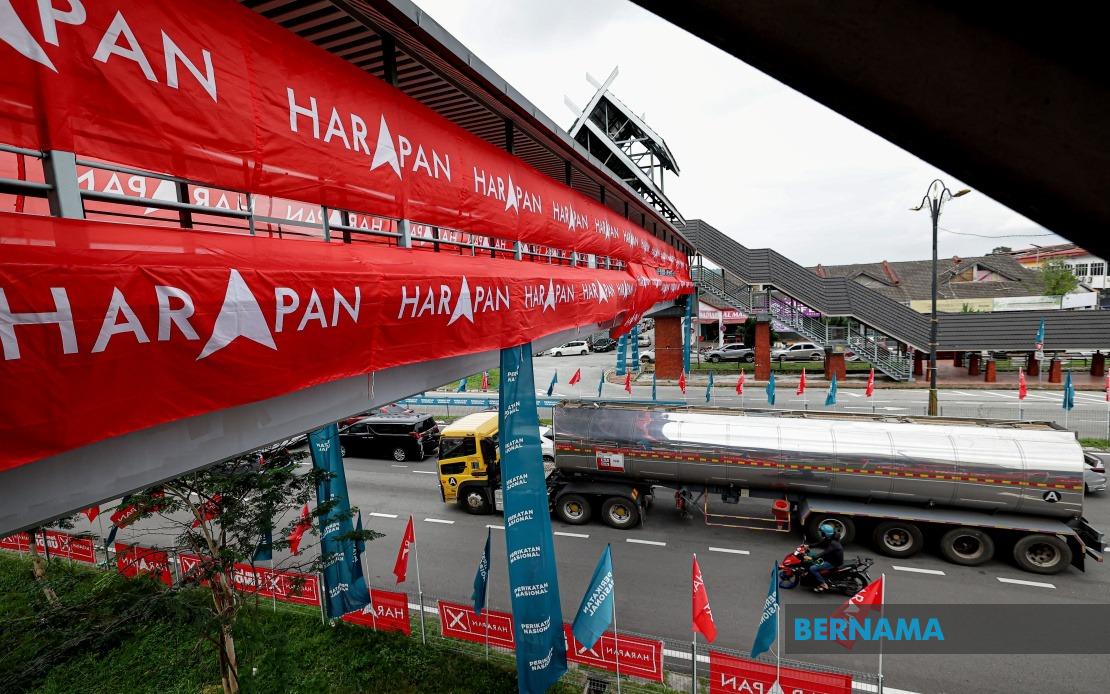
The broader electoral contest will determine representation across 36 state seats, with 103 candidates fielded by various coalitions and independent parties. Pakatan Harapan contests all 36 constituencies with a coordinated 36-candidate slate comprising 16 from PKR, 11 from DAP, and nine from Amanah, reflecting the coalition's attempt to consolidate opposition support. This comprehensive coverage signals confidence in challenging the incumbent administration across all districts. Barisan Nasional presents a more modest footprint, contesting only 25 seats through 16 UMNO candidates, seven from MCA, and two from MIC, suggesting a strategic concession of several constituencies deemed unwinnable or undefended.
Perikatan Nasional's participation introduces a significant variable into the competitive equation. The coalition fields 11 candidates across multiple parties—five from PAS, four from Parti Wawasan Negara, one from Gerakan, and one from the Malaysian Indian People Party—representing an attempt to establish itself as a credible third force in state politics. Bersatu's independent candidacy of 24 nominees reflects the party's strategy of pursuing a separate electoral path rather than aligning with established coalitions. Smaller parties including ASLI, PSM, and Berjasa collectively field nine candidates, demonstrating grassroots political engagement even among marginal political formations.
The dissolution of the Negeri Sembilan State Legislative Assembly on June 5 initiated this electoral cycle, with the EC subsequently announcing August 1 as polling day. This timeline provides candidates approximately one month for campaigning, a compressed schedule that concentrates electoral activity and heightens media visibility. For voters in Negeri Sembilan, the compression creates an intensity of political messaging and candidate engagement that differs markedly from longer electoral campaigns typical in other democracies. The early voting arrangement for security personnel thus represents an important initial phase of a broader democratic exercise that will determine the state's political direction for the next five years.
For Malaysian political observers, the Negeri Sembilan contest carries implications extending beyond state boundaries. The election serves as a barometer of voter sentiment regarding federal political alignments, with results potentially signalling shifts in support for Pakatan Harapan or indicating Perikatan Nasional's capacity to consolidate support in non-peninsular strongholds. The security personnel voting bloc, while not determinative, represents a constituency whose political leanings often reflect broader societal trends, particularly regarding national governance and institutional stability concerns. Their participation tomorrow will provide early signals regarding overall electoral momentum before the full populace votes on August 1.
Logistically, the early voting exercise demonstrates Malaysian electoral administration's increasing sophistication in accommodating diverse voter circumstances while maintaining integrity and accessibility. The standardised 8 am opening times, despite location-specific closing arrangements, reflect best practices in electoral administration that balance uniformity with flexibility. For security personnel themselves, the arrangement offers meaningful voting access without compromising operational readiness, a practical accommodation that reinforces inclusive democratic participation. As Negeri Sembilan moves toward August 1, tomorrow's early voting will set procedural and political patterns that the state's Electoral Commission will monitor closely for lessons applicable to future exercises.

