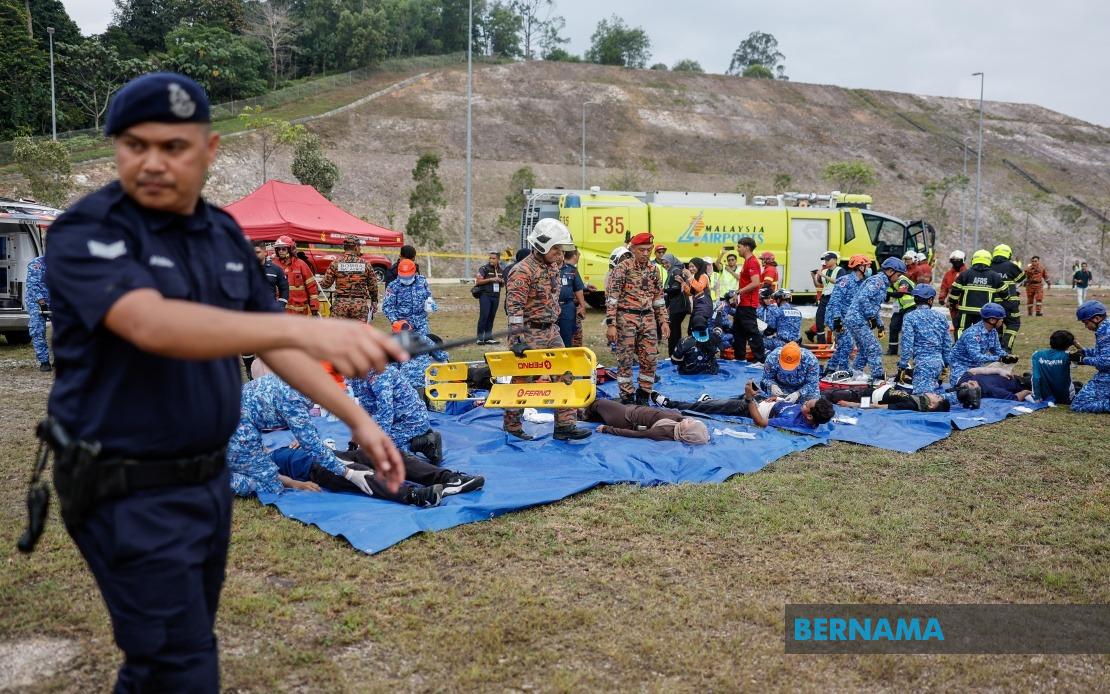
On July 16, Malaysia conducted one of its most comprehensive aviation emergency exercises to date, with more than 20 enforcement and emergency response agencies participating in Ex Urban Falcon 2026. The full-scale simulation, held at the Denai Alam Rest and Service Area along the Damansara-Shah Alam Elevated Expressway, represented a significant shift in disaster preparedness planning by focusing on scenarios where aircraft accidents occur beyond airport boundaries rather than within controlled airfield environments.
The exercise centred on a hypothetical ATR72 aircraft incident occurring approximately six kilometres from Sultan Abdul Aziz Shah Airport in Subang. This distance is strategically meaningful because it falls within the eight-kilometre radius of responsibility established under the National Aeronautical Search and Rescue Manual for Airport Fire and Rescue Services operations. Muhammad Hidayat Ismail, general manager of AFRS, emphasised that the drill aimed to validate Malaysia Airports Holdings Berhad's operational readiness and test whether multiple responding agencies could effectively coordinate emergency operations under the aerodrome emergency plan when an accident extends beyond the airport's direct control zone.
What distinguishes this exercise from previous training initiatives is its unprecedented focus on extra-territorial crash scenarios. Historically, Malaysia's aviation disaster drills have concentrated on incidents occurring near airport boundaries or within airport property itself. By moving the simulation six kilometres away to a commercial rest area adjacent to a major expressway, organisers created a more complex operational environment that better reflects genuine emergency conditions. This geographical choice immediately introduced realistic complications that responders would genuinely face during an actual incident, transforming the exercise from a controlled airport scenario into something substantially more challenging.
The logistical realities of responding to an off-airport crash present distinct obstacles that urban airports rarely confront. Emergency teams must navigate through populated areas, contend with existing road infrastructure including multiple toll plazas, and manage access along roads designed for civilian traffic rather than emergency vehicles. Muhammad Hidayat identified these narrow roads and toll booth passages as the exercise's primary challenge, highlighting how geography can significantly hamper response times. The simulation exposed potential delays in reaching disaster scenes that would be measured in minutes but could translate to meaningfully different outcomes for survivors requiring immediate medical intervention.
Another critical distinction emerged regarding victim survival prospects. Aircraft accidents occurring within airport zones, where emergency infrastructure exists immediately on-site and response teams can deploy within seconds, generally offer higher survival rates. Conversely, crashes in off-airport locations with irregular terrain often result in lower survival proportions among total casualties. This reality shaped the exercise's design to reflect scenarios where survivors might be significantly outnumbered by fatalities, a sobering reality that demands different resource allocation and operational approaches than airport-based incidents. Rescue teams were therefore trained to manage situations where victim identification and casualty processing become the dominant operational focus rather than concurrent rescue extraction.
Disaster Victim Identification operations led by the Royal Malaysia Police formed a crucial component of the simulation. These operations require meticulous coordination with medical examiners, forensic specialists, and database managers to systematically identify deceased victims—a process that becomes exponentially more complex when aircraft break apart across outdoor terrain. The exercise provided participating agencies, including police, medical services, and civilian authorities, with realistic training for managing mass casualty identification when victims are dispersed across an expansive outdoor area rather than contained within airport facilities.
Technological capabilities featured prominently in the preparation framework. Muhammad Hidayat noted that Malaysia currently operates aircraft firefighting vehicles built to international specifications established by both the International Civil Aviation Organisation and the Civil Aviation Authority of Malaysia. These specialized vehicles represent significant capital investment and embody contemporary technology standards for aviation safety. However, deploying such equipment beyond airport grounds introduces transmission, accessibility, and coordination challenges that technological sophistication alone cannot resolve.
The exercise involved 450 participants drawn from critical public and private sector agencies, reflecting the comprehensive inter-agency partnerships now essential for aviation disaster response. Malaysia Airports Holdings Berhad coordinated with the National Disaster Management Agency, the Selangor state government, and PROLINTAS-DASH, the private operator managing the expressway where the simulation occurred. This multi-stakeholder approach acknowledges that modern aviation disasters demand seamless cooperation across governmental levels, civilian infrastructure managers, and emergency services—a complexity that traditional airport-focused exercises might underestimate.
The findings and operational observations from Ex Urban Falcon 2026 are scheduled for systematic review at a workshop on July 26 and 27, where participating agencies will analyse performance data and identify specific improvement measures. This post-exercise analysis phase demonstrates mature crisis planning methodology, recognising that training value extends beyond the simulation itself to include structured evaluation and documented lessons learned. Such systematic review processes enable incremental strengthening of disaster response capabilities through evidence-based adjustments rather than ad hoc modifications.
Muhammad Hidayat characterised the comprehensive agency participation and demonstrated commitment as indicative of Malaysia's aviation safety culture. By voluntarily conducting demanding exercises that expose operational weaknesses, Malaysian authorities signal genuine investment in public safety and aviation security. The sustained commitment visible in Ex Urban Falcon 2026 represents more than procedural compliance; it reflects an institutional recognition that aviation disasters, however statistically rare, demand perpetually refreshed readiness. This preparedness mindset ultimately enhances public confidence in the nation's aviation safety framework and demonstrates that Malaysian aviation authorities maintain contemporary emergency response capabilities comparable to international standards.

