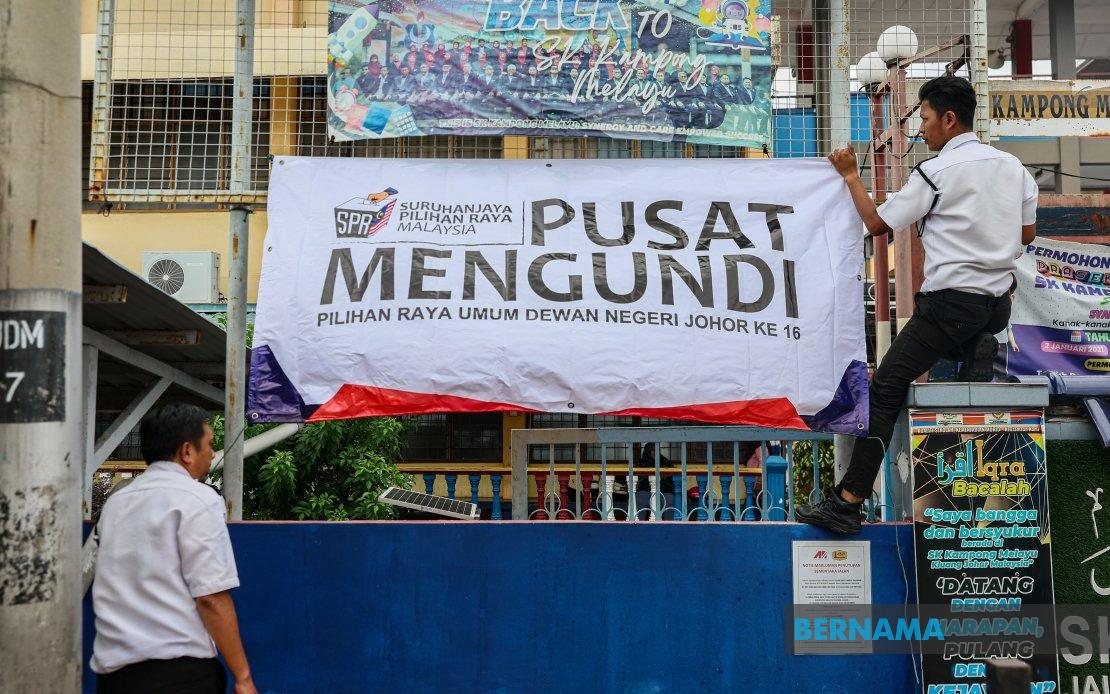
Johor held its 16th state election today, drawing more than 2.7 million eligible voters to polling stations across the southern state. The electoral exercise represents a significant democratic exercise for the region, with voters deciding which representatives would occupy all 56 seats in the State Legislative Assembly. The scale of the operation underscored the substantial administrative machinery required to conduct elections in Malaysia's second-largest state by population and economic significance.
Election officials synchronised the opening of voting stations across Johor at 8 am, establishing 1,076 polling centres staffed by a combined 4,889 voting streams to manage the anticipated voter flow. The Election Commission had mobilised 43,036 election workers throughout the state to ensure the polling process operated smoothly and efficiently. This extensive deployment of personnel reflected the scale and complexity of conducting a state-wide electoral exercise in Johor, which spans diverse geographic and demographic areas from urban centres to remote island communities.
The election concluded a two-week campaign period that had ended at midnight the previous evening. Throughout the contest, the state witnessed competing visions from eight different political parties and independent candidates totalling 172 contestants. The campaign reflected the increasingly fragmented Malaysian political landscape, with traditional power-brokers Barisan Nasional and Pakatan Harapan each fielding 56 candidates, while Perikatan Nasional brought 33 contenders and newer challengers including Parti Bersama Malaysia and MUDA presented alternative options to voters.
Voting arrangements accommodated Johor's geographic diversity, with polling stations closing in stages rather than simultaneously. Stations on the island of Pulau Besar were scheduled to close at 11 am, reflecting the practical need to facilitate ballot transportation from offshore locations. Pulau Aur and Pulau Pemanggil would close at noon, while mainland polling centres would remain open until 6 pm. This staggered closure allowed island communities to participate fully while managing the logistics of returning ballots to counting centres before the 6 pm deadline for postal votes.
The Election Commission targeted a voter turnout of approximately 70 per cent, a significant increase from the 2022 state election which recorded participation of 54.92 per cent. If achieved, such a turnout would suggest heightened engagement among Johor voters compared to the previous electoral cycle, potentially reflecting changing political dynamics or voter mobilisation efforts. Election officials anticipated completing the vote-counting process and announcing full results by 10 pm, allowing the state to know its electoral outcome the same evening.
Early voting had already occurred on Tuesday, when 20,607 members of security forces—police and armed forces personnel together with their spouses—exercised their franchise. This advance voting mechanism accommodated the operational requirements of uniformed services and reflected standard Malaysian electoral practice. The accumulated early votes would form part of the final tally, though counting of these ballots typically proceeded alongside regular polling station results.
Weather conditions presented a variable backdrop across different regions of Johor on polling day. The Malaysian Meteorological Department had forecast morning rainfall in urban areas including Johor Bahru, Batu Pahat, Kulai, Muar, Pontian and Tangkak, with conditions improving toward afternoon and evening hours. Afternoon thunderstorms were predicted for Kluang, Kota Tinggi and Segamat, while Mersing would experience similar weather disturbances extending into the evening. These weather patterns potentially affected voter convenience and turnout patterns, though officials had no indication they would materially disrupt the polling process.
Employer cooperation formed an important element of election day logistics. The Election Commission had reminded businesses and organisations to grant employees reasonable time away from work to fulfil their voting obligations. This reminder reflected recognition that without workplace flexibility, many voters might struggle to reach polling stations during the prescribed hours, potentially suppressing turnout among the working population.
The political landscape entering this election reflected significant recent changes in Johor's legislative composition. Before the state assembly was dissolved on June 1, Barisan Nasional controlled the majority with 40 seats, while Pakatan Harapan held 12 seats, Perikatan Nasional occupied three seats and MUDA retained one. The election would determine whether this existing balance persisted or whether voters would deliver a mandate shift toward contenders positioning themselves as alternatives. The contest would significantly influence the trajectory of Johor politics and potentially signal broader trends affecting Malaysian state and federal politics more generally.
For Malaysian observers, the Johor election held broader significance beyond the state itself. Johor remains economically crucial to Malaysia, serving as a major industrial, commercial and trading hub. Election outcomes would influence the state government's policy direction on taxation, investment promotion, labour relations and economic development—matters affecting not only Johor residents but regional economic activity and cross-border trade with Singapore. The composition of the state assembly would thus have ripple effects throughout Malaysian business and political circles watching to interpret what voter decisions in Johor signalled about national political trends.

