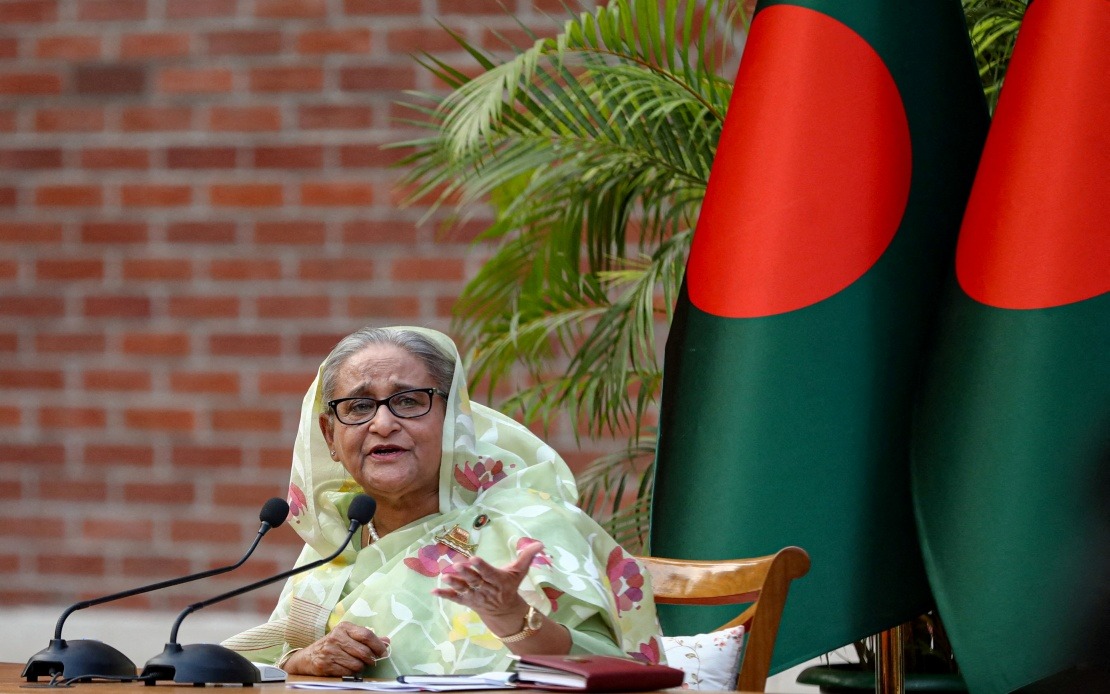
Sheikh Hasina, the 78-year-old former prime minister of Bangladesh, has publicly committed to returning to her country and submitting herself to judicial proceedings, even as she faces a capital punishment verdict handed down in absentia. In remarks conveyed through a written interview with Kyodo News, Hasina acknowledged the perilous circumstances surrounding her potential homecoming, stating plainly that authorities might imprison her or seek her execution, yet she remains resolved to face her accusers in court.
Hasina fled Bangladesh in August 2024 during the height of civil unrest triggered by massive student-led demonstrations against a court decision that restored a 30 percent employment quota for descendants of veterans from the nation's 1971 independence war. What began as protests against job quota policies rapidly evolved into a broader uprising against her government, with clashes between demonstrators and security forces claiming an estimated 1,400 lives according to United Nations assessments. The former premier has consistently disputed responsibility for the deaths, characterizing the movement as orchestrated by political adversaries intent on destabilizing her administration.
Following her departure, Bangladesh's war crimes tribunal convicted Hasina in November 2025 of crimes against humanity stemming from the security response to the unrest. The trial proceeded without her physical presence, a procedural aspect that has drawn scrutiny from international human rights organizations. Human Rights Watch, while affirming that those accountable for abuses during Hasina's tenure should face proper accountability, has expressed reservations about conducting capital trials in absentia, raising fundamental questions about due process and judicial fairness that resonate across Southeast Asia.
Currently residing in India, Hasina has become the subject of an extradition request from Bangladesh's current government. India's Ministry of External Affairs confirmed receipt of the request and indicated it was reviewing the matter through the lens of applicable legal and judicial frameworks. This development places New Delhi in a diplomatically sensitive position, balancing its historical ties with Bangladesh against established legal protocols governing the treatment of political asylum seekers. For Malaysia and other regional nations, the situation underscores ongoing tensions regarding how states handle displaced political leaders and the complexities of extradition arrangements in South Asia.
The current administration in Dhaka, led by Prime Minister Tarique Rahman of the Bangladesh Nationalist Party following the February 2026 elections, has signaled its determination to bring Hasina to trial. Zahed Ur Rahman, serving as information adviser to the prime minister, declared at a July press briefing that the government was committed to ensuring Hasina's return and would guarantee her opportunity to mount a legal defense. This public reassurance, while ostensibly addressing international concerns about fair proceedings, reflects the political stakes involved in a nation still navigating its transition away from Hasina's decade-and-a-half of governance.
Hasina's political career spans multiple terms as prime minister, with her influence shaping Bangladeshi governance from June 1996 to July 2001 and again from January 2009 until her recent departure. Her tenure witnessed significant security incidents, including the July 2016 attack on Holey Artisan Bakery in Dhaka, where 20 hostages perished—predominantly foreign nationals including Japanese employees working on Japan-funded infrastructure projects. The incident underscored Bangladesh's vulnerability to militant activity and tested her government's counterterrorism capabilities. Seven Islamist militants were initially sentenced to death, though their sentences were later commuted to life imprisonment, illustrating the complexities surrounding security responses during her administration.
In her recent statements, Hasina has called for independent forensic investigation into the circumstances surrounding the deaths during the 2024 unrest, proposing that international experts examine the evidence to establish factual accountability. This proposal reflects her broader contention that the current legal proceedings are driven by political calculation rather than impartial justice. She has positioned herself as a victim of weaponized judicial processes, a narrative that carries particular weight in a region where transitions of power frequently entail legal action against deposed leaders. The tension between accountability and vengeance in post-conflict transitions represents a persistent challenge throughout South and Southeast Asia.
The interim government that assumed power following Hasina's departure was anchored by Muhammad Yunus, the Nobel Peace Prize laureate who served as chief adviser before the February 2026 elections. This transition marked a significant departure from Hasina's Awami League dominance, which has been comprehensively marginalized through a ban on all party activities implemented in May 2025. The electoral victory of the Bangladesh Nationalist Party established a fundamentally altered political landscape, wherein the previous ruling establishment has been effectively removed from institutional participation. This reconfiguration of power carries implications for regional stability and democratic norms in South Asia.
Hasina's assertions regarding Bangladesh's future development emphasize the nation's importance to broader regional interests and international partnerships. She referenced the significance of stability for South Asia, the Bay of Bengal region, and development partners including Japan, which has invested considerable resources in Bangladeshi infrastructure projects. This framing situates her personal and political circumstances within a larger conversation about regional prosperity and international cooperation. For Malaysian policymakers and observers, Hasina's emphasis on the interconnectedness of Bangladesh's fate with regional development trajectories highlights how internal political upheaval in neighboring countries can affect broader Southeast Asian dynamics.
Crucially, Hasina has articulated a vision of national reconciliation that distinguishes between forgiveness and accountability, asserting that healing must not come at the expense of justice. She stated that Bangladesh requires reconciliation, yet this cannot extend to granting impunity for those responsible for crimes. This conceptualization reflects ongoing international debates about transitional justice mechanisms and the difficulty of balancing social cohesion with the imperatives of holding perpetrators accountable. The principle she articulates—that recovery and renewal depend on democratic restoration and popular sovereignty—represents a challenge to the current Bangladeshi administration regarding the legitimacy and inclusivity of ongoing judicial proceedings.
The broader implications of Hasina's situation extend throughout Southeast Asia, where questions of political accountability, judicial independence, and the treatment of deposed leaders remain unsettled. Malaysia has navigated its own transitions involving former prime ministers, making the Bangladesh experience instructive for understanding regional patterns of political succession. The willingness of governments to pursue capital charges against exiled leaders, combined with the international extradition dimensions, creates precedents that affect how neighboring countries contemplate their own political transitions and the legal frameworks governing them.
Hasina's declaration that she will return home represents either a genuine commitment to facing trial or a strategic rhetorical position designed to rehabilitate her international standing while remaining safely ensconced in Indian asylum. Regardless of her ultimate intentions, her case exemplifies the precarious position of ousted Asian leaders navigating exile, extradition proceedings, and the politicization of justice systems. As Bangladesh continues its post-Hasina trajectory under new leadership, the resolution of her status will send significant signals about the country's approach to accountability, the rule of law, and the treatment of political adversaries in transitional contexts.

