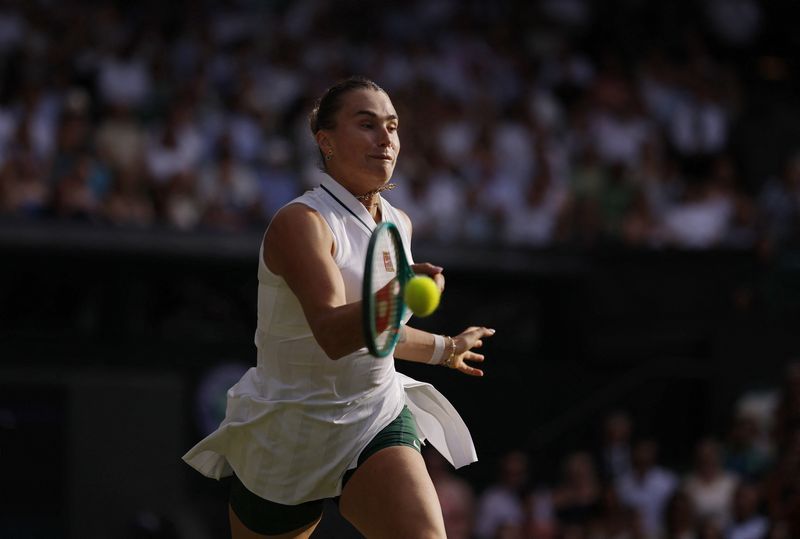
Naomi Osaka produced a commanding performance to eliminate top-seeded Aryna Sabalenka from Wimbledon on Sunday, securing a 6-2 7-6(2) victory on Centre Court and fundamentally reshaping the women's championship landscape. The clash between two former Grand Slam champions who collectively boast eight major titles proved far less competitive than expected, with Osaka's 14th-ranked status belying her authoritative display that left Sabalenka visibly frustrated throughout the encounter.
The Belarusian world No. 1 struggled to establish her trademark aggressive baseline game from the outset, losing the opening set in a brisk 32 minutes as her power strokes repeatedly misfired. Sabalenka's mounting frustration became evident as the first set progressed, a sharp contrast to Osaka's composed and clinical execution. The Japanese player's superior positioning and devastating returns of serve repeatedly placed Sabalenka on the back foot, breaking her opponent's service twice and never relinquishing control of the proceedings.
While the second set offered spectators closer competition as Sabalenka regained some composure, Osaka maintained her equilibrium and composure when it mattered most. Demonstrating remarkable poise under pressure, the 26-year-old Japanese star dismantled Sabalenka's previously formidable Grand Slam tiebreak record, snapping her opponent's extraordinary streak of 21 consecutive tiebreak victories at major tournaments. This victory marked Osaka's most significant achievement since her return to professional tennis in 2024 following the birth of her daughter Shai, underscoring the trajectory of her competitive resurgence.
Sabalenka's emotional response to losing the tiebreaker revealed the intensity of the moment, as she unleashed her frustration by blasting a ball far beyond the stadium after squandering a match point opportunity. The 28-year-old later acknowledged her subpar performance during her press conference, held just minutes after leaving the court, with a candid assessment that she needed respite from the sport. Her defeat represented a particularly cruel turn of events, arriving after she had successfully navigated three consecutive Wimbledon semi-final appearances without securing the title.
Oska's progression to her first Wimbledon quarter-final arrival carries profound significance beyond the individual match result. With defending champion Iga Swiatek and second seed Elena Rybakina both suffering third-round exits on Saturday, the tournament's top three seeds are now completely eliminated from title contention. This unprecedented situation has effectively opened the draw wide, creating unprecedented opportunities for lower-seeded competitors and entirely redistributing the perceived hierarchy of the women's championship.
Both players share a common foundation as exceptional hardcourt specialists, each having accumulated four Grand Slam titles exclusively on hard surfaces before this encounter. However, their career trajectories have diverged significantly despite being born merely seven months apart. Osaka reached the pinnacle of the sport earlier, capturing all four of her major championships before Sabalenka eventually secured her first Grand Slam victory. Their Sunday encounter marked only their second meeting at a Grand Slam level, with their previous clash occurring eight years earlier when Osaka triumphed on her path to the U.S. Open championship.
Oaka's tactical superiority was particularly evident in her return-of-serve execution, which consistently disrupted Sabalenka's service rhythm and prevented the Belarusian from establishing the first-strike dominance that typically characterizes her game. Breaking serve twice in the opening set proved decisive, as Osaka never afforded her opponent opportunities to regain momentum. The Japanese player's willingness to absorb pressure and maintain her strategic approach throughout the match demonstrated maturity and competitive intelligence that transcended mere technical skill.
The Tokyo-born competitor has generated considerable attention for her distinctive Japanese-inspired walk-on attire that reflects her cultural pride and individual style. However, Sunday's performance illustrated that her evolving tennis prowess is equally compelling, catching the attention of observers and analysts who have monitored her comeback trajectory. Osaka's ability to perform under the most demanding circumstances, on tennis's most hallowed grass court, signals a player determined to reclaim her position among the sport's elite competitors.
Despite Sabalenka's attempts to energize herself through characteristic displays of competitive emotion—including striking her racket against her head early in the second set—she never managed to locate the rhythm necessary for mounting a serious comeback challenge. Osaka's unwavering composure and refusal to become rattled by her opponent's psychological strategies ultimately proved decisive. The Japanese star powered through the second-set tiebreak without hesitation, establishing her quarter-final appointment with Czech 10th seed Karolina Muchova.
Oaka's landmark victory represents a significant turning point in this year's Wimbledon narrative, transforming what appeared to be Sabalenka's championship to lose into an entirely open competition. The elimination of the tournament's top three seeds within four days has created conditions where numerous contenders suddenly possess realistic title aspirations. This development carries broader implications for women's professional tennis, demonstrating that even the most dominant competitors can be toppled by inspired performances from players ranked considerably lower in the current standings.

