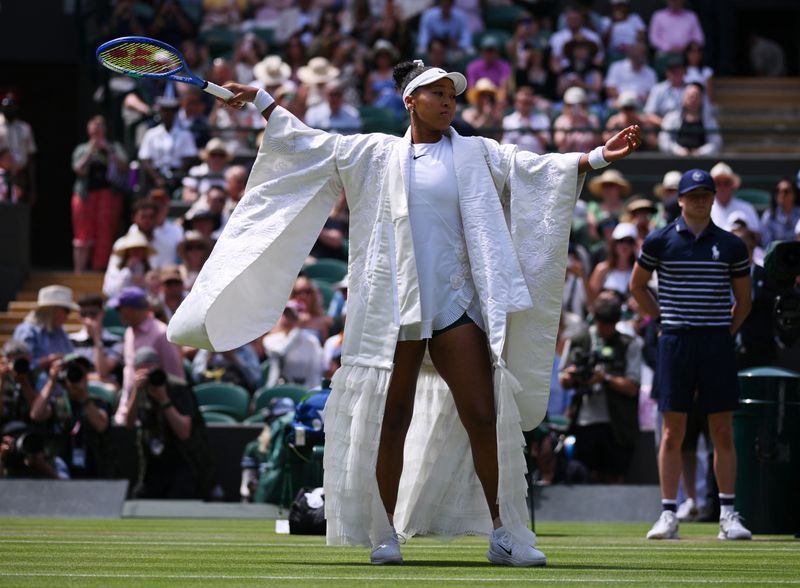
Naomi Osaka has cemented her presence as a force at this year's Wimbledon Championships, dispatching unseeded opponent Daria Kasatkina 6-1 6-3 on Friday to secure a berth in the tournament's final sixteen—her best performance to date at the prestigious London venue. The Japanese four-times Grand Slam champion, seeded 14th, combined her trademark stylish court presence with a display of controlled aggression that left little room for her Russian-born rival to mount a meaningful challenge across the two sets.
Osaka has become synonymous with tennis fashion during the opening week at the All England Club, drawing considerable media attention for her eclectic selection of eye-catching ensembles. Her arrival on Court One saw her sporting another iteration of her thematic "Kill Bill" inspired kimono outfit, this time rendered in a delicate floral pattern. Yet what distinguishes her campaign this fortnight is the remarkable parity she has achieved between her celebrated aesthetic choices and the competitive mettle she displays within the lines. The narrative has shifted from one predominantly focused on what Osaka wears to genuine intrigue surrounding her technical capabilities on grass, a surface where consistency has historically eluded her.
The match itself unfolded as a masterclass in controlled dominance from the opening service game. Osaka broke Kasatkina immediately, employing a devastating backhand winner that set the tone for what would become a relentless first set. She compounded this advantage moments later with a deeply struck forehand that extended her lead to a double break, allowing her to cruise through the opening set in just over twenty minutes on the sun-bathed expanse of Court One. Kasatkina, despite her unseeded status and lack of Grand Slam pedigree, found herself unable to establish any rhythm against an opponent wielding both precision and power with discernible confidence.
The second set presented a different narrative, revealing the competitive nature that underpins Osaka's temperament. After establishing an commanding position, she squandered her early advantage, allowing Kasatkina to claw back into contention. This moment proved pivotal, as Osaka rallied magnificently to reassert her authority. She raised two match points before clinching the contest in commanding fashion, demonstrating the mental fortitude required to navigate such fluctuations at a Grand Slam venue. Her ability to recover from adversity and finish decisively illustrates her evolving maturity as a competitor.
Immediate post-match commentary from Osaka revealed a player conscious of the significance of her achievement at this particular venue. She acknowledged her previous struggles at the All England Club, expressing genuine elation at having created what she termed "a really good memory" on Court One. Her gratitude extended to the crowd, whose vociferous support appeared to energize her performance throughout the encounter. These remarks underscore a player who, having stepped back from professional tennis for extended periods to address personal and mental health challenges, has reconnected with the intrinsic joy that competition provides.
The Japanese champion referenced her competitive schedule across the grass court season preceding Wimbledon, noting that her recent tournament appearances at Bad Homburg—where she reached her inaugural grass court final before withdrawing due to injury—had built confidence and rhythm essential for performing at the highest level on this surface. This extended preparation stands in sharp contrast to previous years when she arrived at the All England Club without sufficient match practice on grass, invariably contributing to premature exits. The deliberate groundwork has yielded tangible results, positioning her as a genuine contender for a deeper run through the draw.
Osaka's next opponent will emerge from the ongoing contest between world number one Aryna Sabalenka and former French Open champion Jelena Ostapenko. The prospect of facing either competitor underscores the formidable challenge that awaits in the round of sixteen. Sabalenka's dominance across multiple surfaces this season positions her as the default favorite, while Ostapenko's explosive baseline game and Grand Slam experience represent an equally potent threat. Regardless of which player prevails, Osaka can enter that fixture with demonstrated confidence, having dismantled a competent opponent without surrendering momentum.
For Malaysian and Southeast Asian observers of professional tennis, Osaka's trajectory carries particular resonance. Her willingness to prioritize mental wellness whilst maintaining professional ambitions resonates across a region increasingly attuned to the importance of mental health advocacy. Her return to elite competition, marked by performances such as Friday's dismissal of Kasatkina, demonstrates that prolonged absence from professional sport need not signal career diminishment. Furthermore, her ability to sustain commercial relevance and fashion influence whilst competing at the highest level offers a different paradigm for how female athletes can construct multifaceted public personas without sacrificing competitive credibility.
The broader implications of Osaka's resurgence at Wimbledon extend beyond individual tournament results. Her presence as a seeded player competing meaningfully in the second week represents a recalibration of expectations surrounding her career trajectory. That she achieves this whilst maintaining the distinctive personal brand that extends to fashion choices and public messaging suggests a more integrated approach to professional identity than sport has traditionally permitted. The alignment of her aesthetic expression with performance excellence—rather than these elements existing in tension—marks a potentially influential statement within women's professional tennis.

