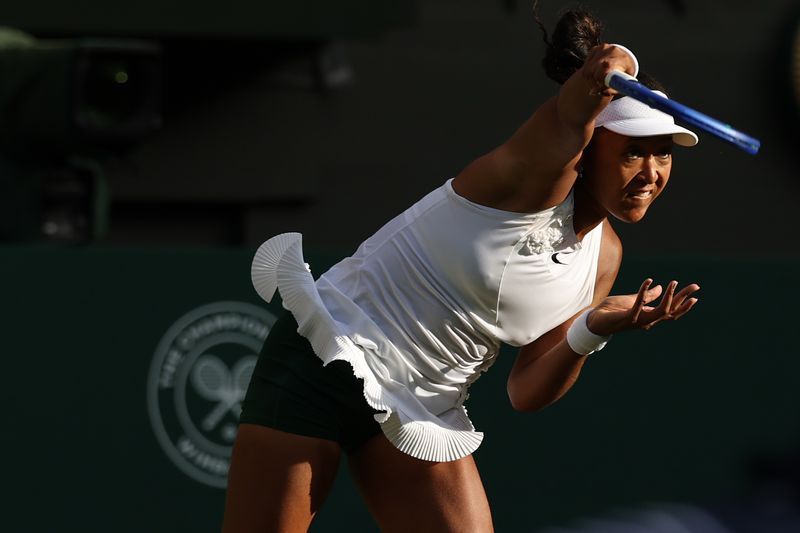
Naomi Osaka delivered a commanding performance to eliminate top seed Aryna Sabalenka 6-2 7-6(2) and secure a place in the Wimbledon quarter-finals for the first time in her career, capping a remarkable day seven at the All England Club with power and precision that harked back to her four Grand Slam championship campaigns. The Japanese 14th seed, who arrived at Centre Court in a kimono-inspired outfit drawn from Quentin Tarantino's Kill Bill, proved unstoppable against Sabalenka, whose error-strewn display saw her screaming in frustration as Osaka dominated throughout the match with sustained accuracy and controlled aggression.
Osaka's victory represents her biggest triumph since returning from maternity leave in 2024 and marks a significant turning point in their head-to-head record. The pair had not faced each other for nearly eight years following Osaka's 2018 U.S. Open triumph, but when they resumed their rivalry this season, Sabalenka had won three consecutive encounters. On grass at Wimbledon, however, the momentum shifted decisively, with Osaka's superior positioning and execution breaking down her opponent's usual dominant baseline game. She described the experience afterwards as a release of tension, noting that overcoming those three recent losses to Sabalenka had been particularly galling.
The result compounds what has become a historic collapse in the women's championship race, with the tournament now guaranteed a ninth successive first-time Wimbledon champion. Defending champion Iga Swiatek and 2022 winner Elena Rybakina both exited in the third round, while Czech fourth seed Barbora Krejcikova fell to compatriot Karolina Muchova 7-5 5-7 6-3 in the fourth round on Sunday. The removal of the top three seeds signals unprecedented parity in women's tennis at the grass-court Grand Slam, creating genuine intrigue about which unlikely champion will lift the trophy at the tournament's conclusion.
Muchova's victory over Krejcikova sets up an intriguing quarter-final matchup with Osaka, who indicated she intends to channel her renewed competitive fire into her remaining matches. When asked about her relatively restrained outfit choice for her Centre Court appearance, Osaka acknowledged she had deliberately toned down her usual fashion statements to maintain focus on her performance, suggesting she may continue this approach as she pursues a deeper run through the draw.
On the men's side, Novak Djokovic progressed to his seventeenth Wimbledon quarter-final, though the 39-year-old Serbian champion provided a stark contrast to Osaka's masterclass by grinding out an ungainly 7-6(6) 6-3 3-6 6-3 victory over Russian qualifier Roman Safiullin. Djokovic's four-set success came without the fluency or rhythm that typically characterises his grass-court dominance, and he was candid in his post-match assessment, admitting he had never truly settled into the rhythm of play and felt relief rather than satisfaction at escaping the court. The win nonetheless extended his men's record to 106 Wimbledon match victories, surpassing the legendary Roger Federer's previous mark and underscoring his remarkable longevity at the tournament.
Djokovic's path to a potential semi-final meeting with defending men's champion Jannik Sinner now runs through Canadian third seed Felix Auger-Aliassime, who emerged from an epic four-hour 26-minute battle with Spanish qualifier Alejandro Davidovich Fokina. The match, which concluded 6-7(4) 7-6(6) 6-3 6-7(2) 6-1, featured an angry confrontation at the net between the exhausted competitors, reflecting the intensity and frustration that marked their extended duel on the grass courts.
Polish eighth seed Hubert Hurkacz's tournament came to an abrupt and cruel end when he was forced to retire during the fifth set of his fourth-round encounter against German veteran Jan-Lennard Struff. Struff's presence in the quarter-finals at age 36 represents a remarkable achievement for the veteran, marking his first appearance in a Grand Slam quarter-final despite decades competing on the professional circuit. The narrative of unexpected runs and breakthrough performances continues to define this year's championship.
The American contingent showed particular strength in the women's draw, with five American competitors advancing to the last sixteen, the largest representation from the United States since 2002. Among them, fourth seed Jessica Pegula demonstrated her experience advantage against 18-year-old Iva Jovic, securing a decisive 4-6 6-3 6-1 victory on Court One. Pegula's performance matched her best previous Wimbledon showing and positioned her for a potential all-American quarter-final clash, depending on the outcome of Coco Gauff's remaining fixture against Switzerland's Belinda Bencic.
The tournament landscape at the midway point reveals a compelling mix of established champions struggling to maintain their positions and fresh talent seizing opportunities created by unexpected exits. Osaka's resurgence from her maternity break, combined with the unseeded and lower-seeded players filling the void left by the departing top seeds, suggests the final rounds will feature unpredictable and potentially thrilling contests. For Malaysian and Southeast Asian tennis enthusiasts, Osaka's breakthrough carries particular resonance, as her return to form and her thoughtful approach to balancing personal goals with competitive excellence offers an inspiring narrative.
Djokovic's advancement, despite his own acknowledgment of substandard play, reinforces the principle that championship experience and mental fortitude can carry athletes through challenging matches. His record-breaking 106th Wimbledon win acknowledges his status as arguably the tournament's greatest modern champion, yet even he recognises that sustained excellence across a two-week Grand Slam requires executing at peak levels across multiple matches. The remaining quarter-finals promise to deliver matches between competitors fighting to claim what could be their sole Grand Slam title opportunity, a reality that should sharpen performances and provide compelling viewing for the sport's global audience.

