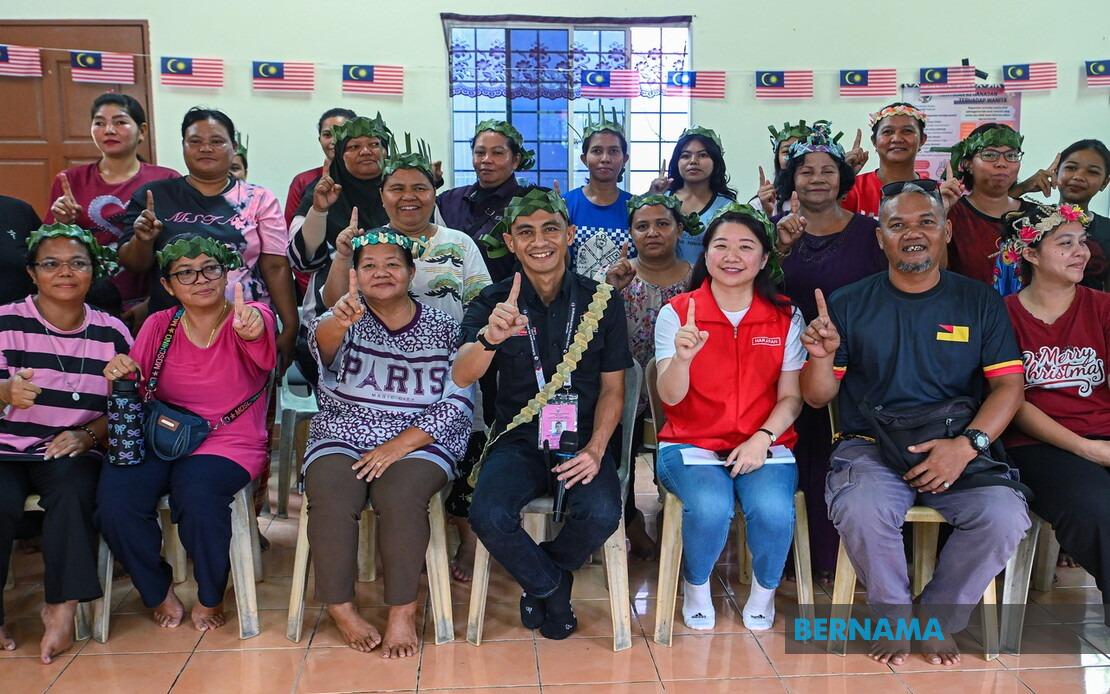
Datuk Ahmad Faez Abdul Razak, the Pakatan Harapan candidate contesting the Labu state seat in the upcoming Negeri Sembilan election, has positioned indigenous development as a cornerstone of his campaign platform. Speaking at an Orang Asli Women Empowerment programme in Kampung Orang Asli Tekir, Ahmad Faez outlined an ambitious agenda centred on raising living standards and creating sustainable economic pathways for the community through strategic infrastructure investment and targeted livelihood initiatives.
Among the most pressing matters Ahmad Faez intends to bring before the State Legislative Assembly is the thorny issue of customary land rights in Kampung Orang Asli Tekir, a longstanding grievance affecting indigenous land security and economic prospects. This commitment addresses a fundamental concern within Orang Asli communities across Malaysia, where land disputes and unclear tenure arrangements have historically hampered development efforts and created barriers to property-based economic participation. By elevating this issue to the state assembly level, Ahmad Faez signals recognition that land ownership and recognition form the bedrock upon which other development initiatives must rest.
Connectivity and basic services remain critical gaps in many indigenous settlements. Ahmad Faez has committed to upgrading essential infrastructure, particularly road networks and internet connectivity, recognising that physical and digital isolation perpetuates economic disadvantage. In an era where digital access increasingly determines economic opportunity, particularly for small-scale producers seeking market access, reliable broadband connectivity could unlock significant potential for remote communities. Road improvements similarly hold transformative potential, reducing transport costs for goods and enabling easier access to markets, healthcare facilities, and educational institutions.
Education and youth development feature prominently in Ahmad Faez's platform, reflecting demographic realities within Kampung Orang Asli Tekir, which has a population of 796 residents. The candidate emphasises that while young people within the community possess considerable untapped potential, they require targeted support to develop marketable skills and generate sustainable income. This framing acknowledges that talent and ambition exist across all communities, but structural barriers—limited access to training, mentorship, and capital—prevent realisation of that potential without deliberate intervention.
The candidate has identified handicraft production as a particularly promising avenue for economic diversification. Rather than envisioning static subsistence-level activities, Ahmad Faez proposes expanding the market reach of local artisan products, transforming what may currently be occasional or supplementary income into a primary livelihood. This approach requires investment not merely in production but in marketing infrastructure, quality certification, and distribution networks that connect village producers directly to regional and national consumer bases.
Modernising agricultural production forms another plank of Ahmad Faez's economic strategy. The introduction of fertigation systems—which integrate fertiliser delivery with precision irrigation—represents an uptake of contemporary farming techniques that can substantially increase yields while reducing water waste and input costs. For communities dependent on agriculture, adoption of such technologies could substantially improve productivity and make farming a more reliable income source, particularly relevant given Malaysia's tropical climate patterns and water availability challenges.
Ahmad Faez has sought to distinguish himself through consistent community engagement beyond electoral cycles. He emphasises that his involvement with Labu residents spans two years of groundwork, establishing what he characterises as an ongoing relationship rather than opportunistic politicking confined to campaign season. This framing attempts to build trust through demonstrated commitment, though voters will ultimately assess the credibility of such claims against tangible outcomes. In Malaysian electoral contests, such assertions of continuous grassroots engagement frequently feature prominently in candidate communications, serving as counter-narrative to opposition claims of fly-by-night election-season visits.
Kampung Orang Asli Tekir's village chief, Nasir Musil, has publicly validated Ahmad Faez's engagement levels, noting that the candidate distinguishes himself through frequent visits and concrete assistance. Nasir has articulated the community's own priorities: infrastructure development, economic advancement, and resolution of the stray cattle problem that poses ongoing safety hazards to residents. This alignment between candidate promises and community-articulated needs suggests at least surface-level understanding of local priorities, though the critical question remains whether electoral victory translates into materialisation of these commitments.
The electoral context shapes these development promises considerably. Ahmad Faez faces a three-cornered contest against incumbent Mohamad Hanifah Abu Baker representing Parti Pribumi Bersatu Malaysia and Siti Nur Umaira Hasim of Barisan Nasional. For a first-time contestant, Ahmad Faez must overcome the incumbent advantage typically enjoyed by sitting representatives while simultaneously navigating the complex dynamics of Negeri Sembilan state politics. Early voting is scheduled for 28 July, with polling day set for 1 August, providing limited time for campaign momentum-building.
The Orang Asli community occupies a distinctive position within Malaysian electoral politics. Collectively, indigenous communities represent a minority demographic, yet their concentrated settlement patterns in certain constituencies can yield significant electoral leverage. Candidates seeking these communities' votes must grapple with genuine development challenges—land insecurity, infrastructure gaps, limited economic opportunities, educational disparities—that transcend routine campaign rhetoric. The acid test for commitments like those articulated by Ahmad Faez will arrive not on election day but in the months following, when resource allocation decisions determine whether campaign promises become budgetary reality or fade into familiar patterns of unfulfilled electoral pledges.
The broader significance of Ahmad Faez's platform extends beyond Labu. His emphasis on indigenous development, customary land rights, skills training, and sustainable livelihoods reflects evolving recognition across Malaysian political parties that Orang Asli communities merit targeted policy attention. Whether framed through Pakatan Harapan's reformist lens or other political vehicles, developmental initiatives directed toward indigenous populations represent acknowledgment that historical policy neglect has created persistent disadvantage requiring deliberate corrective action. The 16th Negeri Sembilan state election will test whether such commitments resonate with voters and translate into meaningful policy implementation.

