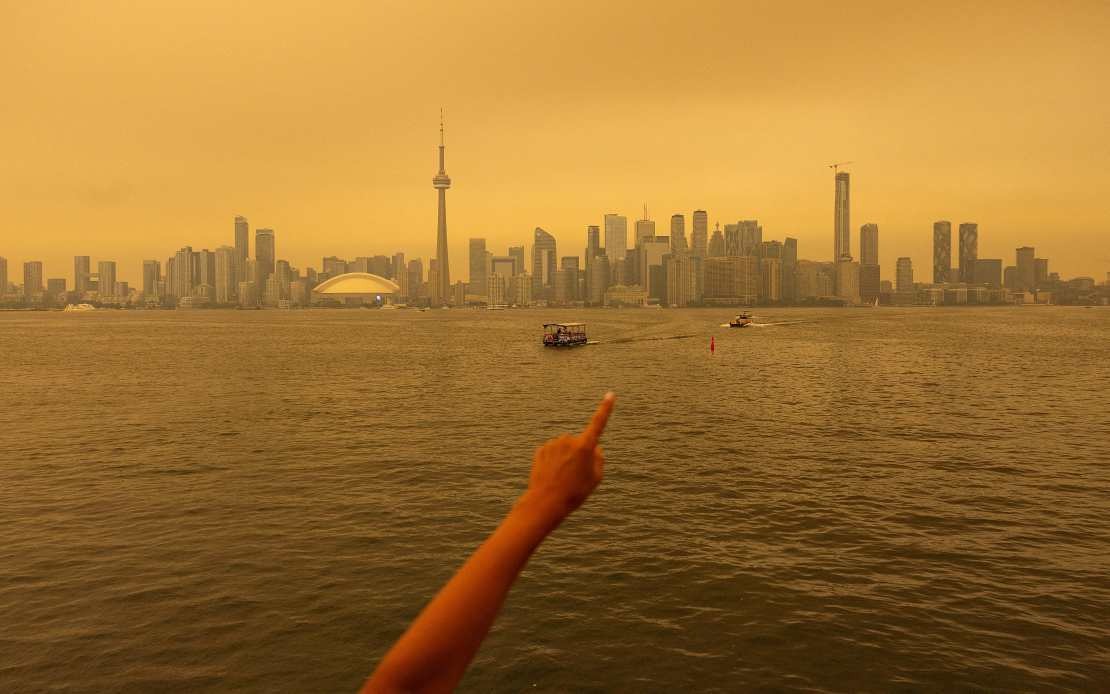
Catastrophic wildfires ravaging northwestern Ontario have transformed Canada's urban landscape into a haze of hazardous smoke, with the nation's largest city and capital now grappling with dangerous air quality levels not seen in recent years. The crisis, which intensified over the past week, extends beyond environmental concern into infrastructure disruption and public health emergency territory as authorities struggle to contain the spread and manage its cascading effects across the region.
Toronto, Canada's economic and cultural heart, found itself ranked among the most polluted cities globally on Wednesday morning when measured by air quality indices. Environment Canada's Air Quality Health Index classified the metropolis as operating under "very high risk" conditions, a designation that typically prompts health authorities to advise vulnerable populations—including children, elderly residents, and those with respiratory conditions—to remain indoors and limit outdoor exposure. The situation reflects an unprecedented convergence of wildfire smoke from remote areas colliding with urban population centres, a phenomenon becoming increasingly common as climate patterns shift across North America.
Ottawa, though further east than the fire zone, has not escaped the atmospheric assault. The nation's capital issued formal air quality alerts as meteorological conditions conspired to trap smoke particles at ground level. A particularly troubling factor involves humidity levels, which have remained elevated throughout the region. This moisture acts as a barrier, preventing smoke from dispersing vertically into the upper atmosphere and instead concentrating it where residents must breathe it. The consequence is a visibly altered skyline, with the sun obscured behind a yellowish veil that transforms daytime into a perpetual twilight.
The scale of the wildfire emergency underscores the severity of the situation. More than 100 active fires are currently burning across northwestern Ontario, a concentration that has necessitated the emergency evacuation of multiple communities. These are not isolated blazes but rather a widespread conflagration that overwhelms existing firefighting capacity and threatens to expand further if weather conditions favour rapid spread. Local authorities have activated emergency protocols, prioritising the safety of residents in threatened areas while attempting to establish perimeters around critical infrastructure.
A dramatic illustration of the fires' proximity to essential services emerged when Canadian National Railway released video footage captured by locomotive crew members late Monday near Armstrong, Ontario. The dramatic imagery shows towering flames engulfing forest on both sides of the railway line, with the intense red glow illuminating the locomotive cabin in an apocalyptic scene. The crew's safe evacuation and the footage's subsequent authentication by CN on Wednesday evening served as a stark reminder that these are not distant phenomena but immediate threats to the functioning of critical supply chains. Railway corridors form the backbone of Canadian freight and passenger transport, and any disruption cascades through regional and national economies.
Recognising the danger, CN announced a temporary suspension of operations along the affected section, a decision that reflects both safety imperatives and the practical impossibility of moving trains through active fire zones. This suspension carries significant ramifications for resource extraction, agricultural exports, and manufacturing supply chains dependent on rail transport. The economic impact extends beyond Ontario itself, affecting interprovincial commerce and cross-border trade relationships that depend on uninterrupted logistics networks. For Malaysian readers, such disruptions underscore how environmental crises in distant regions can eventually affect global commodity prices and supply availability.
Weather forecasting provides little near-term relief. Meteorological authorities have warned that prevailing airflow and wind patterns will likely sustain the heavy smog conditions for several additional days. This projection suggests that major urban centres will remain shrouded in unhealthy air quality longer than many anticipated. The persistence of these conditions means extended disruption to daily life—reduced visibility affecting traffic safety, school outdoor activities cancelled, construction projects paused, and healthcare systems preparing for increases in respiratory-related emergency visits.
The Ontario wildfire crisis exemplifies broader environmental vulnerabilities emerging across North America. Climate scientists have long predicted that warmer temperatures and altered precipitation patterns would increase wildfire frequency and intensity, yet the reality still shocks observers with its ferocity. What began as localized fires in remote forest regions has evolved into a transnational air quality emergency affecting millions of urban residents far removed from the ignition sources. This pattern—where environmental crises breach geographical and jurisdictional boundaries—reflects the interconnected nature of modern atmospheric systems.
For Southeast Asian observers, the Ontario situation carries cautionary implications. The region regularly confronts transboundary smoke from Indonesian and Malaysian forest fires, particularly during El Niño years when drought conditions intensify. The images of Toronto and Ottawa shrouded in smoke offer a preview of challenges that rapidly urbanising regions may face if forest management and fire prevention policies remain inadequate. The economic cost of air quality emergencies extends far beyond direct firefighting expenditures to include healthcare expenses, lost productivity, and damage to business and tourism sectors.
Canadian authorities face mounting pressure to articulate both immediate response measures and longer-term strategies. Short-term interventions focus on evacuation coordination, fire suppression resource mobilisation, and public health guidance. Longer-term considerations involve examining forest management practices, infrastructure resilience, and climate adaptation measures. The suspension of rail operations, while necessary, highlights how critical infrastructure vulnerability intersects with environmental hazards in ways that policy frameworks have yet to adequately address.

