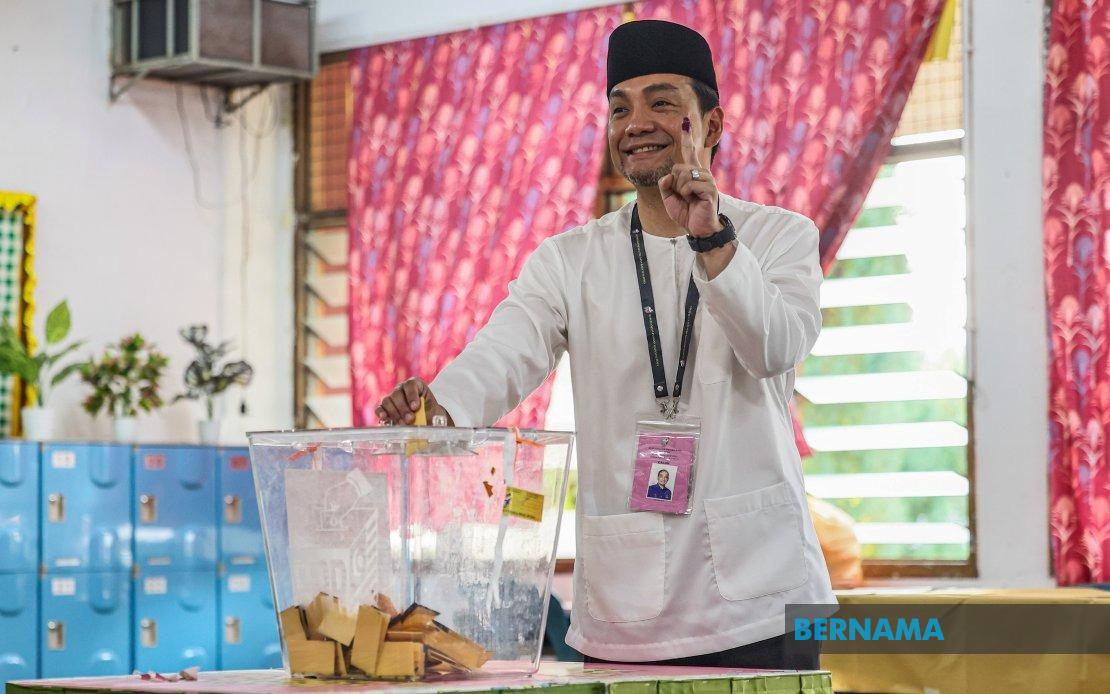
Johor Menteri Besar Datuk Onn Hafiz Ghazi cast his ballot in the 16th Johor state election on July 11, arriving at Sekolah Kebangsaan Simpang Renggam just before 8.33 am to participate in the democratic process. The voting venue marked a significant moment for the BN-backed incumbent, who is attempting to secure continuity in his leadership role by winning re-election.
Onn Hafiz, who doubles as chairman of the Johor Barisan Nasional chapter, did not immediately proceed to the polling stream upon arrival. Instead, he spent time engaging with constituents who were waiting to vote, greeting them and discussing the importance of the election. This brief period of interaction reflected the customary approach taken by sitting politicians during election day, attempting to demonstrate connection with the voter base even as the formal voting process unfolds.
The Menteri Besar is contesting in a two-way race that pits him against Nur Hafiz Roslan of Pakatan Harapan, marking a direct confrontation between the two major coalitions competing for control of Malaysia's second-largest state. His pursuit of a second term represents the BN's continued effort to maintain its grip on Johor, a state that has historically been viewed as crucial to national politics and as a stronghold of Umno-led coalitions.
After completing his civic duty, Onn Hafiz addressed reporters gathered at the polling station. He made an appeal to all eligible voters to cast their ballots early in the day, emphasizing that timely participation strengthens the integrity and efficiency of the electoral exercise. His message highlighted the responsibility that citizens bear in upholding democratic institutions and ensuring that the polling process runs without disruption or delays.
Elsewhere in Simpang Renggam, Dr Maszlee Malik, the Pakatan Harapan candidate for the Puteri Wangsa state seat, arrived at SJK (C) Tuan Poon polling station at 8.58 am. The former education minister under the previous PH federal government is competing in what has become a notably crowded contest, reflecting the increasingly fragmented political landscape in Johor.
The Puteri Wangsa seat presents a more complex battle than Onn Hafiz's straight fight, with five candidates competing for voter support. Beyond Dr Maszlee and his primary rival from Barisan Nasional, Teow Chia Ling, the contest includes Rashifa Aljunied representing MUDA (Malaysian United Democratic Alliance), Nicholas Paul Vincent campaigning for Parti Bersama Malaysia, and independent hopeful Wang Wee Siong. This multiplicity of candidates reflects the broader trend of political fragmentation affecting recent Malaysian elections, where smaller parties and independent voices have attempted to carve out space amid competition from the two main coalitions.
Dr Maszlee's participation in the Johor election represents a notable test for Pakatan Harapan's strategy in the state. His prominence as a former federal minister brings experience and visibility to the PH campaign, yet it also underscores the coalition's determination to reclaim or expand influence in a state where BN maintains structural advantages through institutional machinery and historical voter loyalty.
The 16th Johor state election itself carries significance beyond the state borders. As Malaysian politics remains unsettled following the 2022 general election's hung parliament outcome and subsequent political realignments, state-level contests serve as indicators of shifting voter sentiment and the durability of existing political coalitions. The outcome in Johor, with its large Muslim Malay-majority electorate and its historical importance to Umno, will provide insights into whether BN's recovery continues or whether PH and other opposition forces are gaining traction.
Both major coalitions have invested considerable resources into campaigning in Johor. The state represents a test of whether BN's strategy of focusing on economic development and stability can maintain voter support, or whether PH's messaging around reform and governance can persuade Johoreans to switch allegiance. The presence of MUDA and other newer entrants adds unpredictability to predictions, as these parties may split votes in ways that were not factored into traditional two-coalition calculations.
Voter participation levels on election day carry their own significance in Malaysian elections. Early turnout often correlates with competitive races and high stakes, suggesting that voters perceive the election as consequential. The appeals made by both Onn Hafiz and other candidates for citizens to vote early and participate reflect candidates' interest in maintaining momentum and demonstrating public confidence in the electoral process.
The voting experience across different constituencies in Johor on July 11 would ultimately determine the composition of the state legislature and whether Onn Hafiz continues his tenure as Menteri Besar. The election results would shape not only the governance of Malaysia's southern state but also influence broader calculations about coalition strength ahead of any future federal electoral contests. For Malaysian observers and political analysts, the Johor outcome would serve as a barometer of democratic engagement and shifting political preferences in one of the nation's most strategically important regions.

