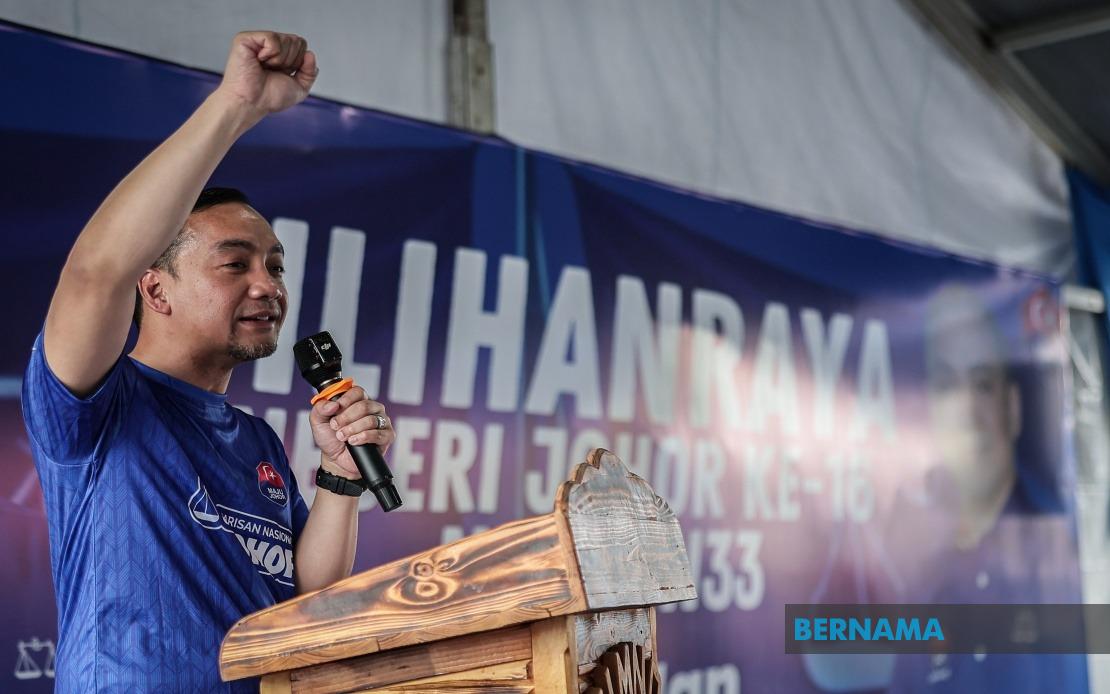
Barisan Nasional's campaign machinery in Johor is operating at high speed ahead of the state election on July 11, buoyed by what coalition leaders describe as encouraging grassroots support for its Endau candidate. Datuk Onn Hafiz Ghazi, serving simultaneously as BN chairman and Johor's Menteri Besar, expressed confidence that the positive reception voters have shown towards Alwiyah Talib throughout the campaign period will translate into victory for the coalition across contested constituencies.
Alwiyah Talib, colloquially known as "Kak Awi" among constituents, presents an intriguing case study in Malaysian electoral politics. The veteran politician previously held the Endau seat under BN's banner during the 14th General Election before switching to Bersatu, which then aligned with Perikatan Nasional for the 2022 Johor state election. Her return to BN this year encapsulates the fluid nature of coalition politics in Malaysia, where party affiliations shift in response to local and national political currents. Her comeback signals a broader reconciliation within the BN framework following years of internal tensions and defections that had fractured the once-dominant coalition.
Onn Hafiz framed Alwiyah's homecoming within the context of UMNO president Datuk Seri Dr Ahmad Zahid Hamidi's "Rumah Bangsa" concept, a framework explicitly designed to promote unity and embrace within the broader BN structure. This terminology carries particular weight in Johor, where BN has historically maintained its strongest organisational presence and voter loyalty. The Menteri Besar's emphasis on inclusivity suggests BN is attempting to rebuild its coalition by welcoming back former members rather than simply focusing on traditional party structures, a pragmatic approach given the fragmentation of Malaysian politics since 2018.
The Endau constituency has proven a consistent stronghold for Alwiyah regardless of her party affiliation. In the 2022 election, she secured victory with a majority of 3,041 votes in a five-cornered contest while representing Perikatan Nasional—a respectable margin that demonstrates personal popularity transcending party label. Her ability to command voter loyalty across different electoral cycles suggests she possesses genuine grassroots organisation or personal resonance that extends beyond typical partisan voting patterns. This individual candidate strength could prove decisive in constituencies where electoral margins have been tightening.
Onn Hafiz's remarks at the "Santai ONN X ONN Bersama Menteri Besar Johor" event in Endau revealed confidence in the broader campaign machinery. He indicated that both Endau and the adjoining Tenggaroh constituency, where BN candidate Mohd Youzaimi Yusof is contesting, demonstrated full preparedness and commitment from party operatives. This dual-constituency messaging strategy suggests BN is targeting specific geographic clusters rather than spreading resources thinly across all state seats, a more efficient approach in a regionally concentrated campaign.
The Johor state election assumes significance beyond the state itself, carrying implications for national political dynamics. A strong BN showing would reinforce the coalition's claim to represent Malaysia's political centre and could influence calculations ahead of the next general election. Conversely, weakness in Johor would signal continuing fragmentation of Malaysia's traditional power structures. For Southeast Asian observers monitoring Malaysian stability, elections in traditionally BN-stronghold states offer crucial indicators of whether the coalition is successfully reconsolidating or continues fragmenting further.
Early voting is scheduled for July 7, three days before the main polling day, a compressed timeline that requires intensive campaign coordination. Onn Hafiz noted that the Johor state election campaign had proceeded smoothly without untoward incidents thus far, suggesting security and electoral management officials have successfully maintained order despite the competitive environment. This procedural efficiency matters for voter confidence and the broader legitimacy of electoral outcomes.
The reference to July 11 as polling day anchors these developments within Johor's specific electoral calendar, though the state election also occurs within Malaysia's broader political context. The coordination required between BN's federal structures and state-level machinery in Johor during this period will test the coalition's operational coherence. Successfully delivering victory in a traditionally friendly state could provide psychological momentum for any future national initiatives, whereas electoral setbacks might trigger recriminations within BN's fractious membership.
Alwiyah Talib's candidacy also reflects evolving patterns of female political representation in Malaysia. While women occupy growing numbers of electoral seats, their prominence often depends on personal standing and community connections rather than systematic advancement mechanisms within parties. Her crossover between parties and persistent electoral success suggests Malaysian voters evaluate female candidates partly on individual merit and demonstrated commitment to constituency interests.
The campaign focus on Endau and Tenggaroh constituencies indicates BN's strategic prioritisation of specific battlegrounds rather than uniform effort statewide. This concentration of resources and leadership attention, evident from Onn Hafiz's personal campaigning, demonstrates that modern Malaysian elections involve calculated targeting of competitive seats. Such selective engagement reflects both the mathematical reality that not all constituencies are equally competitive and the efficiency considerations that shape campaign strategy across democracies.
Onn Hafiz's public expressions of confidence serve multiple functions simultaneously. They attempt to shape voter perceptions of inevitability around BN victory, mobilise party workers through messaging of assured success, and signal to coalition partners that internal morale remains high. Political scientists have long observed that campaign rhetoric about momentum and positive reception operates partially as self-fulfilling prophecy, as expressed confidence can influence voter decisions and worker enthusiasm.
The early voting window on July 7 provides a crucial data point that could significantly influence final campaign messaging during the remaining days before the main poll. Early voting patterns often correlate with final results, giving campaigns opportunity to adjust strategy based on observable participation rates and voting trends across different constituencies. For Johor BN operatives, monitoring early voting performance in Endau and Tenggaroh will inform resource allocation during the final campaign push.
As Malaysia navigates its evolving political landscape characterised by coalition fluidity and regionalised voting patterns, the July 11 Johor state election represents a consequential test of whether the BN, through inclusive approaches like the Rumah Bangsa framework, can successfully reconstruct the broad-based coalition that historically characterised Malaysian governance. The enthusiasm Onn Hafiz described regarding voter reception for candidates like Alwiyah Talib will face definitive evaluation when voters cast ballots on July 11.

