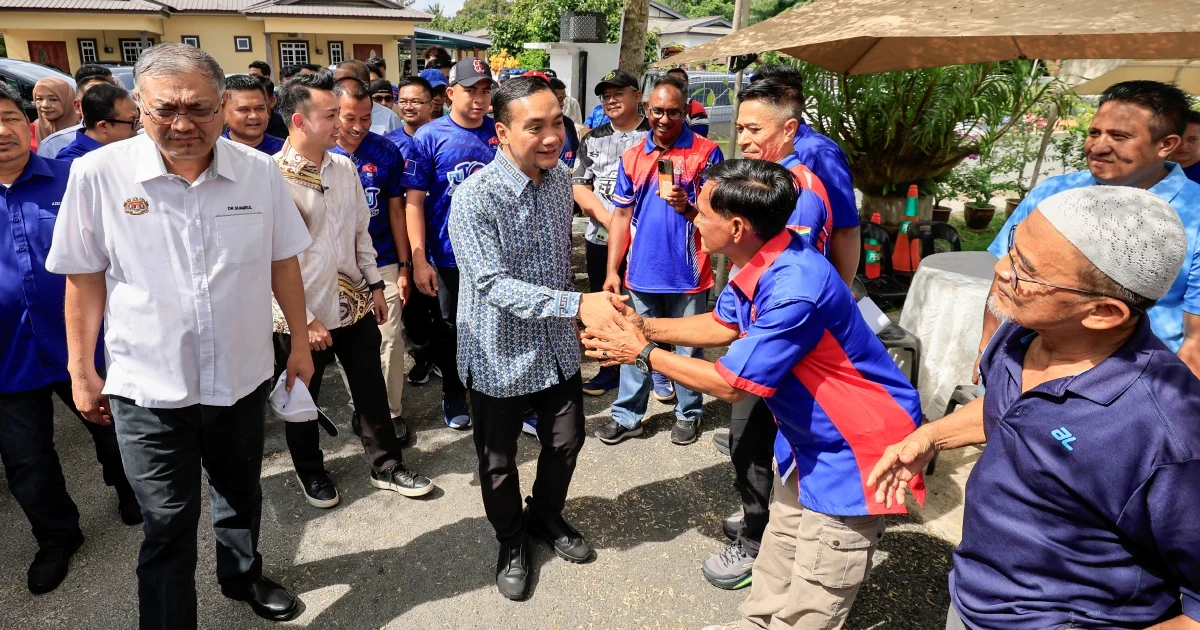
Johor Menteri Besar Onn Hafiz Saaidi has weighed in on the growing debate over Pas' political positioning ahead of upcoming electoral contests, emphasising that each party maintains the constitutional right to shape its own electoral strategy without external interference. Speaking at Simpang Renggam, Onn Hafiz addressed observations about Pas' recent call for its members to back Barisan Nasional candidates in seats where Perikatan Nasional has chosen not to field contenders, characterising such moves as legitimate tactical decisions within Malaysia's competitive democratic framework.
The Johor leader's remarks come amid heightened discussion about the intricate coalition dynamics now defining Malaysian politics following the 2022 general election. Rather than criticising Pas' approach, Onn Hafiz positioned his comments to normalise the kind of strategic repositioning that has become increasingly common among major political blocs seeking to maximise electoral performance. His statement reflects an understanding that political parties routinely recalibrate their alliances and tactical placements in response to changing circumstances, constituent pressures, and shifting national sentiment.
Pas' directive represents a significant evolution in the party's political calculus, particularly given its historical alignment with Perikatan Nasional and its position within the broader PN coalition structure. By instructing members to support BN candidates in constituencies deemed uncontestable by PN, the Islamic party appears to be preparing for a scenario where tactical cooperation with a former rival might yield better overall outcomes than rigid adherence to existing alliance structures. This flexibility suggests recognition that the political landscape continues to evolve in ways that demand pragmatic responses.
For Malaysian observers and political analysts, Onn Hafiz's intervention carries particular weight given his position as a senior figure within Barisan Nasional and his influence within Johor's political establishment. His willingness to publicly endorse the principle that parties should autonomously determine their strategies tacitly acknowledges BN's interest in benefiting from Pas support in constituencies where PN presence might otherwise split the opposition vote or complicate electoral mathematics. The subtext appears designed to legitimise such arrangements as normal political practice rather than some extraordinary departure from convention.
The statement also reflects broader realities within Southeast Asian politics, where coalition governments and fluid party allegiances have become standard features rather than anomalies. Malaysia's experience since 2020 has demonstrated that traditional notions of permanent political blocs increasingly give way to pragmatic arrangements that shift with electoral circumstances and internal party pressures. What once might have been regarded as opportunistic behaviour now falls within accepted parameters of strategic political engagement.
Onn Hafiz's framing proves particularly significant for understanding how BN leadership may be approaching the next general election whenever it arrives. Rather than viewing Pas' outreach as problematic or requiring confrontation, the Johor Menteri Besar implicitly endorses the legitimacy of Pas' tactical autonomy, which simultaneously validates BN's openness to benefiting from such arrangements. This language construction allows BN figures to accept external support without explicitly negotiating formal alliance terms that might prove politically complicated domestically.
The political environment in Johor itself provides crucial context for understanding why Onn Hafiz chose this moment to articulate such principles. Johor has emerged as a critical battleground in Malaysian electoral politics, with multiple parties competing for dominance and legislative control. The state's complex political dynamics—involving competition between BN components, PN entities, and emerging independent forces—make the kind of tactical flexibility Onn Hafiz described potentially valuable for maintaining BN's competitive edge in constituencies where different approaches might yield different results.
Pas' strategic pivot also merits examination in relation to the party's broader positioning following the 2022 election results, which left the Islamic party in a more precarious parliamentary position than its leadership had anticipated. By authorising support for BN candidates in select constituencies, Pas may be calculating that facilitating BN victories in marginal seats could create political capital for future negotiations and coalition-building discussions, while simultaneously preventing three-way contests that might inadvertently benefit parties it opposes more fundamentally.
The principle of party autonomy Onn Hafiz articulated extends beyond immediate electoral calculations to touch on fundamental questions about how Malaysian democracy functions. Political parties, as entities with their own institutional interests and member bases, necessarily possess agency in determining their participation in electoral contests. Respecting this autonomy—as Onn Hafiz's comments suggest BN should do—establishes important boundaries in democratic practice, distinguishing between legitimate political competition and attempts to constrain parties' fundamental rights to strategic decision-making.
For Malaysian voters and political observers tracking the trajectory of national politics, such statements offer valuable insight into how major political actors increasingly view their relationships and competitive arrangements. The normalisation of tactical cooperation between formerly opposed parties suggests that electoral outcomes may depend less on ideological coherence or programmatic alignment than on the complex mathematics of seat distribution and vote concentration. This reality has significant implications for how voters might expect campaign messaging and political alliances to evolve during election seasons.
Onn Hafiz's intervention ultimately serves multiple audiences simultaneously. To Pas members and leadership, it provides implicit recognition and legitimation of their strategic autonomy. To BN figures and supporters, it signals openness to tactical arrangements with non-traditional partners when electoral circumstances warrant such cooperation. To the broader Malaysian political class, it articulates a framework for understanding contemporary politics as inherently fluid, where parties must retain flexibility to adapt strategies in response to evolving conditions and opportunities.

