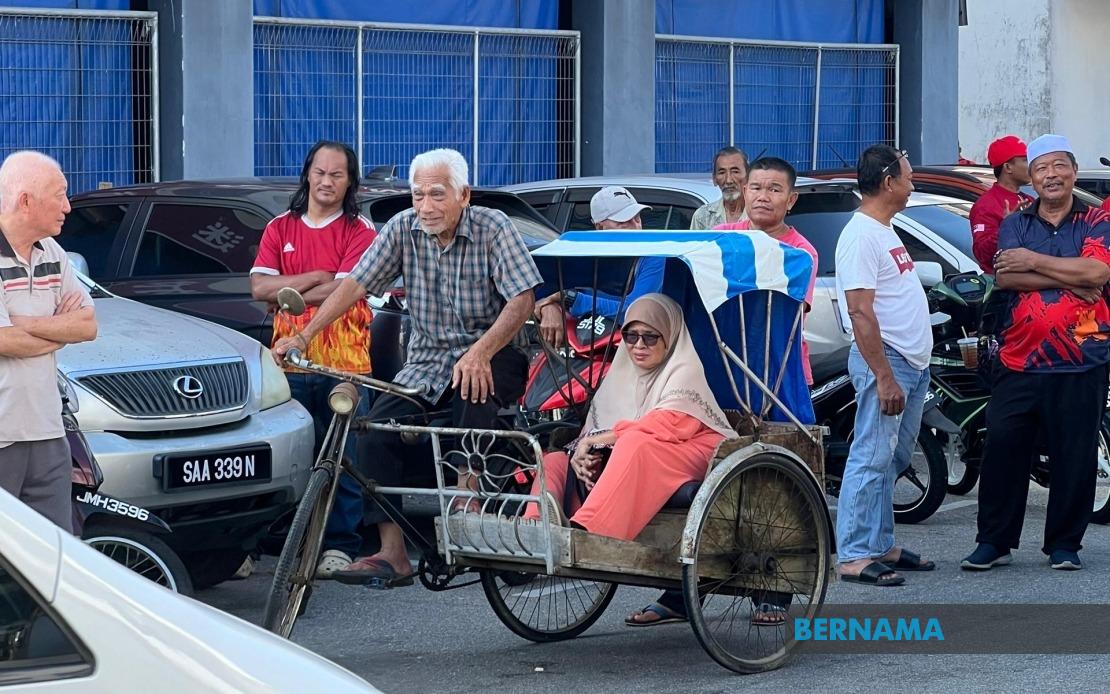
Abdul Razak Pelangga, an 86-year-old resident of Kampung Parit Bugis in Batu Pahat, defied the oppressive midday heat to pedal his trishaw on a nearly kilometre-long journey, determined to grant his wife Jamilah Samsudin's wish of catching a glimpse of Prime Minister Datuk Seri Anwar Ibrahim. The couple's effort underscores the deep connection some Malaysians feel towards their leaders and the lengths they will go to witness them in person, even when modern transport options remain available.
After learning that the Prime Minister would be stopping for breakfast at Kedai Kopi Hailam Sri Medan in Senggarang as part of his campaign trail, Abdul Razak made the decision to transport his wife to the venue using his traditional trishaw. The choice of transport was deliberate and pragmatic. Though he possessed alternatives—a car or motorcycle that would have provided greater comfort and speed—Abdul Razak chose the trishaw specifically to sidestep the complications of parking in what he anticipated would be a crowded area. This reasoning reveals how municipal realities in smaller Malaysian towns continue to shape the choices residents make, even when convenience options exist.
Abdul Razak's connection to Anwar Ibrahim stretches back several years. Serving as the imam of Masjid Raudhatul Jannah Parit Bugis, he recalls a significant earlier encounter with the then-opposition politician who visited the mosque to lead prayers. The exchange left a lasting impression on him—a moment of personal interaction where they shook hands and exchanged pleasantries. He described Anwar as remarkably personable, an experience he later recounted to his wife, planting the seed of her desire to see the Prime Minister herself.
When news reached him that Anwar would be in the area, Abdul Razak seized the opportunity. The couple's journey on the trishaw became a symbolic pilgrimage of sorts, combining household logistics with political engagement. Upon arrival at the coffee shop, however, the pair discovered that the crowd was too dense to permit direct interaction with the Prime Minister. Yet the experience still proved worthwhile for them. Witnessing Anwar from a reasonable distance sufficed—they had achieved what had previously only been possible through television broadcasts.
The Prime Minister's visit formed part of the PMX Meet-and-Greet Programme, a direct engagement initiative targeting the Senggarang state constituency in conjunction with the Johor state election campaign. Anwar spent approximately 50 minutes at the coffee shop, moving among local residents in an informal setting designed to foster connection beyond formal political rhetoric. Communications Minister Datuk Fahmi Fadzil, who also directs Pakatan Harapan's communications efforts, accompanied the Prime Minister during this constituency-level campaign activity.
Beyond the personal milestone of seeing the Prime Minister, Abdul Razak's story intersects with another significant date in his calendar. The Johor state election poll is scheduled for July 11, which happens to coincide with his 87th birthday. For Abdul Razak, participating in the electoral process on his birthday carries special weight. While he has exercised his voting rights throughout his life, this particular election resonates more deeply because it aligns with the day of his birth—transforming a routine civic duty into a personally momentous occasion.
The convergence of political participation and personal celebration reflects how some Malaysian voters view elections not merely as obligations but as affirming moments of citizenship. Abdul Razak's enthusiasm about voting on his birthday suggests a perspective wherein democratic participation becomes interwoven with life milestones, adding emotional and personal significance to the institutional process. His willingness to undertake the trishaw journey also hints at a generational commitment to engagement—an 86-year-old man choosing not to remain a passive observer but instead to participate actively in political events.
The Johor state election itself carries substantial implications for Malaysia's political landscape. Scheduled polling on July 11 follows early voting on July 7, with various constituencies across the state presenting electoral contests. The 16th Johor state election represents another moment in the broader pattern of state-level contests that have punctuated Malaysian politics since the 2022 general election. Regional outcomes in Johor hold significance for national political dynamics, given the state's size, population, and historical importance in Malaysian governance.
Anwar Ibrahim's campaign presence in smaller constituencies like Senggarang demonstrates a strategic approach to electoral engagement that prioritises direct contact with voters across diverse geographical settings. The breakfast stop format, informal and accessible, contrasts with more formal political rallies and reflects contemporary campaign methodology. Candidates and party leadership increasingly attempt to create moments of everyday ordinariness where political figures interact with residents in familiar spaces—coffee shops rather than convention halls, informal handshakes rather than podium speeches.
Abdul Razak's narrative also illuminates the persistent appeal of traditional Malaysian modes of transport in community life. The trishaw, once ubiquitous in Malaysian towns, has declined significantly but remains culturally resonant and practically useful for short-distance journeys, particularly in areas where parking pressures complicate vehicular options. His decision to employ this mode of transport preserved a form of local mobility while achieving his purpose, demonstrating the continued utility of such vehicles in specific contexts.

