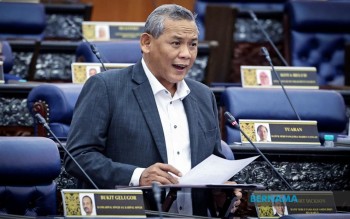
Investment losses at Lembaga Tabung Haji require a nuanced examination that acknowledges the inherent risks of financial markets rather than reflexively blaming poor governance for all shortfalls, according to Port Dickson Member of Parliament Datuk Seri Aminuddin Harun. Speaking during a parliamentary special sitting on the Royal Commission of Inquiry report into the pilgrimage fund, the former Negeri Sembilan menteri besar cautioned legislators against oversimplifying the institution's financial difficulties, emphasising that distinguishing between inevitable market volatility and actual negligence remains essential to a fair reckoning with the findings.
Aminuddin's intervention comes as Parliament examines the 211-page RCI report released on July 29, which investigated Tabung Haji's management and operations across the 2014-2020 period. The inquiry identified systemic weaknesses in governance and put forth 25 recommendations, of which Tabung Haji has implemented approximately 75 per cent as of late July. Yet while acknowledging these findings, Aminuddin sought to differentiate between losses attributable to unfavourable market conditions—a reality all investment vehicles face—and those resulting from negligent decision-making, conflicts of interest, or procedural breakdowns within the organisation's framework.
Central to Aminuddin's argument is the necessity for rigorous forensic audits of 14 investments that experienced significant declines, a step the RCI itself recommended. Such audits would provide the granular analysis needed to establish whether poor returns reflected external economic factors beyond management's reasonable control or stemmed from questionable investment choices or internal mismanagement. This distinction matters profoundly for how the institution recalibrates its approach going forward. An investment that loses value during a market downturn requires a different remedial response than one that fails due to inadequate due diligence or cronyism, yet both categories have frequently been lumped together in public discourse surrounding Tabung Haji's struggles.
The broader concern Aminuddin raised centres on how the fund's leadership has been selected historically. He argued forcefully that board appointments and senior management positions should be based strictly on professional credentials—specifically investment expertise, relevant experience, and demonstrable competence in financial management—rather than political patronage or social networks. This critique cuts to the heart of a recurring governance problem in Malaysian institutional life: the tendency to distribute positions of trust as rewards for loyalty or connections rather than merit.
In a notably frank statement, Aminuddin asserted that Tabung Haji positions should not be viewed as stepping stones to political influence or rewards for party loyalty. Instead, he positioned them as professional responsibilities requiring individuals of genuine expertise and unquestionable integrity. The former menteri besar called for a comprehensive cultural shift within the institution, moving away from the conventional Malaysian practice of treating senior appointments as patronage opportunities toward a strictly meritocratic model where professional qualifications take absolute precedence.
The RCI itself recommended legislative amendments to the Tabung Haji Act that would prohibit active politicians from serving as chairman or board members of the fund or its subsidiaries. Aminuddin embraced this recommendation but proposed extending such safeguards further. He advocated for mandatory screening of all board candidates across multiple dimensions: integrity assessments, investment experience, Islamic finance knowledge, risk management capabilities, accounting and auditing proficiency, legal acumen, corporate governance understanding, and haj management expertise. Additionally, all potential conflicts of interest would require formal declaration before appointment.
This comprehensive vetting framework reflects growing recognition that protecting public institutions from mismanagement requires more than simply rotating personnel or implementing surface-level reforms. It demands establishing institutional barriers that make it difficult for unqualified or compromised individuals to assume positions of influence over funds entrusted to the organisation by millions of Malaysian Muslims preparing for the pilgrimage. For a fund managing savings accumulated over years or decades by ordinary Malaysians, the stakes of leadership selection are not merely financial but deeply religious and social.
However, some parliamentarians argued the RCI's scope was insufficiently broad. Datuk Mohd Isam Mohd Isa, the Tampin representative, contended that investigating only the 2014-2020 period left significant gaps in understanding Tabung Haji's trajectory. He pointed out that crucial developments affecting the fund occurred after 2020, yet remained outside the RCI's mandate. Mohd Isam called for a second commission of inquiry to examine the 2021-2025 period, ensuring continuity of scrutiny and preventing the compartmentalisation of problems into conveniently bounded timeframes that obscure longer-term patterns of dysfunction.
As a member of the Public Accounts Committee, Mohd Isam further recommended that governance and management issues relating to Tabung Haji be referred to the PAC for deeper investigation, particularly examining the 2022-2026 period. This proposal reflects concern that a one-off RCI, whatever its value, cannot provide the ongoing institutional oversight needed to ensure reforms stick and new problems are caught early. The PAC's continuous function positions it better to monitor implementation of RCI recommendations and identify emerging governance challenges before they metastasise into major financial or reputational losses.
The government established the RCI in 2021, appointed its members in January 2022, and received the final report in August 2022, making the public release of findings more than two years later. This substantial delay between inquiry completion and public disclosure raises questions about the political and bureaucratic processes mediating transparency regarding public institution failures. The staggered timeline also means Parliament is examining findings from events now several years distant, potentially limiting public memory and political momentum for reform implementation.
Moving forward, the debate around Tabung Haji reflects broader Malaysian concerns about institutional integrity, leadership selection, and the tension between accountability and operational stability. Religious endowments and pilgrimage funds occupy unique positions in Muslim-majority societies, combining spiritual significance with fiduciary responsibility. Any losses or mismanagement affects not just financial returns but community trust in Islamic institutions. The challenge for policymakers involves establishing governance reforms robust enough to prevent future problems while acknowledging that some investment underperformance reflects market conditions rather than human failings, a balance Aminuddin's contribution to the parliamentary discussion sought to articulate for his colleagues.

