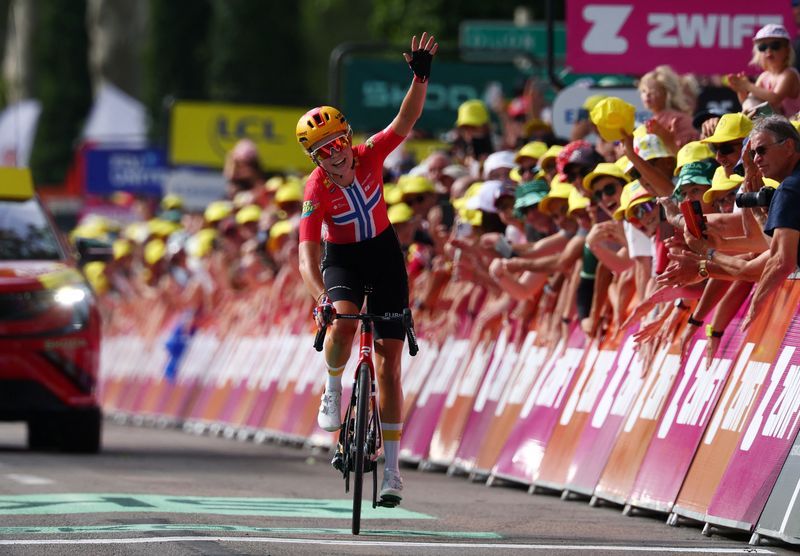
Sigrid Haugset of Norway etched her name into cycling history on Monday when she powered across the finish line to claim a prestigious stage victory at the Tour de France Femmes, a breakthrough moment that also propelled her into the race lead. The 27-year-old Uno-X Mobility rider's dominant performance saw her overtake Dutchwoman Lorena Wiebes at the top of the general classification, establishing a commanding advantage of two minutes and 22 seconds over second-placed Kimberly Le Court of Mauritius. Haugset's triumph carries particular significance for Norwegian cycling, as she becomes the first rider from her nation to win a stage in this premier women's cycling competition, and the inaugural Norwegian wearer of the coveted yellow jersey at the Tour de France Femmes.
The 156.5-kilometre stage unfolded with Haugset gradually building her advantage through a sustained solo effort that tested both her physical reserves and mental fortitude. Her escape began during the ascent of Col de la Savine, where she decisively opened a gap on the main peloton. The move proved difficult for her rivals to control, with only Belgian champion Lotte Kopecky mounting a serious pursuit in the closing kilometres. Kopecky, who rode for a competitive outfit, managed to close to within just ten seconds of Haugset with ten kilometres remaining, creating genuine doubt about whether the Norwegian could maintain her lead to the finish. However, Haugset dug deep when it mattered most, finding reserves of strength to extend her margin to one minute and 24 seconds by the time she crossed the line in Poligny. The Netherlands' Marianne Vos completed the podium in third position.
The stage itself presented significant tactical and physical challenges as the Tour de France Femmes ventured into the Alps for the first time this edition. Category one climbs featured prominently, beginning with the notorious Col de la Faucille, where a serious incident temporarily disrupted the race's rhythm. Multiple prominent riders went down in a crash on the steep slopes, including reigning world champion Magdeleine Vallieres and Demi Vollering, a previous Tour de France Femmes victor. The incident could have proven consequential for the overall standings, but emergency protocols functioned smoothly, with all affected riders remounting quickly and returning to their efforts. The peloton maintained sufficient cohesion that no significant breakaway attempts materialised during the remaining 11.4 kilometres of the Col de la Faucille climb.
Haugset's breakthrough victory represents a watershed moment for Norwegian women's cycling on the sport's grandest stage. Her emotional reaction upon crossing the finish line conveyed the magnitude of her achievement, with the rider struggling to process what she had accomplished. When interviewed moments after her victory, Haugset admitted that she had genuinely doubted her capacity to hold off Kopecky's powerful challenge. During the closing stages of her solo effort, she questioned whether accepting second place might have been the prudent choice, acknowledging that securing a podium position would have constituted a respectable performance. The thought of supporters back home watching her effort, however, galvanised her determination to push beyond the limits of her exhaustion and claim the victory.
Kopecky's performance, whilst ultimately unsuccessful in catching Haugset, demonstrated the calibre of competition within the Tour de France Femmes field. The Belgian champion pursued her rival with relentless pressure, systematically reducing the gap in the final kilometres and creating a genuine sense that the stage honours remained in play. This dynamic contest showcased the depth of talent within contemporary women's professional cycling, where riders of Kopecky's stature must still yield to superior performances on particular stages. Le Court, who entered the stage as second in the overall standings, struggled to respond to the accelerations from Haugset and Kopecky, suggesting that the race leadership might shift towards climbers and all-rounders as the remaining mountain stages approach.
The strategic context surrounding Haugset's attack reveals important dynamics about contemporary Tour de France Femmes tactics. Wiebes began the stage wearing the yellow jersey but found herself trailing by thirteen minutes entering the final twenty kilometres, effectively removed from contention for stage honours by that juncture. This development emphasised how mountain stages can dramatically reshape race hierarchies, with riders suited to rolling terrain finding themselves vulnerable once gradients steepen significantly. The fact that neither Le Court nor Vollering, who occupied second and third positions respectively before the stage, could mount effective counters to Haugset's acceleration demonstrates how individual brilliance can overcome pre-existing advantages on particular days.
Haugset's physical and mental resilience during the closing stages provided a compelling narrative thread to her victory. As exhaustion threatened to overwhelm her in the final kilometres, and Kopecky methodically reduced the gap that had once appeared secure, the Norwegian cyclist confronted a critical moment where psychological strength determined the outcome. She acknowledged that Kopecky's chase forced her to question her capacity to prevail, yet she consciously chose to elevate her effort rather than settle for a respectable second place. This determination yielded dividends as the finishing line approached, with Haugset summoning additional reserves to extend her advantage substantially, effectively concluding the contest with roughly three kilometres remaining.
The emotional aftermath of Haugset's triumph highlighted both the intensity of her effort and her pure satisfaction at achieving this historic milestone. Moments after crossing the finish line, her physical exhaustion proved so complete that she could not even lift her arms from the handlebars to perform the celebratory gestures that typically accompany significant victories. She jokingly acknowledged that her boyfriend might criticise her for not engaging in proper celebrations, but the reality of her total physical commitment to the victory made such expressions impossible. This authentic moment, far from diminishing her achievement, underscored the extraordinary effort required to claim victory in professional cycling's most demanding competitions.
Looking forward, Haugset's assumption of the yellow jersey establishes her as a primary target for her rivals during the remaining mountain stages. The two-minute-plus advantage she has established provides meaningful insurance against daily tactical battles, yet the mountains ahead will subject all contenders to severe selection pressures. Her ability to sustain this lead will depend partly on whether she can repeat her dominant performance on future climbs, and partly on the collective response from rival teams who may coordinate efforts to neutralise her advantage. The significance of her breakthrough extends beyond personal achievement, potentially inspiring Norwegian cycling development and attracting greater attention to women's professional cycling within her home nation and throughout Southeast Asia's growing interest in international cycling competition.

