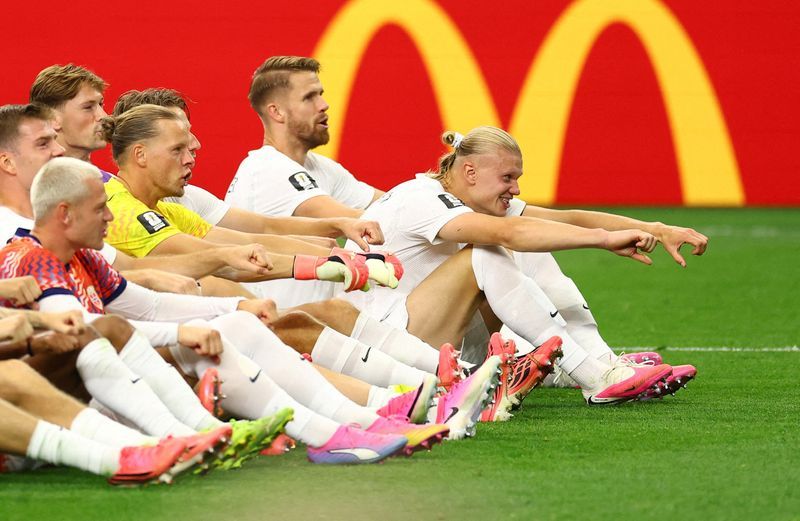
Norway's fairytale World Cup campaign came to a bittersweet conclusion when they surrendered a one-goal advantage to England in Saturday's quarter-final in Miami, losing 2-1 after extra time. Yet the Scandinavian nation's summer adventure represents far more than just another tournament exit. After a 28-year absence from the world's biggest football stage, coach Stale Solbakken has guided a squad brimming with talent and character through a tournament that captured imaginations on both sporting and cultural grounds.
The narrative surrounding this Norwegian side extends well beyond conventional match statistics. In the weeks before the tournament commenced, the team participated in a distinctive photoshoot embracing their Viking heritage, a calculated move that transformed into something organically powerful. That thematic thread wove through their entire campaign as fans created the "Viking row" celebration, which emerged as one of the tournament's most distinctive and beloved moments. The imagery of fearless Scandinavian warriors proved irresistible, and by the final stages, even American spectators had embraced the towering figure of Erling Haaland and his characteristic tongue-in-cheek demeanour with genuine enthusiasm.
The qualification process that preceded the finals gave every indication that Norway would trouble the established hierarchy. With Haaland converting opportunities with clinical efficiency, the Norwegians delivered a qualifying campaign of such calibre that advancing from their group represented merely the baseline expectation. Exceeding those ambitions, however, proved dramatically more compelling. A 2-1 victory over Ivory Coast in the last 32 featured Haaland's clinical double, confirming that this was no fluke, no sentimental journey. The prospect of a genuine deepening run suddenly seemed plausible rather than fantastical.
The defining moment of their campaign arrived when Norway dismantled Brazil in a performance that transcended mere tactical competence. Winning 2-1 against a nation synonymous with global football pedigree demonstrated that Solbakken's squad possessed not merely individual brilliance but collective cohesion and tactical sophistication. That victory triggered genuine speculation that an improbable march to the semi-finals, perhaps even a final appearance, remained within the realm of possibility. For a nation absent from the finals for nearly three decades, such ambitions represented extraordinary vindication of the project being constructed.
The unravelling against England in the quarter-final represented not a collapse of nerve but rather the physical and mental accumulation of a campaign that had demanded everything. As the fixture progressed beyond normal time into the additional thirty minutes, Jude Bellingham struck twice to flip the narrative decisively, while the mounting fatigue affecting Haaland and captain Martin Odegaard became increasingly apparent. The demands placed upon a squad missing the rhythm-building advantage of regular tournament exposure finally extracted their toll. Yet even in defeat, the manner of their exit carried dignity, a team that had given maximum effort against competition that never allowed them sanctuary.
The broader health of Norwegian football transcends this single tournament, offering Southeast Asian federations instructive lessons in sustained player development. Bodo/Glimt's repeated successes in European competition over recent seasons signals that Norwegian football culture has fundamentally shifted away from its traditional characterization as a brute-force, kick-and-rush operation. Instead, the nation now manufactures technically proficient, intellectually engaged players capable of competing against elite opposition on equal tactical terms. This structural transformation represents a deliberate institutional choice, not fortunate accident.
The triumvirate of Solbakken, Odegaard and Haaland embodies a distinctively Norwegian temperament that combines intellectual confidence with self-aware humour. These are personalities entirely comfortable laughing at themselves during press conferences while simultaneously projecting the lethal seriousness required to dismantle World Cup opposition. That psychological balance proves rarer than conventional talent assessments typically acknowledge. The capacity to remain composed during adversity, to extract learning from setback without becoming consumed by it, distinguishes sustained success from fleeting achievement.
Solbakken's closing reflections captured the philosophical sophistication with which Norwegian football has approached their return to the global stage. His characterization of the summer as "fairly OK" represented deliberate understatement rather than genuine dismissal, a rhetorical device that acknowledged extraordinary accomplishment while declining to become intoxicated by single-tournament narratives. More meaningfully, he articulated the genuine confidence now circulating through the squad, noting that players depart convinced of their capacity to match elite global competition on genuine terms.
This confidence possesses genuine substance rather than inflated rhetoric. The players who featured in this tournament will carry forward the memory of victories over illustrious opponents and performances that commanded respect from football's established powers. That psychological foundation, that proven evidence of capability against the world's best, transforms their trajectory. Younger players observing from the margins have witnessed that their nation can compete credibly at football's summit. Recruitment of talent becomes easier when demonstrable evidence suggests that playing for Norway represents not settling for inferior competition but participating in a genuinely ascending project.
For Malaysian and Southeast Asian observers, Norway's resurgence offers important cautionary and inspirational elements. The investment required to develop a competitive football culture extends across decades rather than single-cycle quadrenniums. Bodo/Glimt's European performance demonstrates that domestic leagues can genuinely develop talent even without membership in Europe's richest competitions. Norway's success flows from systematic youth development, coaching education, and institutional patience rather than merely acquiring expensive players from abroad. The tournament also revealed how cultural narrative and national identity can amplify sporting endeavour without becoming consumed by it.
The quarter-final loss represents conclusion but not conclusion in any terminal sense. This Norwegian team has permanently altered their sport's conversation, demonstrating that nations outside traditional football's aristocracy can build sustained competitive projects. England's victory concluded their campaign but could not diminish what they accomplished, the mark they left on a tournament, and the foundation they constructed for future campaigns. As Solbakken noted, the months ahead will provide perspective that the immediate moment cannot yet offer. What remains indisputable is that Norwegian football has re-announced itself as a continental force worthy of sustained attention and respect.

