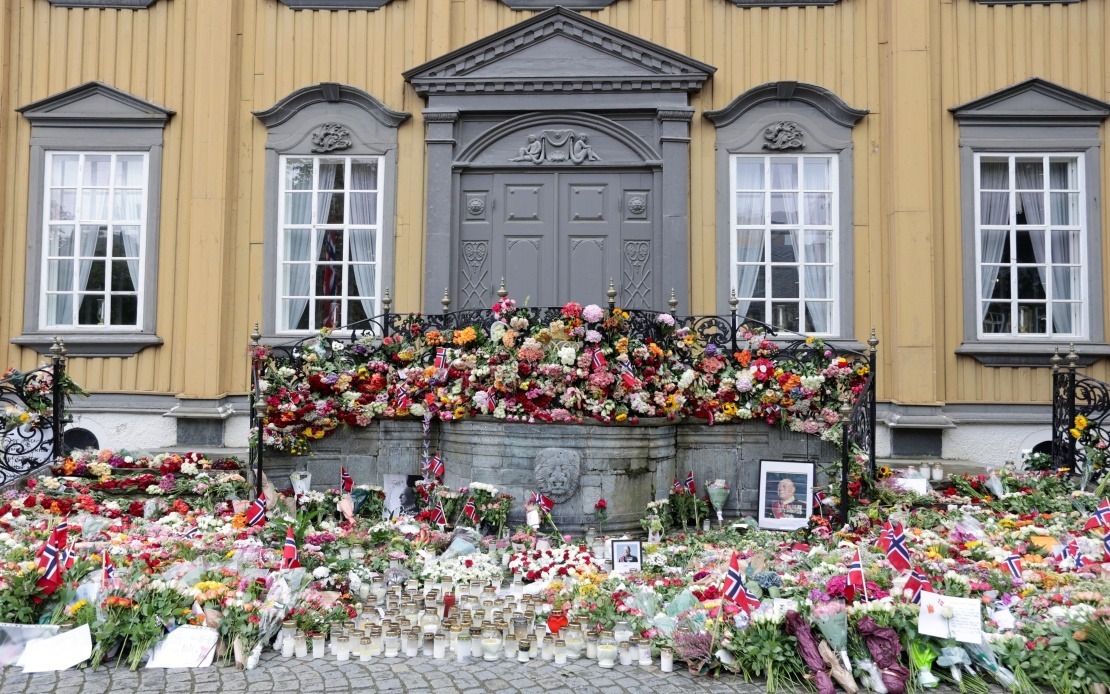
Across Norway, citizens gathered in churches and cathedrals on Sunday to honour the memory of King Harald V, the nation's longest-reigning monarch who died on Friday at the age of 89. The extensive outpouring of public grief demonstrated the deep affection Norwegians held for their late sovereign, who had guided the Scandinavian kingdom through nearly seven decades of profound social and political transformation.
The memorial services, organised simultaneously at religious institutions throughout the country, drew tens of thousands of mourners seeking to pay their respects in their local communities. Rather than a single centralised state funeral ceremony, the distributed approach to commemorating Harald V allowed citizens across Norway's diverse regions—from Oslo to the far north—to participate in collective mourning while reflecting on the monarch's legacy.
Outside the Royal Palace in Oslo, the spontaneous memorials created by ordinary Norwegians told a particularly poignant story. Flowers, candles, and handwritten cards accumulated in growing numbers as visitors left personal tributes to their departed king. These physical expressions of grief, accumulating day after day at the palace gates, served as a visible manifestation of national sentiment and provided a focal point for public expression during the period of mourning.
The Norwegian Royal House formally announced that the state funeral ceremony will take place on September 9, providing a specific date for the nation's final formal farewell. This timing allows sufficient preparation for what is expected to be a significant ceremonial event, drawing dignitaries and representatives from across Europe and beyond. The funeral arrangements will likely follow centuries-old Norwegian royal protocols while honouring Harald V's particular place in the nation's modern history.
Under Norway's constitutional rules of succession, the throne passed immediately and automatically to Harald V's eldest son, who assumed the regnal title of King Haakon VIII. At 53 years old, the new monarch brings his own experience and perspective to the role, having spent decades preparing for eventual kingship through public service and royal duties. The seamless transfer of power reflects the stability of Norway's constitutional monarchy system, where the line of succession is clearly established and universally accepted.
The succession to Haakon VIII marks a significant generational transition for Norway. While Harald V represented continuity with Norway's mid-twentieth-century history—including the nation's experience during World War II and its subsequent development into a modern welfare state—his son represents a bridge between that historical period and contemporary challenges facing Scandinavia and Europe. The new king inherits a nation that has evolved dramatically since his father's accession in 1991, facing contemporary issues ranging from climate change to geopolitical shifts in Northern Europe.
For regional observers across Southeast Asia, Norway's smooth transition of power offers instructive lessons in institutional stability and constitutional governance. The Malaysian context, with its own system of constitutional monarchy and established succession procedures, can note how mature democracies manage the transfer of sovereign authority through established legal frameworks rather than through political disruption. Norway's experience demonstrates that clear constitutional rules, public acceptance of succession norms, and strong institutions enable nations to navigate such transitions while maintaining continuity and public confidence.
King Harald V's 33-year reign witnessed Norway's emergence as one of the world's wealthiest nations, driven substantially by North Sea oil revenues. His tenure encompassed Norway's deepening integration into European affairs while maintaining independence from the European Union—a balance his son will need to maintain amid evolving continental dynamics. The late king's measured approach to constitutional monarchy, combined with his accessibility to ordinary Norwegians, helped define the character of modern Scandinavian royalty.
The gathering of Norwegian citizens at churches nationwide underscores how, even in increasingly secular societies, major life transitions and national moments draw people toward communal and spiritual spaces. The willingness of tens of thousands to participate in formal memorial services suggests that the institution of monarchy retains genuine meaning in Norwegian national identity, extending beyond ceremonial function to represent continuity, stability, and shared national values.
As Norway prepares for the September 9 funeral, the period ahead will involve not only formal commemorations but also a broader national reflection on Harald V's contributions to Norwegian society and the world. International delegations and ceremonial observances will underscore Norway's place within the global community of constitutional monarchies. Simultaneously, King Haakon VIII's early months on the throne will set the tone for his reign, offering Norwegians and the international community insight into how he envisions his role in steering the nation through an increasingly complex twenty-first century landscape.

