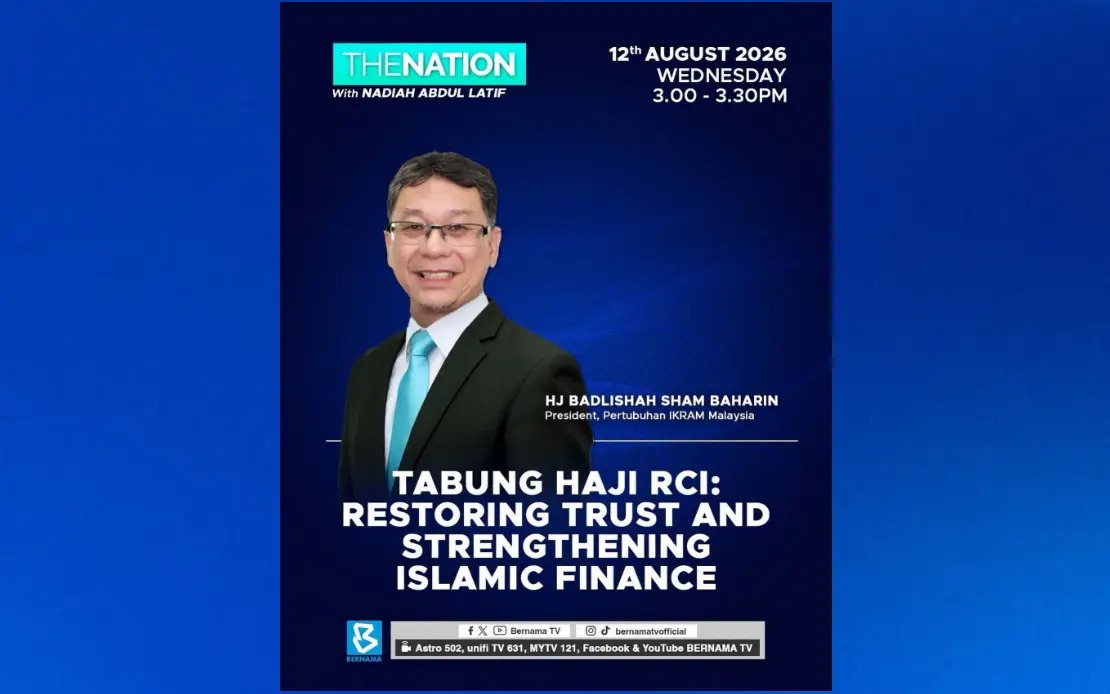
Badlishah Sham Baharin, president of Pertubuhan IKRAM Malaysia, has pushed back against proposals for a fresh Royal Commission of Inquiry into Tabung Haji, contending that the current investigations conducted by government authorities provide sufficient oversight without requiring additional formal inquiries. Speaking after his appearance on Bernama TV's "The Nation" programme, which examined the restoration of trust within Islamic finance institutions, Badlishah reasoned that establishing multiple RCIs for different periods or circumstances risks diluting the mechanism's credibility and authority within the Malaysian governance framework.
The debate over whether a new RCI is warranted stems from the existing investigation's temporal limitations. The published findings cover only the 2014 to 2020 period, while some parliamentarians from both Barisan Nasional and Pakatan Harapan have called for an examination of the subsequent 2021-2025 period to ensure comprehensive scrutiny. Badlishah's intervention suggests that rather than expanding the use of royal commissions, Malaysian policymakers should rely on established institutions like the Malaysian Anti-Corruption Commission (MACC) to handle ongoing investigations and ensure that irregularities are pursued through normal legal channels.
This position carries weight given the substantial losses that Tabung Haji has incurred. Finance Minister II Datuk Seri Amir Hamzah Azizan revealed during parliamentary debate that the institution experienced nearly RM13 billion in losses attributable to fourteen problematic investment decisions. The financial impact was distributed across multiple sources: the government absorbed RM10.2 billion through a bailout mechanism established via Urusharta Jamaah Sdn Bhd in 2018, whilst Tabung Haji itself recorded RM2.6 billion in impairment losses between 2018 and 2025 for investments that remained under management despite their deteriorating value.
Among these losses, the Al-Rawda investment emerged as particularly damaging, representing the single largest failure within Tabung Haji's portfolio. This venture involved lease agreements for accommodation facilities in Makkah and Madinah intended to serve pilgrims, with Tabung Haji committing 1.4 billion Saudi riyals—approximately RM1.5 billion—to an intermediary for the leasing arrangements spanning 2015 to 2017. When Al-Rawda defaulted on rental payments beginning in the first quarter of 2019, the loss cascaded, forcing Tabung Haji to record a full impairment write-down of RM1 billion in 2024 alone, effectively wiping out the entire investment value.
While Badlishah rejected the need for an expanded RCI, he endorsed the proposal to establish a multi-agency task force that would examine investments carrying risks of future losses and implement safeguards against repeating such failures. This pragmatic approach acknowledges that institutional reform requires more than investigative bodies—it necessitates preventive mechanisms embedded within the investment decision-making process itself. Badlishah emphasised the critical importance of rigorous due diligence before capital allocation, particularly in ensuring that proposed investments conform to ethical standards and comply with established regulatory procedures. His reference to examining matters "at the grassroots" suggests deeper scrutiny of how investment proposals originate and gain approval within organisational hierarchies.
The existing RCI report, released publicly on July 29, documented systemic weaknesses in Tabung Haji's management and operational structures throughout the 2014-2020 investigation period and formulated twenty-five remedial recommendations. By July 30, Tabung Haji had implemented seventy-five per cent of these recommendations, indicating reasonable institutional responsiveness to investigative findings. Whether this pace of reform would satisfy critics proposing an extended inquiry remains contested, though Badlishah's framework suggests that accelerating implementation of existing recommendations should take precedence over launching fresh inquiries.
Badlishah also addressed the conduct of opposition parliamentarians during the special Dewan Rakyat sitting that debated the RCI findings. Several opposition members withdrew from the chamber in protest, a decision Badlishah characterised as irresponsible and contrary to their constitutional obligation to represent constituents. With nearly ten million Tabung Haji depositors potentially affected by the institution's losses and governance failures, Badlishah argued that elected representatives bear a duty to engage seriously in parliamentary discourse and exercise proper checks on executive authority. His criticism extended to what he portrayed as opposition members substituting substantive parliamentary participation with social media commentary, thereby abandoning their representational responsibilities.
The Tabung Haji case exemplifies broader challenges within Malaysia's Islamic finance sector regarding institutional governance, investment risk management, and public accountability. The scale of losses—with fourteen investments proving problematic and seven suffering complete capital destruction—raises fundamental questions about the adequacy of investment committees, internal controls, and regulatory oversight mechanisms within the institution. Badlishah's preference for MACC investigations and multi-agency task forces rather than additional RCIs reflects a view that Malaysia's existing institutional capacities, if properly mobilised, can address accountability requirements without perpetually resorting to expensive, time-consuming formal inquiries.
The broader implications for Malaysian readers extend beyond Tabung Haji itself. The nearly ten million Malaysian depositors who entrust savings to the institution represent a significant portion of the adult population, many of whom anticipate accessing these funds for hajj pilgrimage or retirement. Governance failures that eroded RM13 billion in value directly affect the actual financial security of ordinary Malaysians who saved through the institution under the assumption of prudent stewardship. Understanding whether existing investigation mechanisms prove sufficient or whether extended inquiries are necessary thus carries personal financial relevance beyond abstract institutional debate.
For the wider Southeast Asian context, the Tabung Haji experience offers cautionary lessons regarding Islamic financial institution governance across the region. Several neighbouring countries operate comparable pilgrimage fund management schemes, and weaknesses in due diligence, investment committee oversight, and regulatory enforcement documented in the Malaysian case may resonate elsewhere. The question of how thoroughly to investigate institutional failures—whether through additional formal commissions or existing investigative machinery—presents a governance choice that other nations similarly grapple with when addressing financial institution misconduct.
Moving forward, the success of Badlishah's position depends substantially on whether MACC investigations and the proposed multi-agency task force can deliver accountability and institutional reform outcomes equivalent to what fresh RCI work might achieve. If implementation of existing recommendations accelerates and no new major investment failures emerge, the argument against establishing an additional inquiry gains persuasive force. Conversely, if governance failures persist or additional problematic investments surface, pressure for more comprehensive investigative mechanisms will likely resume, regardless of concerns about RCI credibility depreciation.

