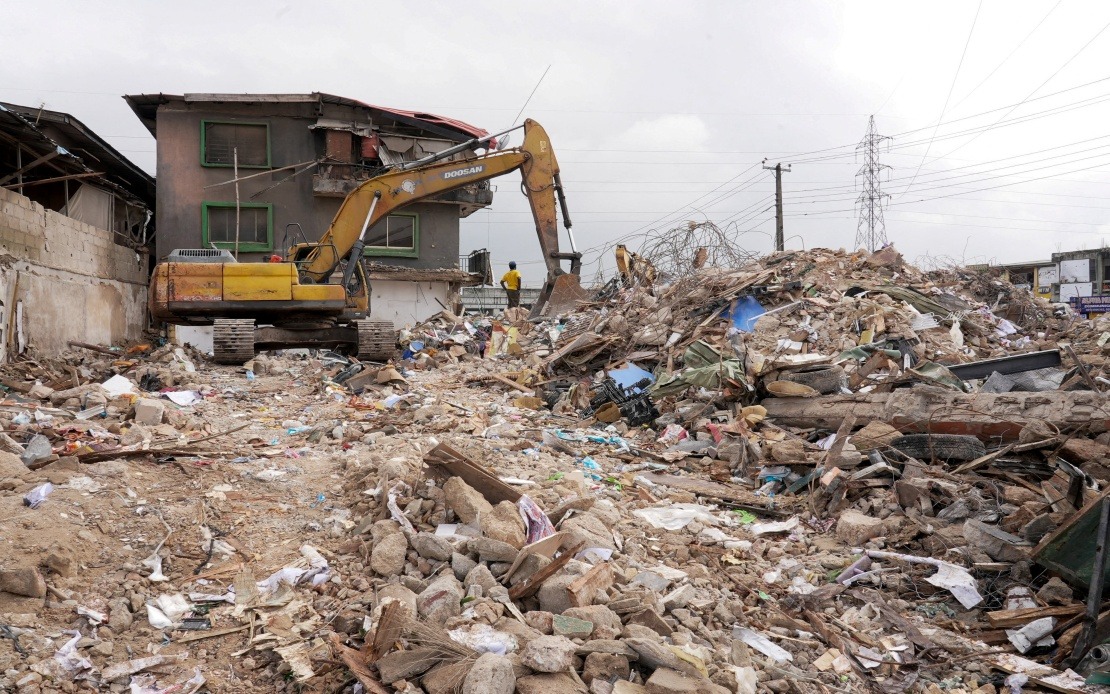
Nine people have been confirmed dead following the collapse of a three-story shopping complex in Alakija, a rapidly developing town situated along the Lagos-Badagry Expressway in Nigeria's southwestern Lagos State. Search and rescue operations that commenced immediately after the structure gave way on Thursday morning concluded on Friday, with emergency responders successfully extracting 27 survivors from the wreckage. The multi-agency response highlighted the scale of the disaster, drawing in teams from across the region to work through layers of rubble in an effort to locate and free those who had become trapped beneath the fallen building.
Olufemi Oke-Osanyintolu, permanent secretary of the Lagos State Emergency Management Agency, disclosed that rescue personnel maintained continuous operations throughout the day and night to navigate the debris field and reach victims. The intensity of the effort reflected both the urgency of the situation and the challenge posed by the structural collapse. All individuals rescued from the site, who sustained injuries ranging from minor to severe, have been transferred to medical facilities for assessment and care. Authorities confirmed that every trapped person had been recovered by the time rescue operations formally concluded on Friday morning.
Eye-witness accounts and preliminary investigations suggest that the majority of those affected were business proprietors and patrons who had arrived to conduct commerce at the shopping complex. The location functions as a commercial hub, and the timing of the collapse during morning business hours meant that the site was occupied. Additionally, some residents from adjacent neighborhoods who were in the vicinity at the time became ensnared in the incident. This mix of victims underscores how building failures in densely populated urban areas can affect far more than just the immediate occupants of the structure itself.
The involvement of the China Civil Engineering Construction Corporation, which is engaged in a major railway development initiative in the Lagos vicinity, proved significant in mounting the rescue response. The organization deployed resources and personnel to assist in the extraction operations, demonstrating how large-scale infrastructure projects can pivot to provide emergency support when major incidents occur. The participation of multiple agencies coordinated through the Lagos State Emergency Management Agency ensured that specialized equipment and trained personnel could be mobilized rapidly.
While recovery efforts have concluded, investigators have not yet determined what caused the three-story structure to collapse. The Lagos State authorities have initiated a formal inquiry into the incident, with preliminary findings expected to shed light on whether the disaster stemmed from structural deficiencies, construction oversights, or other contributing factors. The need for such investigations reflects broader concerns about building safety practices across Nigeria's rapidly urbanizing landscape.
Building collapses represent a recurring crisis in Nigeria, particularly in major metropolitan areas like Lagos where rapid urban expansion often outpaces regulatory oversight. Structural engineers and safety experts have consistently identified three primary culprits behind such catastrophes: deteriorating, aging buildings that have not undergone proper maintenance or reinforcement; systematic non-compliance with established building codes and regulations; and the deployment of inferior construction materials that cannot bear the load they are designed to support. These factors often work in combination, creating hazardous conditions that may remain hidden until a triggering event causes failure.
For Malaysian readers, the Lagos incident resonates given Southeast Asia's own experience with rapid urbanization and the associated infrastructure challenges. Countries in the region, including Malaysia, have grappled with similar pressures to accommodate expanding populations while maintaining construction standards. The incident serves as a cautionary reminder of the consequences when economic pressures and profit motives override safety protocols. Lagos, as Africa's largest city and a major commercial hub, faces intense development pressure that can sometimes prioritize speed and cost-cutting over structural integrity.
The frequency of such collapses in Nigeria suggests systemic governance issues beyond individual building failures. Effective building permit systems, rigorous inspections, and meaningful penalties for violations require institutional capacity and political will. The difference between cities where collapses remain rare and those where they occur regularly often reflects not just differences in wealth but in the strength of regulatory institutions and their enforcement mechanisms. Lagos authorities must balance the imperative for rapid development against the necessity for safety compliance.
This particular collapse in Alakija, occurring along one of Lagos's primary commercial corridors, underscores how infrastructure vulnerabilities can impact major transportation arteries and business districts. The Alakija area, characterized by mixed commercial and residential development, has experienced significant growth in recent years, with informal and formal construction occurring in proximity. Such heterogeneous development patterns, common throughout West African cities, can create conditions where structural standards vary widely and older buildings deteriorate while new construction rises nearby.
The recovery operation itself, while tragic in its necessity, demonstrated the logistical capacity of Lagos State's emergency management systems. The speed with which multiple agencies coordinated, resources were mobilized, and rescue operations commenced and concluded suggests that institutional frameworks for disaster response do exist, even if prevention mechanisms require strengthening. The question facing Nigerian authorities, and indeed city administrators across the developing world, concerns how to shift resources and emphasis from emergency response to prevention through stricter building enforcement and regular structural audits.
Moving forward, the incident will likely prompt renewed discussions within Lagos State government about building code enforcement and the conditions that permitted a three-story structure to deteriorate to the point of collapse. Whether this particular disaster catalyzes meaningful reform in construction oversight or becomes another tragic statistic in a long pattern of building failures remains to be seen. For the families of those who died and the survivors recovering from injuries, the investigation's findings carry profound personal significance beyond the broader policy implications.

