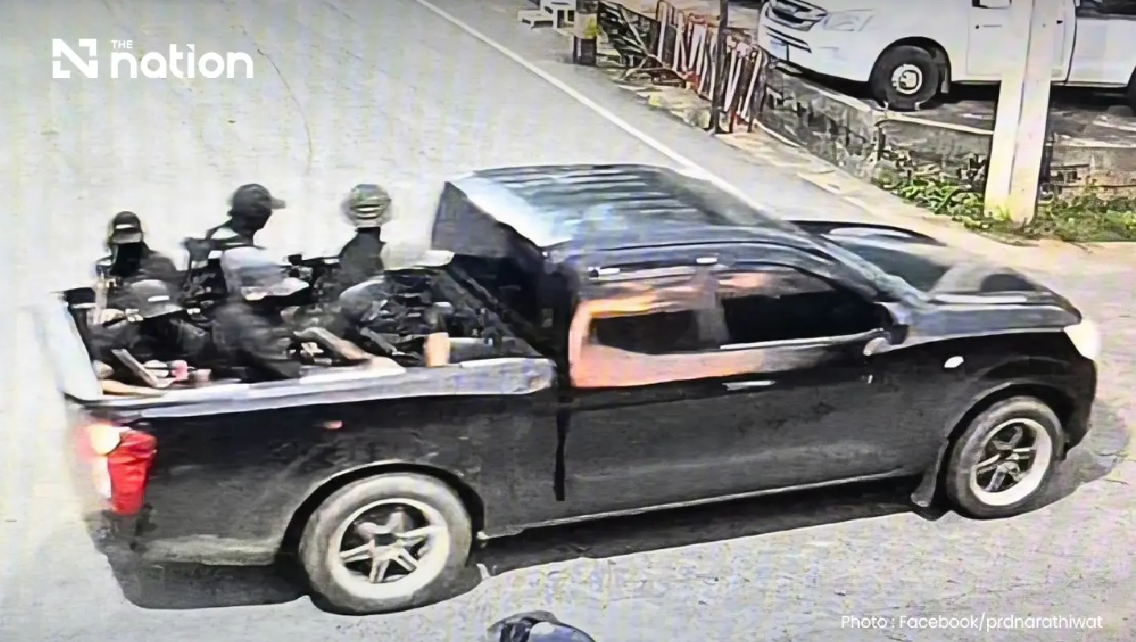
A brazen and precisely executed raid on a remote ranger checkpoint in Thailand's Narathiwat province has laid bare the operational sophistication of armed groups operating in the country's insurgency-torn south. CCTV documentation of the assault on the Bukeh Sami checkpoint on the evening of July 22 reveals that nine attackers, operating in two distinct teams, overran the position in just 90 seconds, killing five paramilitary rangers and leaving six civilians wounded. The lightning-fast nature of the incursion underscores persistent security challenges in a region where conflict has claimed thousands of lives over two decades.
The checkpoint, located in Village 7 of Tanyong Mat subdistrict within Ra-ngae district, was staffed by rangers belonging to the 4509th Ranger Company operating under the 45th Ranger Regiment Task Force. The assault commenced at approximately 6.45pm, when security forces were at their most vulnerable during evening shifts. What authorities initially assessed as a six-person operation was later revealed to be far more coordinated, with camera footage from multiple angles showing a meticulously planned two-pronged attack structure designed to overwhelm the post with overwhelming firepower before defenders could mount an effective response.
The primary assault team consisted of seven individuals transported in a black Nissan pickup registered in Songkhla province, with the registration number ผน 6866. One person operated the vehicle while six combatants occupied the truck bed, dressed in tactical black clothing resembling paramilitary uniforms and broad-brimmed hats that obscured their identities. A secondary mobile team followed on a red-and-white Honda Wave motorcycle, whose registration could not be determined from available footage. This supporting element proved crucial to the operation's success, providing covering fire and rear security during both the assault and withdrawal phases.
The motorcycle contingent was armed distinctively for maximum tactical impact. The rider, clad in a white shirt and helmet, carried an 11mm pistol, while the passenger—disguised in a black women's hijab to confuse identification—wielded an AK-pattern rifle. This asymmetrical armed configuration suggests deliberate task specialization within the unit, with heavier firepower concentrated in the truck-based element while the motorcycle team maintained mobile flexibility. The deployment strategy indicates planning by individuals with military or paramilitary training, as the coordination between vehicles and the sequencing of fire suggest familiarity with small-unit tactics.
Three rangers positioned at the roadside checkpoint became the first targets as the Nissan slowed before them. Occupants of the truck bed unleashed a barrage of M16 and AK-pattern rifle fire, rapidly neutralizing these forward sentries. The pickup then halted, disgorging additional personnel who maintained suppressive fire directed at the main checkpoint structure and its reinforced bunker, which housed two additional rangers. The bunker's concrete walls were subsequently found peppered with hundreds of impact marks, testament to the intensity and volume of fire concentrated upon it. This layer-by-layer assault—initial contact suppression followed by sustained bunker fire—demonstrates tactical sequencing unlikely to emerge from spontaneous militia activity.
Following their neutralization of defensive positions, the attackers conducted a rapid weapons search through the checkpoint facility, systematically removing military hardware before departing. As the raiding party withdrew toward their vehicles, one assailant discharged a pipe bomb toward an elevated structure adjacent to a nearby bridge, further demonstrating the operation's deliberate demolition phase. The entire action concluded within the stated 90-second window, allowing both the Nissan and motorcycle to escape toward Dusongyo subdistrict before security forces could establish effective cordons or contact engagements. The speed and efficiency of the withdrawal phase mirrors the assault's opening movements, suggesting advance reconnaissance and pre-planned escape routing.
The five rangers killed in the operation were identified as Sergeant Major First Class Theerayut Somakerd and ranger volunteers Sakiriya Jena, Wimon Dabthong, Nattasit Kaewsena and Salahuding Pi. Six civilians sustained injuries during the raid, including a ten-year-old child, prompting emergency medical responses and hospital transfers across the district. Initial casualty reports proved inconsistent, with early figures ranging between two and five civilian wounded before stabilizing at six, a common phenomenon during emergency response phases when information rapidly evolves. The scale of civilian harm, despite the operation's targeting of military personnel, reflects the indiscriminate nature of high-volume automatic weapons fire in confined spaces.
Forensic analysis following the attack proved revealing regarding both offensive and defensive weapons employment. Over 100 spent cartridge cases littered the checkpoint perimeter, representing a mixture of M16, AK-pattern, and 11mm caliber rounds. Investigators also recovered ammunition apparently ejected during weapon-clearing procedures, suggesting the attackers experienced jammed firearms during the assault—a common occurrence with rapid fire cycles from AK-type platforms under stress conditions. The quantity and diversity of ammunition casings provided forensic investigators with distinctive ballistic signatures for matching against future incidents and potentially tracing weapons through international arms trafficking networks.
The attackers' inventory acquisition proved substantial and strategically significant. Security forces documented the theft of four folding-stock AK-pattern rifles, one 11mm pistol, four ammunition magazines, and four bulletproof vests. However, authorities acknowledged ongoing discrepancies in accounting for seized materiel, with early reports differing regarding both quantities and weapon specifications. This accounting difficulty reflects the chaos inherent to checkpoint security during active assaults, where personnel focus on survival rather than inventory management. The loss of ballistic protective equipment particularly concerns security analysts, as such vests represent scarce resources in insurgent arsenals and their acquisition improves operational sustainability for future actions.
The vehicle believed deployed in the operation was subsequently discovered abandoned and incinerated, clearly in an evidence-destruction attempt. The burning of the Nissan represented a logical final phase in operational security procedures, eliminating fingerprint evidence, residual DNA material, and vehicular identification traces. Security officials rapidly established roadblock systems across likely escape corridors following the attack's conclusion, though the assailants' apparent familiarity with local geography and pre-positioned vehicles suggests successful egress was already accomplished before such countermeasures could prove effective. The attack's execution and aftermath underscore the operational sophistication and planning capabilities of southern Thailand's militant networks, factors that complicate conventional security responses focused on reactive checkpoint fortification.
Narathiwat Governor Boonchuay Homyamyen coordinated the extensive overnight investigation involving Provincial Police Region 9 commissioner Pol Lt Gen Piyawat Chalermsri, Narathiwat police chief Pol Maj Gen Prayong Khot Sakha, and Col Witthaya Sariya, commander of the 45th Ranger Regiment Task Force. Bomb-disposal specialists, tactical police formations, and forensic teams maintained continuous operations through the night, collecting and cataloging evidence across the expanded crime scene. This multi-agency coordination reflected the incident's significance within Thailand's broader security framework, mobilizing senior officials from military and police hierarchies to oversee investigative procedures. The concentration of high-ranking personnel at the scene underscored both the operational success of the attackers and the institutional concerns about capabilities demonstrated through the checkpoint's penetration.

