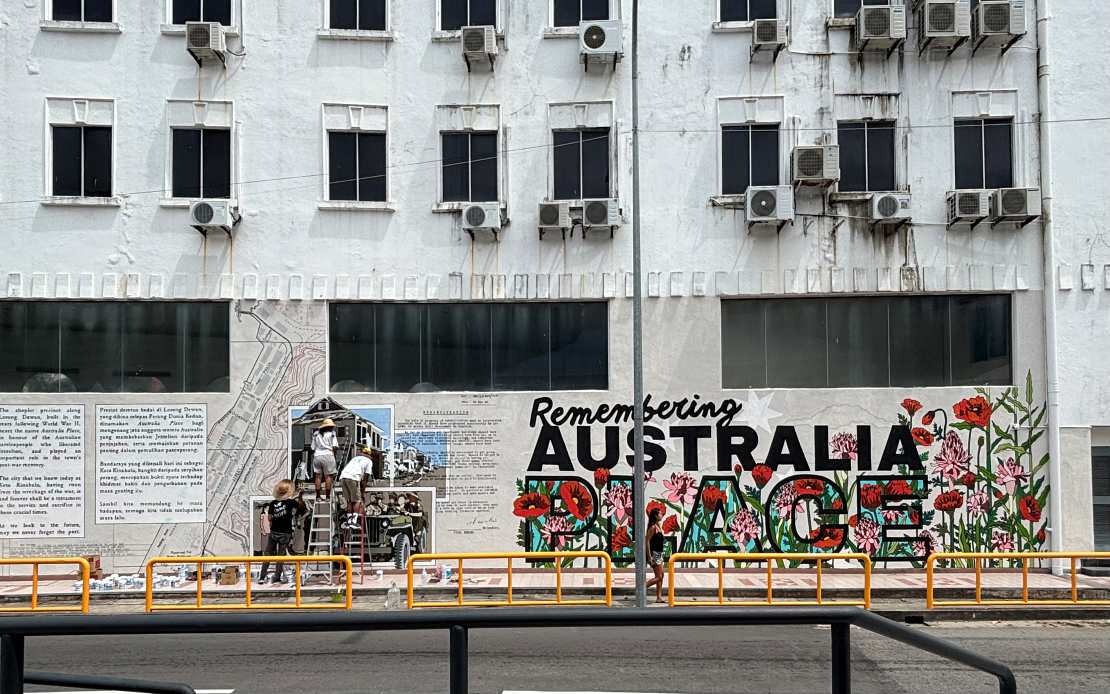
Kota Kinabalu's historic 'Australia Place' neighbourhood has gained a striking new cultural landmark with the unveiling of a public mural that visually narrates the long and intertwined history connecting Sabah and Australia. The artwork, formally titled 'Remembering Australia Place', now adorns the Wisma Intiutama building in the locality where Australians and Sabahans have maintained close ties for generations. Unveiled on Friday, the mural's timing proved symbolically significant, arriving on the eve of Sandakan Day, the annual observance that honours the sacrifice and resilience demonstrated during World War II by both Australian prisoners of war and the Sabahans who aided them.
Australian High Commissioner to Malaysia Danielle Heinecke emphasized during the launch ceremony that the mural serves as far more than decorative public art. Rather, it functions as a tangible representation of the multifaceted relationship between the two nations—one built on sustained cultural exchanges, community partnerships, and institutional cooperation that has weathered decades of change. In her remarks, Heinecke noted that the artwork captures individual stories of people whose personal and professional lives have woven the two countries together, creating bonds that remain relevant and influential in shaping contemporary bilateral relations. The launch drew considerable community participation, with parliamentarians, local leaders, and alumni of Australian educational institutions gathering to witness the unveiling alongside Kota Kinabalu Mayor Datuk Seri Sabin Samitah.
The mural's creation reflects the work of Pillars of Sabah, a local community arts organization that approached the project as an exercise in visual storytelling rooted in shared values. Through carefully chosen imagery and symbolism, the artwork conveys themes of friendship, resilience, cooperation, and the interpersonal connections that have defined the Australia-Malaysia relationship. The artistic approach demonstrates how murals and public art can function as educational tools, making historical and cultural narratives accessible to diverse audiences across generations.
Jared Abdul Rahman, co-founder of Pillars of Sabah, brought a distinctly personal dimension to the project. Rahman's own biographical journey embodies the very cross-border connections the mural celebrates—his father arrived in Australia as a Colombo Plan scholar, where he met Rahman's Tasmanian mother, leading to Rahman's birth and upbringing in Malaysia while maintaining ties to Australia. This dual heritage positioned Rahman uniquely to translate the nuances of both cultures into visual form. For Rahman, the project transcended conventional artistic commission work, instead becoming a profound expression of his mixed identity and an opportunity to honour the sacrifices of the Colombo Plan generation, whose educational exchanges laid crucial groundwork for institutional ties between Malaysia and Australia.
The collaborative process itself embodied the community-centered values the mural depicts. Rahman and Pillars of Sabah deliberately involved multiple generations of Kota Kinabalu residents in the painting process, particularly incorporating students and educators from Sekolah Menengah Kebangsaan Sanzac. This intergenerational participation ensured that younger Sabahans gained direct engagement with their shared history with Australia, transforming abstract historical knowledge into lived experience through artistic creation. Such collaborative approaches to public art strengthen community bonds while simultaneously enhancing public understanding of bilateral relationships that might otherwise remain confined to diplomatic and academic circles.
The historical context underpinning this celebration warrants careful attention. Sandakan Day, observed annually on August 15, commemorates one of World War II's most harrowing chapters—the Sandakan Death Marches. Between 1942 and 1945, 2,434 Australian prisoners of war perished during forced marches and detention in Sabah under Japanese occupation. However, the historical narrative extends beyond military conflict to encompass remarkable acts of civilian courage. Sabahans at considerable personal risk provided assistance to imprisoned soldiers, facilitated escape attempts, and offered sanctuary to those seeking refuge. This dimension of shared suffering and mutual aid, transcending national boundaries and wartime enmities, established profound emotional and historical bonds between Australian and Sabahan communities.
For Malaysian readers, particularly those in Sabah and Sarawak, this mural acquisition carries specific significance. The Colombo Plan, under which Rahman's father studied in Australia, represented a landmark post-independence educational initiative that shaped generations of Southeast Asian professionals and leaders. The Plan's legacy persists in contemporary scholarship and exchange programmes, maintaining educational pipelines that continue benefiting Malaysian students. Furthermore, the mural's emphasis on people-to-people connections reflects broader Southeast Asian diplomatic strategy, wherein sustained civilian and cultural engagement often proves more durable and influential than formal governmental protocols alone.
The broader regional implications deserve consideration as well. As Australia navigates its Indo-Pacific strategy and seeks to strengthen relationships throughout Southeast Asia, cultural initiatives like this mural demonstrate how soft power operates effectively at local community levels. Rather than relying exclusively on high-level diplomatic engagements, Australia cultivates goodwill through support for cultural projects, educational partnerships, and recognition of shared historical experiences. For Malaysia, such initiatives reinforce existing bilateral ties while signalling Australian commitment to understanding and honouring Malaysian regional identities and historical narratives.
The physical location of the mural within the 'Australia Place' neighbourhood underscores how historical geography shapes contemporary identity and memory. 'Australia Place' itself emerged organically over decades as a gathering point where Australians and Sabahans congregated, conducted business, and forged personal relationships. Formalizing this informal designation through public art installation transforms vernacular geography into official commemoration. The mural thus acknowledges both the bottom-up processes through which international friendships develop and the importance of institutional recognition in sustaining such connections.
Looking forward, this mural represents one component within a broader ecosystem of Australia-Malaysia cultural engagement. Educational exchanges continue drawing Malaysian students to Australian universities, while reciprocal partnerships bring Australian researchers, artists, and professionals to Malaysia. Tourism flows in both directions, cultural festivals feature mutual participation, and business relationships span multiple sectors. The mural serves as physical anchor for these various connections, a visible reminder that bilateral relationships, while sometimes formal in structure, derive their true substance from countless individual stories of friendship, learning, and mutual respect.
The timing of this unveiling, positioned on the eve of Sandakan Day, reinforces memory and gratitude while simultaneously looking forward. Younger generations, increasingly distant from the World War II era, nonetheless inherit the responsibility of maintaining the bonds forged through shared sacrifice and wartime aid. By engaging students in the mural's creation and ensuring its prominence in public space, the project invests in continuity, ensuring that future Sabahans understand their community's historical connections to Australia and appreciate the foundations upon which contemporary partnerships rest.
Ultimately, the 'Remembering Australia Place' mural exemplifies how creative expression and public commemoration can deepen mutual understanding between nations and communities. Rather than allowing bilateral relationships to exist solely within institutional channels or official narratives, the mural democratizes historical memory, making the Australia-Sabah connection visible, tangible, and accessible to diverse audiences. In doing so, it reinforces that enduring international friendships depend fundamentally on sustained human connection, shared memory, and genuine appreciation for each other's histories and contributions.

