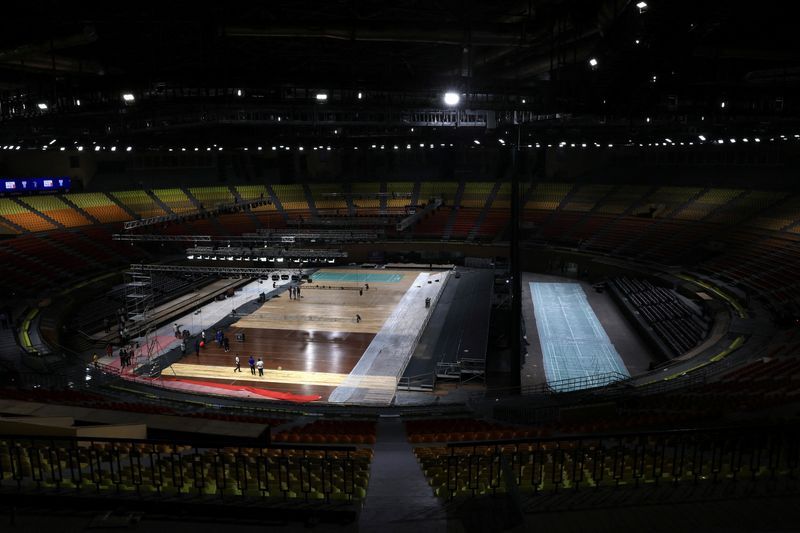
The Badminton World Championships descending on New Delhi next week will feature an unconventional addition to its workforce: a cadre of specialists trained in the art of imitating langur monkey vocalizations. This unusual employment reflects the serious challenge that urban wildlife poses to hosting major international sporting events in India's bustling capital city.
Delhi's rhesus monkey population has long plagued residents and institutions across the city, with the primates notorious for infiltrating buildings, disrupting public spaces, and occasionally attacking unsuspecting pedestrians. The problem intensified markedly enough that the Badminton Association of India faced considerable embarrassment when a monkey breached the Indira Gandhi Indoor Stadium during this year's Indian Open, wandering visibly through the spectator gallery during competition. The incident highlighted vulnerabilities in venue security that threatened to undermine India's credibility as a major events host.
The solution lies in deploying langurs—larger primates distinguished by their black facial features—which naturally repel rhesus monkeys through territorial dominance. Rather than maintain live langurs on site, however, tournament planners recognised the strategic advantage of hiring mimics trained to reproduce the characteristic hooting calls that signal langur presence. Zafar, one of the specialists contracted for the championships, demonstrated his distinctive vocalizations to media representatives during a recent stadium tour, explaining the science behind the approach. As a third-generation practitioner of what he terms his family trade, Zafar carries decades of accumulated expertise in primate behaviour and acoustic deterrence.
Zafar articulated a philosophy underpinning the entire operation: the goal remains not to harm rhesus monkeys but simply to discourage them from approaching the venue. This animal welfare dimension reflects broader contemporary attitudes toward urban wildlife management in India, contrasting sharply with more aggressive historical approaches. His extensive experience in government office buildings across the country has equipped him with refined techniques for deploying langur calls strategically, timing vocalizations to maximum effect without causing undue distress to the animals themselves.
Yet monkey incursion represents only one component of the biological challenges confronting championship organisers. Pigeons pose an equally vexing problem, with an explosive population across Delhi creating sanitary and operational hazards. During the Indian Open earlier this year, matches suffered disruptions when birds fouled the playing court, prompting player complaints regarding hygiene standards and facility conditions. These incidents threatened perceptions of India's readiness to stage world-class sporting events, a concern that gains particular weight given India's broader ambitions on the international sports calendar.
Addressing the pigeon issue required a different technical approach. Organisers have applied non-toxic gels—compounds routinely used on railway infrastructure to prevent bird roosting—across the stadium's roofing and ventilation ducting. This preventive strategy aims to render the venue inhospitable to pigeons without resorting to harmful methods, aligning with the same animal welfare principles guiding the monkey mitigation efforts. The dual approach reflects a sophisticated understanding that modern venue management extends beyond traditional event logistics into environmental and ecological considerations.
Badminton Association of India secretary general Sanjay Mishra publicly affirmed that organisers have systematically remedied the problems that emerged during the Indian Open trials. He credited the sports ministry with investing substantially in facility improvements aimed at elevating standards across multiple dimensions. Mishra's assertion that the Badminton World Federation expresses complete satisfaction with current arrangements suggests that Indian planners have successfully translated lessons from the earlier competition into tangible operational upgrades.
India's management of this championships holds symbolic weight extending beyond badminton itself. As the designated host for the 2030 Commonwealth Games and an active bidder for the 2036 Olympic Games, India must demonstrate comprehensive capability across all aspects of major event hosting. International sporting bodies scrutinise not merely competition infrastructure but the entire ecosystem surrounding venues, including environmental management and operational resilience. Successfully executing the Badminton World Championships—particularly in addressing seemingly peripheral issues like wildlife control—communicates organisational competence and attention to detail that prospective host nations must project.
The deployment of monkey whisperers exemplifies how India's largest cities have become laboratories for innovative solutions to urban-wildlife coexistence challenges. Rather than treating animal management as a security afterthought, New Delhi's approach recognises it as integral to projecting a modern, well-organised hosting capability. For Malaysia and other Southeast Asian nations considering bids for major sporting events, the Indian example illustrates how attention to seemingly unconventional details—including sustainable wildlife management—contributes materially to demonstration of genuine readiness. The Badminton World Championships thus becomes more than a sporting showcase; it functions as a test of India's broader infrastructure and administrative sophistication in an increasingly competitive international arena for mega-events.

